Dear Friends,
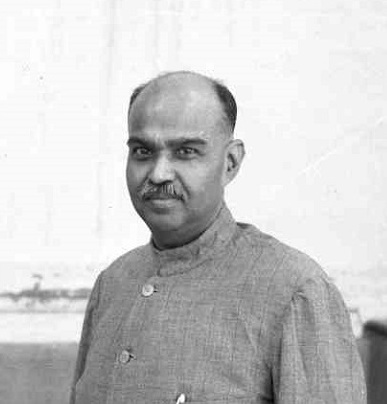
Dr. Syama Prasad Mookerjee (6 July 1901—23 June 1953) was an Indian barrister, educationalist, politician, and the Minister for Industry and Supply (August 1947 to April 1950) in the Cabinet of Jawaharlal Nehru. President of the Akhil Bharatiya Hindu Mahasabha from 1943 to 1946, he founded the Bharatiya Jana Sangh in 1951.
On 24 April 1951, a two-day long convention named ‘Sri Aurobindo Memorial Convention’ was organized at the Tennis Ground of Sri Aurobindo Ashram, Pondicherry, where it was resolved to establish an International University Centre in the memory of Sri Aurobindo. Eminent personalities like Dr. Syama Prasad Mookerjee, Surendra Mohan Ghose, Dr. Kalidas Nag, Hemendra Prasad Ghose and Surendranath Jauhar had participated in the said convention.
6 July 2026 marks the 125th Birth Anniversary of Dr. Syama Prasad Mookerjee. On this said occasion, the texts of the presidential speech and extracts from the concluding speech of Dr. Mookerjee delivered at the ‘Sri Aurobindo Memorial Convention’ have been published on the website of Overman Foundation.
With warm regards,
Anurag Banerjee
Founder,
Overman Foundation, Kolkata.
____________
Dr. Syama Prasad Mookerjee’s Presidential Speech:
It is difficult for an ordinary individual to realise in full the significance of the message of Sri Aurobindo’s life and teaching. His philosophy forms an integrated system of thought created out of the highest and most sustained efforts of the human spirit. It is given to very few of us to attain that level of spiritual effort, for it demands a thorough discipline of the body and the mind, and what is still more difficult, the sacrifice of the immediate for the ultimate. Once upon a time, the Rishis of ancient India rose above the calls of the present, the clash of arms, the rise and fall of Empires, to contemplate the eternal verities of existence.
Coming much nearer to our own times, when the favourite disciples of Guru Govind wanted him to lead them in the affairs of the world, he declined and warned them not to tempt him with ephemeral offerings. Similarly, when in 1922 Mr. C. R. Das asked for Sri Aurobindo’s help in the political struggle, the sage declined on the ground that he had not attained the fullest realisation of the spiritual reality, without which efforts to seek the salvation of mankind would only create an illusion.
These spiritual efforts of the great masters often defy common understanding. Yet the call of the times was never so imperious as it is now. What India is suffering from today is not so much the poverty of material existence. She is suffering much more from the bankruptcy of her spiritual resources. The Government moves in the same vicious circle. Moral standards are at a discount. High purpose is reserved exclusively as an adornment of pontifical pronouncements from high offices. The scene is virtually littered with the debris of the spiritual achievements of a people that was once great.
The fact is that we have lost track of our real culture. The culture of a people, as Sri Aurobindo tells us, may be roughly described as the expression of a consciousness of life which formulates itself in three aspects. “There is”, he explains, “a side of thought, ideal, upward will and the soul’s aspiration; a side of creative self-expression and appreciative aesthesis, intelligence and imagination; and a side of practical and outward formulation”. Philosophy and religion belong to the first of these three aspects of culture; art, poetry, literature to the second; and society and politics to the third. In India, however, the master idea that has governed the life, culture and social ideals of her people has been the seeking of man for his true spiritual self and the use of life. We have lost track of this noble idea. A base hedonistic view of life seems to inform all our activities today, even where they belong to the realm of the first two aspects of culture.
It is thus that the establishment of a University, where the eternal verities of life will be taught and re-taught to a stricken people, becomes supremely relevant. This is the task of an International University and it is in the fitness of things that the University should be dedicated to the sacred memory of Sri Aurobindo. It is in the fitness of things that along with its sister University at Santiniketan, named after another great Indian, this University should also be located in India where so many peoples and so many cultures have met and found their home. The Upanishads have expressed this synthesis and harmony by the three words, Shantam, Shivam, Adwaitam. Sri Aurobindo has also taught us the same truth. He even goes further and says that this synthetic turn of India’s spiritual vision “is not peculiar to the mystics or the literate or the thinkers, nourished on the high sublimities of the Veda and the Vedanta, but permeates even the popular mind”. It is here, on the sacred soil of India, where the call for synthesis first went out to the world and it is here that at the proposed University, scholars from the different parts of the world would assemble and inaugurate a new era of cultural renascence for India and the world.
I have so far dwelt on the spiritual call of Indian culture, even though the call may be going unheeded today. As Sri Aurobindo says, it is a spiritual, an inner freedom, that can alone create a perfect human order. But his freedom does not ignore, cannot ignore, the evolution of man’s lower, physical, vital and mental nature. Progress to the age of the spirit must pass through the three conceptions, each regarded as a reality, the third leading to the subjective age of mankind. We cannot skip over any of the intermediate stages without peril to mankind, though such an adventure may succeed in the case of particular individuals. Body, life and mind, all these must assume significance in man’s adventure of the spirit. The highest achievements may yet elude all except a few. But the disciplines they indicate are meant for the upliftment of mankind as a whole, their ascent from the ignorant nature to the spiritual existence. This great adventure is characteristically typified in the life of Sri Aurobindo. It began in an urge for the political liberation of India. It paved the path for a miracle, the great revelation that came to him in 1909 in his prison. The window that had been closed flew open and the Divine stood revealed before him. With the same abandon with which he had struggled for India’s political freedom, he began his long patient quest for the freedom of the spirit. The two Aurobindos merged with each other, the political fighter and the yogi. Even then his earlier patriotism was tinged with a spiritual penumbra. He was thus a true Indian. When we read from his books, he seems to appear out of the pages of our ancient sacred lore, the representative of all their wisdom made dynamic by an awareness of the present spiritual crisis. I am sure the proposed University will symbolise the world’s urge for a new spiritual rebirth; it will stand out as an oasis amidst the barren tracts that breed jealousies, suspicions and petty conflicts.
Extracts from the Concluding Speech of Dr. Syama Prasad Mookerjee:
The work that is about to be undertaken is a mighty one. No doubt, there will be support throughout the world. Let us not minimise the difficulties and complexities of the task. We propose to work this University for imparting training to men and women in accordance with the highest standards for the purpose of participating in the great task of reconstruction of humanity. Institutions of this type are bound to fail unless we can gather men and women who will not only feel on the lines that Sri Aurobindo lived, but also act upon them. This place has already within its resources such men and women who will be able to undertake this gigantic responsibility. It is our hope that men and women from all parts of the world will be attracted by the ideology for which this institution will stand.
Men and women selected for training must be carefully chosen because they must be able to absorb cent percent the ideology for which this institution will stand. We need not pay attention to the quantitative aspect of the problem, because we have many Universities where thousands of students pass out and we do not want to see any replica of such institutions.
The policy of our Government should be to encourage experiments of the type being made here so that the work may be carried on without hindrance or difficulty.
Any institution, if it is to function, must be under proper discipline and be conducted in a manner which will lead to smooth and efficient work. At the Ashram, we see abundant evidence of the great organizing ability of the Mother, who is the presiding deity over this place. Everywhere there is regularity, smoothness and efficiency. There is no hue and cry. This is a remarkable feature which, obviously, is an asset to any institution of the type we propose to develop. And with the Mother here, we have not the least doubt that this institution will grow from strength to strength and will be the pride of not only India, but of the entire civilised world.
India has a mission and a destiny to fulfil. Some voice will rise from this land to which the world has to listen. It will not be the voice of conflict or chaos but the voice of peace where self-respect and honour will be kept. That voice was discovered by Aurobindo and the people all over the world will come to tread Aurobindo’s path.
___________
Photographs of Sri Aurobindo Memorial Convention, 24 April 1951 :
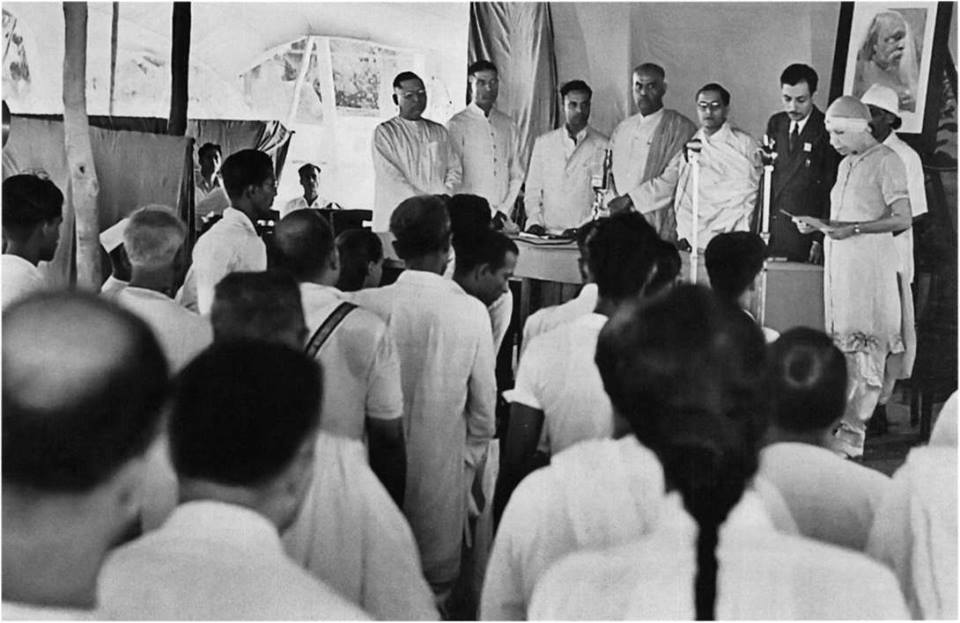
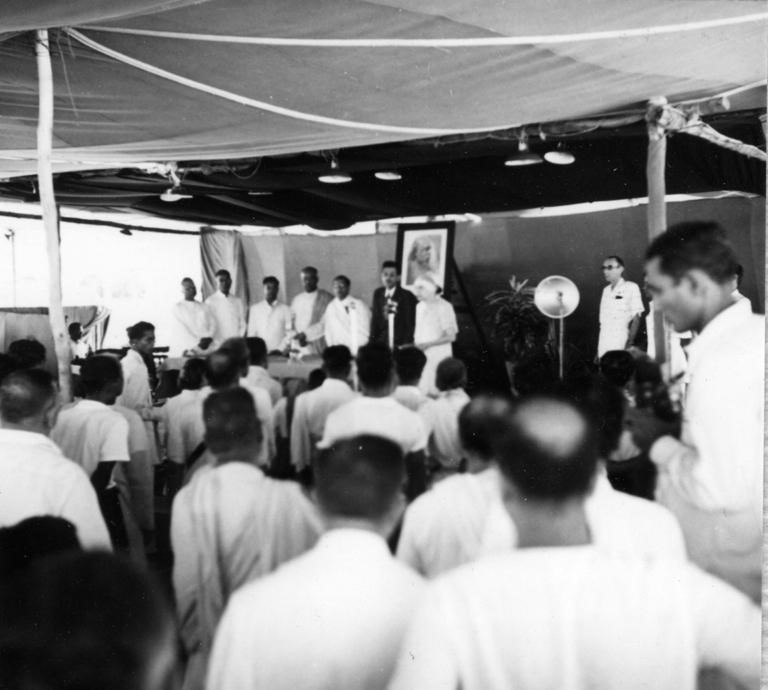
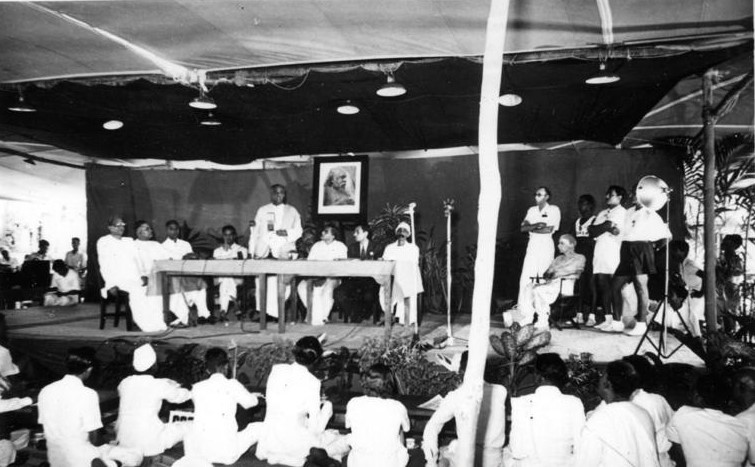
On the 125th Birth Anniversary of Dr. Shyama Prasad Mukherjee, we pay our heartfelt tributes and homage to this soul of the nation. His selfless services, unwavering patriotism and remarkable contributions to the country continue to inspire generations. We remember him with deep gratitude and respect.
There cannot be a greater honour to him than he being asked by the Mother to inaugurate Sri Aurobindo University Centre
UNIVERSITY IN MEMORY OF SRI AUROBINDO
PONDICHERRY, JANUARY 9, 1951:
Sri Nolini Kanto Gupta, Secretary of the Ashram, made the following statement:
“Apart from the suggestion made by the admirers and devotees of Sri Aurobindo—that the Ashram should be placed on a permanent footing, there is the other idea that an international University Centre should be established at Pondicherry. In fact, this is one of the most recent forms under which Sri Aurobindo conceived the development of his work. At this University the instruction given would be based primarily on Sri Aurobindo’s own teachings and writings, and the education generally would be along the lines indicated by him.
“It is considered that the most fitting memorial to his name would be to found this University now so as to give a concrete expression to the fact that his work continues with unabated vigour.
“To give effect to this proposal, it is necessary to collect substantial amount of money and the public are requested to support this fund generously.”
Amrita Bazar Patrika.
On 31 December 1950 the Mother had signed a receipt of Rs. 10,000 towards the Sri Aurobindo Memorial Fund.
Shortly after this, a Memorial Committee was formed with Dr. Syama Prasad Mookerji as the Chairman and on 1 April 1951, Nolini Kanta Gupta announced to the press “a convention of distinguished public men and educationists will be held” at Pondicherry on April 24 and 25, 1951. The invitation to the delegates was sent in the form of a booklet containing an invitation letter, the programme for the Sri Aurobindo Memorial Convention and some travel information, that is, the departure and arrival of trains to Madras and Pondicherry.
The invitation was a letter by the Chairman, Syama Prasad Mookerjee, dated 6 April 1951. Here is an excerpt from the letter:
‘Dear Friend,
We have the pleasure to invite you to attend a convention which is being called at Pondicherry to consider ways and means to raise funds for the establishment of an International University at Pondicherry. We request you to kindly make it convenient to attend this convention.
It will be presumptuous on our part to emphasise to you the significance of Sri Aurobindo’s work and the need for continuing it in a manner which will not only help India’s cause, but also influence the progress of human civilisation itself.
…This occasion will give us an opportunity to see for ourselves how this Ashram has gradually developed into a living centre and how the ideas of Sri Aurobindo are being actually translated into practice. We will also be able to come into direct contact with those who are working at the Ashram. Specially the Mother…’
A perfect observation by Dr Shyamaprasad Mukherjee .All what he said @ Sri Aurobindo philosophy still holds good in the present Scenario too. The world desperately need peace and Harmony today.
Today happens to be my birthday too.
I am glad to read the speech of Dr.Shyam Prasad Mukherjee.
Thank you for the post.
Thank you so much my dear Anurag for this precious post.
Love
Dear Anurag,
This talk by Dr Shyama Prasad Mukherjee is a great presentation indeed, as it is being chosen for posting at the right time, coincidentally on the occasion of the centenary celebration of Sri Aurobindo Ashram. The inauguration of Sri Aurobindo University as an International Centre of Education would remain a milestone achievement in the Golden era of Sri Aurobindo Ashram. The speech delivered by Dr Shyama Prasad Mukherjee on the occasion remains relevant today to people involved in Indian Governance and to humanity’s concerns.
Krishnendu Sekhar Daspatnaik