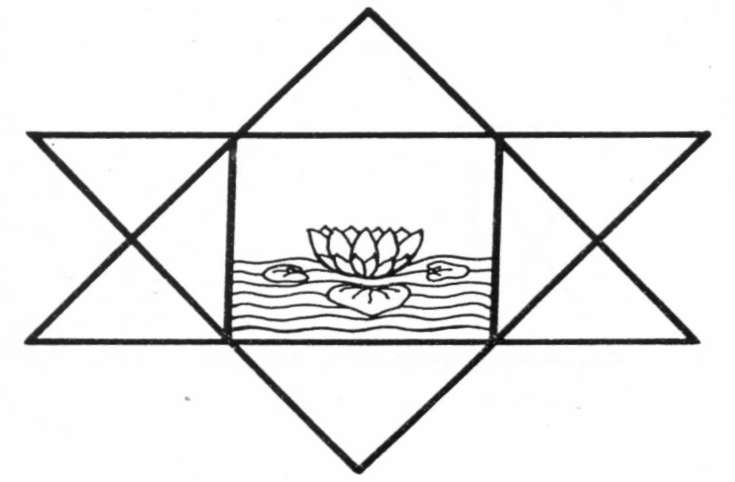
The symbol of Sri Aurobindo, two interlocking triangles enclosing a square within which is a lotus floating on water, is explained by the Mother in these words:
“The descending triangle represents Sat-Chit-Ananda.
“The ascending triangle represents the aspiring answer from matter under the form of life, light and love.
“The junction of both — the central square — is the perfect manifestation having at its centre the Avatar of the Supreme — the lotus.
“The water — inside the square — represents the Multiplicity, the Creation.”
The two triangles form a figure similar to the hexagram, the mystic symbol called by the Jews the Magen David or Seal of Solomon.
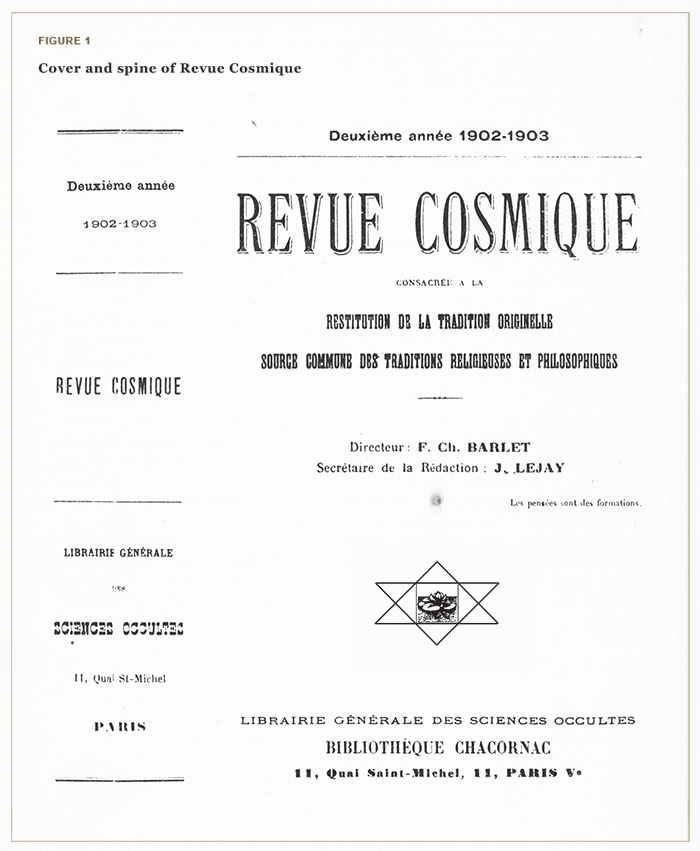
A symbol like Sri Aurobindo’s as finally defined was used as early as 1902 by the “Cosmic Movement”, a Paris-centred organisation which had as its head Max Théon, for some time the Mother’s instructor in occultism. “Most of the cosmic writings [the various writings of the Movement] were unsigned,” explains Pascal Themanlys, the son of a disciple of Théon. “The six-pointed star containing a lotus in its centre alone served to certify the authenticity of the texts. This sign evokes among other things the union of the active and passive principles and doubtless also the Wisdom of Chaldea, of Egypt and of Hindu India.”
The Mother came into contact with the Cosmic Movement through the elder Themanlys, a friend of her brother Matteo, in 1904. Later she went to Algeria to study under Théon, and still later organised in Paris a centre of the “groupes cos-miques de France”. She was also involved with the publication of their organ, the Review Cosmique. The Movement’s symbol appeared on the cover of each issue of this journal [Figure 1].
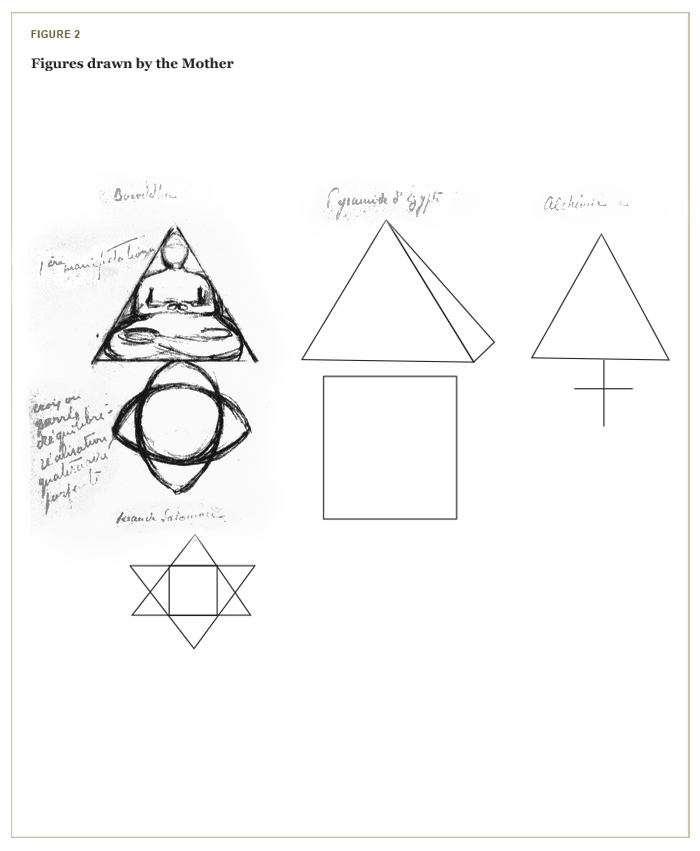
Among the Mother’s manuscripts of the period 1909-12 is a sheet of paper on which she has drawn geometrical figures—some triangles and a square [Figure 2]. There is also a pattern composed of two ovals intersecting to form a sort of cross. Near this is written “croix ou came d’equilibre—realisation quaternaire parfait” (cross or square of equilibrium—perfect fourfold realisation). (It is interesting to note that in the 1930s Sri Aurobindo wrote that the square was the “symbol of complete creation” [SABCL 23:945].) Below the crossed oval pattern is a figure formed by two triangles within which is inscribed a square whose angles meet four of the points of the triangles’ intersection—the symbol of Sri Aurobindo without the water and lotus. Above this figure is written “Sceau de Salomon” (Solomon’s Seal).
It is apparent that the symbol we know as Sri Aurobindo’s was familiar to the Mother before she met Sri Aurobindo in 1914 — even before she first heard of him in 1910, after her then husband Paul Richard had met him in Pondicherry. A story is told in connection with this meeting. It is said that when Richard left for India the Mother gave him a symbol — Solomon’s Seal — saying that the man who would show Richard the same symbol or could explain to him its meaning would be the Master for whom they were looking. The best known version of this anecdote is the following one from Nolini Kanta Gupta’s Reminiscences (page 75). “It was Sri Aurobindo himself who told us about a French lady from Paris who was a great initiate. She was desirous of establishing personal contact with Sri Aurobindo. That the Great Soul whom she meant was no other than Sri Aurobindo would be evidenced by a sign: she would be sending him something that he might recognise. That something was Sri Aurobindo’s own symbol — in the form of a diagram, known as Solomon’s Seal. Needless to add, after this proof of identity, steps were taken to facilitate her coming.”
Some question surrounds this interesting story, particularly because of certain corrections the Mother made to a similar account in the manuscript of the first edition of A.B. Purani’s Life of Sri Aurobindo. Purani had written, “Mother had given Richard some questions which he had to get solved by some spiritual person in India…. One of the questions which the Mother had asked related to the symbolic character of the ‘Lotus’.” The Mother wrote on Purani’s manuscript in regard to the first statement: “Not correct. I never gave him any questions to be solved”, and in regard to the second, “Not I, probably Richard himself.” The Mother’s corrections cast strong doubt on the whole symbol-recognition story, but, it should be noted, they do not directly contradict it. Its persistence and wide acceptance would suggest that it has some veracity; but unless persons who heard it directly from the Mother can recall exactly what she told them, it would probably be best to consider it apocryphal.
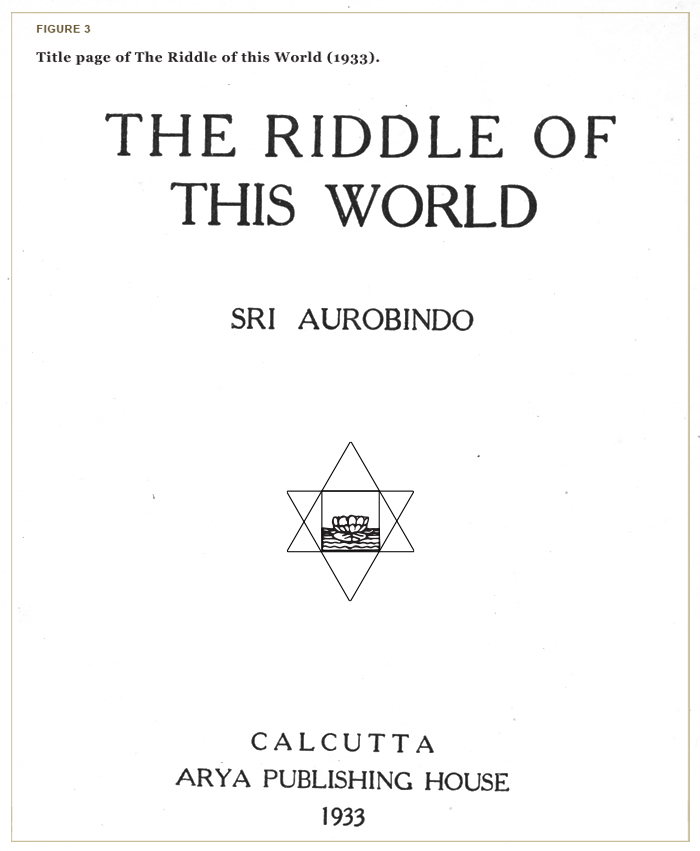
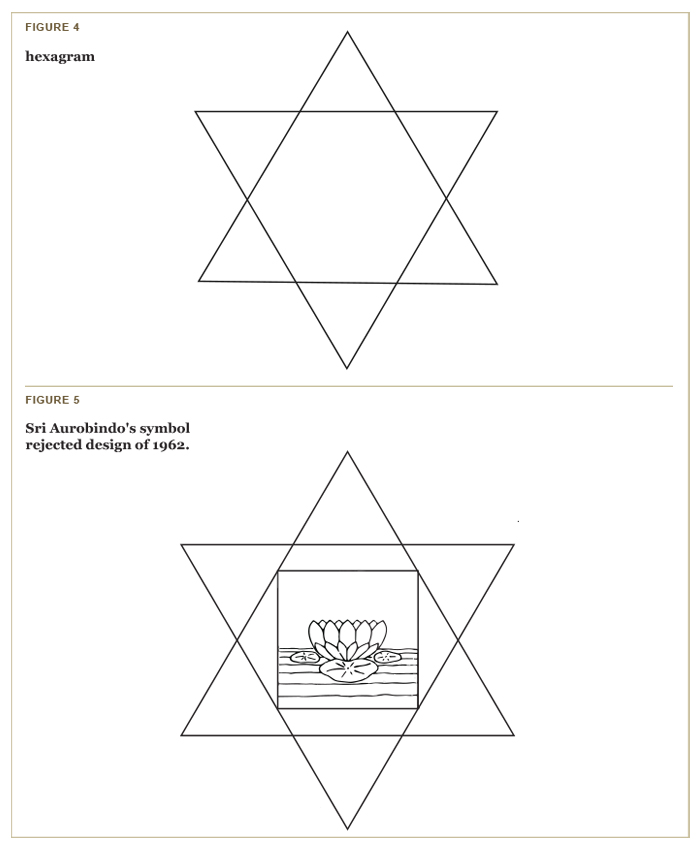
At any rate, sometime after the Mother’s final arrival in Pondicherry in 1920, the six-pointed star enclosing a square containing water and a lotus became the symbol of Sri Aurobindo. It is not known exactly when the symbol was designed, but its first appearance seems to have been on the cover and title page of the 1933 edition of The Riddle of This World, published by the Arya Publishing House, Calcutta [Figure 3]. (The 1932 edition of Thoughts and Glimpses, published by the same house, does not have the symbol.) At this time the two main triangles are equilateral, like those of the true hexagram [Figure 4]. However, in the symbol in Figure 3 the six outer equilateral triangles surrounding the square are of different sizes, unlike those of the hexagram, which is formed by extending the sides of a regular hexagon to make six identical equilateral triangles. The hexagram is capable of being inscribed within a circle; but it is impossible to inscribe a square within it so that the square’s angles meet four of the points of intersection of the two triangles.
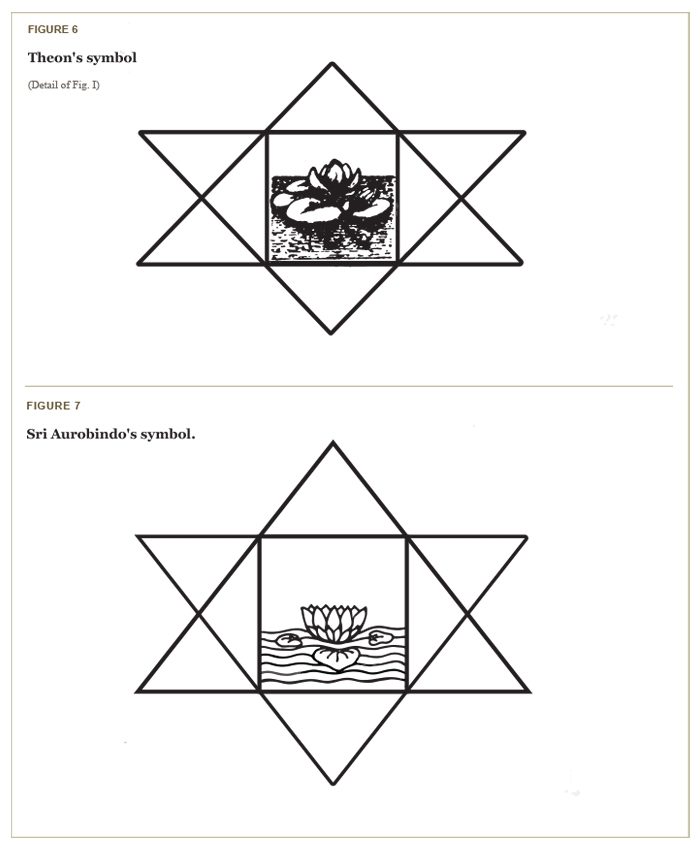
It was apparently regretted that this earliest form of Sri Aurobindo’s symbol, with its top and bottom outside triangles larger than the other four, did not have the harmony of proportion of a true hexagram. So in 1962 another design was made, in which the ascending and descending triangles form a true hexagram, but in which the angles of the central square do not touch any of the points of the triangles’ intersection [Figure 5]. This figure could, of course, be inscribed within a circle. The new design, put in final form by Pavitra, a French disciple close to the Mother, was presented to her on 27 October 1962. At that time she approved of it, signing it and writing, “This is the correct symbol of Sri Aurobindo.” Two months later, on 15 December 1962, the Mother spoke about the new symbol to another disciple. Showing him Théon’s symbol on the cover of a publication of The Cosmic Movement [Figure 6], she said that she had designed Sri Aurobindo’s symbol according to that (d’apres ca). The Mother went on to say that the square in Théon’s symbol was very elongated, by which she meant apparently that the four outer triangles at the sides of the square with their very long bases give the entire figure an elongated look. Speaking then about the new Ashram design [Figure 5], the Mother said that this one was more correct, since Pavitra had made the triangles equal. The Mother added that Théon had told her that his symbol was the Seal of Solomon.
In spite of the Mother’s satisfaction with it at the time, the design of October 1962 [Figure 5] was used for no more than a year and a half. It appeared on the February 1964 edition of Sri Aurobindo’s Evolution, but sometime before July 1964 a new design was prepared, which was first used on an edition of that date of The Hour of God. The equilateral triangles were abandoned in favour of isosceles triangles having the horizontal lines longer than the oblique ones [Figure 7]. This gives the figure something of the elongated look of Théon’s, although the shapes of the two figures differ significantly. In Figure 7 the distance from the centre of the figure to the farthest points of the upper and lower outside triangles is more nearly equal to the distance from the centre to the farthest points of the side triangles. In other words, the oval in which Figure 7 would be inscribed is more circular than the oval which would enclose Figure 6. Another difference is the lotus. In Théon’s symbol the lotus is drawn freehand and with shading; in Sri Aurobindo’s it is drawn in outline diagramatically. The elements of the lotus form part of a numerical series — one square, two triangles, three lotus-pads, four lotus-petals in the back row, five in the middle row, six in the front row and seven lines representing the water — which was meant by the Mother to be present in the symbol even in the original design of 1933 [Figure 3], but which can only be seen clearly in the later designs.
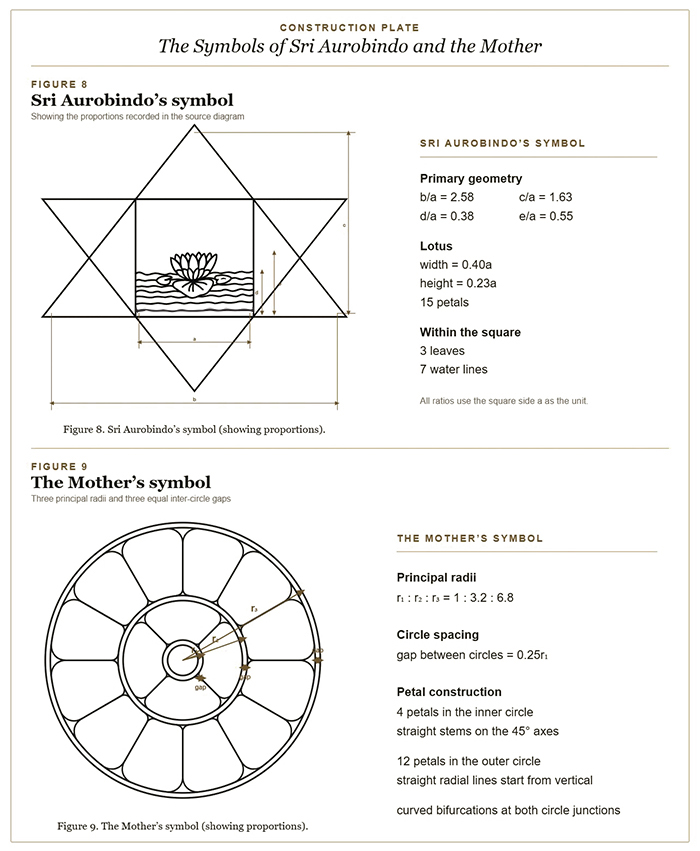
Figure 7 is the final form of Sri Aurobindo’s symbol. The proportions of its lines are illustrated by Figure 8. Sri Aurobindo’s symbol appears on all his books and is used for many other purposes as well. It is often, as on the cover of this magazine, combined with the Mother’s symbol (shown with its correct proportions in Figure 9). These symbols are copyright Sri Aurobindo Ashram Trust.
There is a change in Sri Aurobindo’s symbol on the medals that you distributed on the 29th February 1960. The two triangles, in the middle of which the square containing the lotus is usually put, are missing and in their place there are sun’s rays emanating from the square. Surely you must have made this significant change for some important reason? Can you say what is the reason of this change?
I never intended to give Sri Aurobindo’s symbol.
The design on the medal signifies— the twelve rays of the new creation issued from the manifestation of the Avatar:
lotus—Avatar
square—manifestation
12 rays—new creation
(Collected Works of the Mother, Volume 15: 26 March 1960)
Mother’s Agenda; Volume 3, Conversation dated 15 December 1962:
(Mother shows Satprem some pamphlets printed during Theon’s time, “Fundamental Axioms of Cosmic Philosophy,” which have just been found among some old papers:)
This is pretty funny! (Laughing, Mother reads:)
“In his physical state, man is the supreme evolutor.
“There is but one law, the law of Charity, and it is one with Justice.
“There is but one disequilibrium: the violation of this law.
“The cause of disequilibrium is excess.
“Perpetual evolution towards perfection….
“Mortality is the result….
“Mortality”! What a word!
Infant mortality!
“Mortality is the effect whose cause is disequilibrium. It is accidental and temporary….”
According to Theon, you know, the world has been created and destroyed—creation and pralaya—six times. And each time, a particular attribute was manifested, but since that attribute couldn’t reach fulfillment, the world was “swallowed up again.” Now it’s the seventh time, and the attribute is Equilibrium. And when Equilibrium is established, there will be uninterrupted progress—with no disequilibrium, naturally: that is, a deathless state, with no disintegration.
(Satprem continues the reading)
“There is but one royalty, one aristocracy: the royalty and aristocracy of intelligence.
“There are four classifications of terrestrial formations: mineral, vegetal, animal, and psycho-intellectual or human-divine. Among the four, in order, there are no divisions.
“Divine unity, embodied and manifested by collective humanity….”
It was in both French and English. He called it “Fundamental Axioms of Cosmic Philosophy.” It was the work of a certain French metaphysician who was well known around the turn of the century—his name began with a B. He met Theon in Egypt when Theon was with Blavatski; they started a magazine with an ancient Egyptian name (I can’t recall what it was), and then he told Theon (Theon must have already known French) to publish a Cosmic Review and the “Cosmic Books.” And this B. is the one who formulated all this gobbledygook.
There used to be the name of the printer and the year it was printed, but it’s not there any more….
Yes, it is: “The Little Tlemcenian’s Press.”
It comes from Tlemcen?
Yes.
This B. seems to have had the idea that the perfect man, the immortal man, would be spherical! And then Théon always used to say (he told me the whole story himself): “I told him it wasn’t possible, it would be too impractical—people couldn’t kiss!” His idea of a joke. Théon also told me that when B. came to Tlemcen (they first met in Egypt, then again in Tlemcen), he saw the house Théon was building and asked, “Why is your house painted red? Does it have some mystical significance?” And Théon replied, “No, it’s because red goes well with green!” So you get the picture. But I don’t remember his name any more; in his time he was very well known, he was a contemporary of the fellow who wrote The Great Initiates.
Schuré?
Yes, Edouard Schuré. He was a contemporary of Edouard Schuré, a bit older (I met Schuré, by the way—a rather hollow individual). His name began with a B and he’s the one who formulated these “Axioms.”
You once mentioned someone called Barley….
Ah, that’s it! Barley. Yes, it must be Barley.
Madame Théon, who was English, was the one who wrote, but she used to write stories, while this… this looks like Barley’s work to me, because I read something at the end, on the last page, which is rather…. It’s pathetic, actually, it’s all really pathetic.
(Mother leafs through the pages, laughing as she reads:)
“The only legitimate cult is the cult of man….”
Yes, that’s the superman, whom he calls “psycho-intellectual.” The superman—the only legitimate cult….
It all seems a bit flimsy….
Very. I don’t think it’s worth wasting your time on. But it was interesting to find these first pages because… look at the symbol (Mother shows Satprem the first page).
Yes, I saw it!
The symbol is interesting.
It looks like Sri Aurobindo’s.
I am the one who designed Sri Aurobindo’s, and I adapted it from this one.
Look, they made the central square very elongated. The one done here is more correct: Pavitra made all the sides equal. But the one for the Cosmic Review was elongated, with the lotus in the center.
It’s the same [as the one for the Cosmic Review], only elongated so that the two triangles meet and form a square.
I am keeping this to show Pavitra, because that’s what I had first tried to make. But obviously the one we have now is correct.
It was Theon who told me it was Solomon’s seal.
Now then, did you bring your book?
(Unenthusiastically.) Yes….
(Mother starts leafing through the “Axioms” again)
They make all kinds of recommendations here: for instance, when you go out of your body you should wear a loose-fitting robe, a robe kept specially for that.
Why is that? What’s the idea?
A question of aura. The idea is that the forces accumulate. And she even used to say it was preferable not to wash the robe!
“Ideas.”
There’s something true behind.
She also used to say that to stay in your body you should cover your feet with a piece of blue cloth (when you sleep, of course, your feet are bare); put a piece of blue cloth over your feet and it keeps you in your body.
???
It’s the result of Madame Théon’s occult experiences, from which they made a general rule.
But the reason for a loose-fitting robe is obvious: it’s important not to get cold during such experiences, and there shouldn’t be anything hampering you. And also, it’s important that nothing interfere with your circulation, which diminishes greatly and must be protected.
These things are practical, but….
On the whole it’s pathetic.
All those things put so neatly into paragraphs always look a bit flimsy and dogmatic.
Yes, they’re stupid. They are affirmations of contradictions—I mean affirmations aimed at contradicting certain things. It’s not meant at all to affirm something that has been SEEN, seen and transmitted, but to contradict all the stories of original sin and all the religions, which, according to Théon, always address themselves to more or less hostile beings.
Theon also used to say that man was born perfect, but had taken a tumble.
The story of the earthly paradise?
No, Theon always said that the “Serpent” had nothing to do with Satan, it was the symbol of evolution (Theon was entirely pro-evolution), the spiral path of evolution, and that the earthly paradise, on the contrary, was under the domination of Jehovah, the great Asura who claimed to be unique, who wanted to be the only God. For Theon, there is no such thing as a one and only God: there is the Unthinkable. It’s not a “God.”
But to me this seems to come from his Jewish background. Because Théon was Jewish, even though he never mentioned the fact (the Tlemcen officials made it known: when he arrived he had to tell them who he was). He never spoke of it and he had changed his name. They said he was of Jewish origin, but they could never say whether he was Polish or Russian. At least the person who told me never knew. But for the Jews it’s the “Unthinkable,” whose name must not be uttered (it is uttered only once a year, on the “Day of Atonement”; I think that’s what it’s called). It’s the word Yahveh, and it must not be uttered. But the prayers speak of the “Elohim,” and the Hebrew word “Elohim” is plural, meaning “the invisible lords.” So there was no one and only God for Théon, only the unthinkable Formless; and all the invisible beings who claimed to be one and only gods were Asuras.
He used to call Christ “That young man”! (Laughter) It was very funny.
Anyway, that’s the story. I found this again, and it amused me.
I’m going to read it.
But it’s pretty poor stuff.
It’s succinct.
(Laughter) It’s very meager.
It was obviously a tool for demolishing old notions. It’s the idea that man is divine, that he can become divine again through evolution: he was originally immortal and is to be immortal again.
One wonders how people in Europe can break through that Christian carapace; it seems extremely solid—it’s terrible, really!
Oh, indeed it is.
Even in America, mon petit, they’re in its grip. They’re always falling back into their Christianity.
It’s going to be very hard.
I don’t know why, but every time I come into contact with a Christian thought, it fills me with anger.
Oh, I understand! Because it’s true, you know, that an Asura is behind it all—not Christ! Sri Aurobindo considered Christ an Avatar (a minor form of Avatar). One emanation of the Divine’s aspect of Love, he always said. But what people have made of him!… Besides, the religion was founded two hundred years after his death. And it’s nothing but a political construction, a tool for domination, built with the Lord of Falsehood in the background, who, in his usual fashion, took something true and twisted it.
It’s a real hodgepodge, that religion—the number of sects! The only common ground is the divinity of Christ, and it became asuric when he was made out to be unique: there has been but ONE incarnation, Christ. That’s just where it all went wrong.
We’ll see.
It is resisting, resisting everywhere. It’s even more resistant than materialism.
Of course! Nothing is more terrible than idealists, they’re the worst. They’re worse than the bad people.
Oh, if you mean the puritans, the Protestants… dreadful! They’re the worst. Catholicism still retains something of the occult sense, and after all, they have a certain adoration for the Virgin, which keeps them in contact with something that’s not asuric.
The last Pope, who’s dead now [Pius XII], had broadened both his own mind and Church doctrine a lot: he was a devotee of the Virgin.
But the Protestants turned back to the Father, and so their worship became exactly the worship of a one and only, personal God, an asuric God. And they have fabricated and distorted everything: like asceticism, for instance, and all that sort of thing—everything they touched was twisted and spoiled.
Oh, read me your book!
Mother’s Agenda; Volume 9, Conversation dated February 20, 1968:
You have before you, here (gesture at chest level), Sri Aurobindo’s symbol. The descending triangle is of an almost white light, but with a golden hue, and the ascending part is of an intense dark violet—I don’t know why…. The ascending triangle is dark violet (the color of vital power), an intense dark violet, very, very strong, and with the descending triangle, that makes Sri Aurobindo’s symbol, here, in front of you, like that.
It’s not luminous, but not dark: it has a rich and very intense color, a very intense violet.
The ascending triangle is the creation’s aspiration; the descending triangle is the Divine’s response. And the junction of the two makes the square of the manifestation. It was there, in front of you, very clearly written.
It corresponds to your inner state…. (Laughing) It’s good!
Dans les dernières années de sa vie, Mère dit: « C’est le sentiment d’une perfection totale et infinie dans l’essentiel, et que ce que nous appelons “imperfections” ou “anomalies”, c’est simplement le retard […] c’est le retard de la conscience qui fait la séparation. […] Tout est merveilleux, et c’est notre vision qui est défectueuse. »
6 août 1969 (Volume 10 de l’Agenda).
“Il y a une plénitude de perfection qui est LÀ, tout le temps, et c’est seulement notre imbécile de conscience qui fait la différence.”
(Agenda, 19 March 1971, Vol. 12)
Sri Aurobindo lui, dit à la fin de sa vie:
“His knowledge immortal triumphs by his death.”
Ces mots n’expriment pas un drame, mais la coïncidence immédiate de l’éternel et du temporel.
Sweet Mother,
These days they print your symbol and Sri Aurobindo’s name on all sorts of things, on all the thousand and one little trifles of daily life which have to be thrown away once they have served their purpose, as for example matchboxes, pencils, toothbrushes, combs, even the borders of a sari, which are much trampled on. Is it good to use these precious things in such a free and common way?
And then what can we do with these things, Mother, when we no longer need them? We can’t throw them away. The old calendars, for example; we have a thick pile of them.
The Lord is everywhere, in everything, in what we throw away as in what we keep preciously, in what we trample on as in what we adore. We must learn to live with respect and never forget His constant and immutable Presence. (2 June 1961)
(Collected Works of the Mother, Volume 16, p. 254)
K. D. Sethna alias Amal Kiran writes in his book, “Our Light and Delight”:
‘[In 1910] Richard had arrived in Pondicherry on a political mission. Through a person named Zir Naidu who happened to know Sri Aurobindo he got the chance to have interviews with Sri Aurobindo on two successive days for two or three hours each time. The tale is current in the Ashram that the Mother had asked Richard to find out from some Yogi in India the meaning of the symbol which goes by the designation “Seal of Solomon”, popularly called also “Star of David”. Sometimes it is taken to be a pentagram such as the Middle Ages of Europe employed in magical practices and such as is supposed in India to cure the scorpion-sting if not the snake-bite too. But really it is a hexagram and, under its second name, it is at present the official emblem of the State of Israel—a six-pointed star made of two intersecting triangles with their apexes in opposite directions up and down. With the triangles isosceles in shape, enabling a square to be formed at the centre of their intersection and holding within the square some significant additional design—wavy lines for water and a lotus resting on them—the Seal of Solomon is also Sri Aurobindo’s spiritual symbol. When it is said to have been shown to Sri Aurobindo by Richard, Sri Aurobindo is reported to have given an interpretation which completely satisfied the Mother when Richard conveyed it to her on his return to Paris. Unfortunately this fascinating tale has turned out to be mythical.
‘When a biography of Sri Aurobindo was being prepared by A. B. Purani in 1957, the Mother was asked to consider the statement: “Mother had given Richard some questions which he had to get solved by some spiritual person in India.” The Mother inscribed a twice-underlined “Omit” above statement. In the margin she wrote: “Not correct. I never gave him any questions to be solved.” She also commented on another sentence of Purani’s. Purani had written: “One of the questions which the Mother had asked related to the symbolic character of the ‘Lotus’.” Above the words “which the Mother had asked”, her comment ran: “Not I. Probably Richard himself.”
‘All this, however, does not mean that the Mother had nothing to do with the Seal of Solomon or with the Lotus as symbols. The Ashram’s Research and Archives Library is in possession of a manuscript of the Mother dating probably to 1912 and certainly earlier than 1914, the year of her first arrival in Pondicherry—a manuscript not only relevant to our study but even going beyond it to an astonishing fact. Here we see drawings, mostly geometrical figures. There are some triangles and a square, near which is written “Croix ou carré d’équilibre—réalisation quaternaire parfaite” (“Cross or square of equilibrium—perfect fourfold realisation”). Below this is a hexagram built of two intersecting triangles with a square in the middle, the symbol of Sri Aurobindo minus the wavy wateriness and the lotus! The hexagram-design is surmounted by the inscription: “Sceau de Solomon” (“Seal of Solomon”).
‘What is a still greater surprise is that the same square-enclosing hexagram appears on the cover of the periodical Le Revue Cosmique started by the Mother’s Egyptian teacher of occultism, Théon, and managed for a time by the Mother—but now with a mass of water supporting a lotus inside the square! The opening year was 1901-02. The Mother was managing it in 1904. Evidently, at some point after getting charge of the Pondicherry Ashram in 1926 she based Sri Aurobindo’s symbol upon Théon’s, giving the inner design a more stylised shape. The final version of it was fixed by her on 6th May, 1964.’
K.R. Srinivasa Iyengar writes in his extraordinary biography of the Mother entitled ‘On the Mother: A Chronicle of a Manifestation and Ministry’:
‘Mirra met Paul Richard while they were fellow-seekers in the Cosmic Movement, in 1907. They were married on May 5, 1911 and went to live at 9, Rue du Val de Grâce. As Mirra Richard, her outer existence had apparently entered a new phase, but deep in her being there reigned a calm that nothing could ruffle. In her daily life she still radiated the same sweetness and light as before, and those who came within its charmed sphere of influence thought it had surely a mystic origin. For, she had brought into her human form—
The calm delight that weds one soul to all,
The key to the flaming doors of ecstasy.
Friends and fellow-seekers continued to meet in her apartment, everything there wore a beauty and poise, and the very air was vibrant with a rare expectancy and hope incommensurable.
Richard was a man widely read in the philosophical and religious literature of the West and the East. In March 1910 he departed for India on an electioneering mission on behalf of Paul Bluysen, one of the candidates from French India to the Chamber of Deputies in Paris. Hoping that during his stay there he would meet some realised yogis or saints, he thought of finding out, if possible, the inner significance of the Jewish emblem known as the Star of David or the Seal of Solomon. This was also the mystic symbol of Théon’s Cosmic Movement and appeared on the front page of its organ, Revue Cosmique. Théon’s symbol was a sort of Yogachakra–a “six-pointed star containing a lotus in its centre” which evoked “among other things the union of the active and passive principles and doubtless also the Wisdom of Chaldea, of Egypt and of Hindu India”. The lotus within the square formed by the intersecting triangles was drawn free-hand and with shading. It is believed that it was the Mother who gave Richard some questions related to this symbol and “the symbolic character of the lotus”, which were to be solved by some spiritual person in India. But when this belief was brought to the Mother’s notice she clearly denied it, stating, “I never gave him any questions to be solved.” However, it is true that as a member of Théon’s group and one who was for some time connected with editing the journal, the Mother was already familiar with the symbol we know as Sri Aurobindo’s.’
For the first time in five decades, I read the “history” of Sri Aurobindo’s symbol. It reveals to us that even “great souls” with avataric mission of world transformation have to proceed by trial, by search and research, step by step.
मनुष्य यूनिवर्स का शिकार कभी नहीं कर सकता..!
—————————————————-
हवा की एक बूंद ने सदियों पहले अपनी बाहों में पानी की एक लकीर भरकर पृथ्वी पर अपनी आध्यात्मिक यात्रा शुरू की थी..!जीवन तब सागर की तलहटी पार करके समुद्र के किनारे पृथ्वी पर रहने चला आया था!मैं देख रहा हूँ कि सकल जगत किसी अज्ञात उत्सव में शरीक होने के लिए अस्तिव में शून्य की ओर यात्रा कर रहा है.. अतीत के फ्लैप पर हमारे पूर्वज अपने आलोक भरे शून्य की आध्यात्मिक हथेली से हमारी अंगुली पकड़े …हमारा मार्गदर्शन कर रहे हैं।पृथ्वी की स्मृति के झरोखे से हमें आशीर्वाद दे रहें है।
नदियों का पानी मनुष्य की आंखों में आंसू बनकर सूर्य की प्रदक्षिणा कर रहा है।जगत के आध्यात्मिक सन्नाटे में ईश्वर हमार आलिंगन करने.. हमारी प्रतीक्षा कर रहा है..!
शून्यपुरुष ही सृष्टि में अपने आलोकित हस्ताक्षर कर सकता है। शून्य का होश में आ जाना ही विज्ञान की मानसिक लिपि में बिगबैंग कहा गया है।लेकिन अस्त्तिव एक अमर आध्यात्मिक हस्ताक्षर है।ईश्वर अस्तित्व में अपनी यात्रा तब तक जारी रखेगा,जब तक मानव अपनी आध्यात्मिक यात्रा शुरू नहीं कर देता!
मनुष्य का पृथ्वी पर जन्म अपनी आध्यात्मिक यात्रा तो शुरु करता है,लेकिन अज्ञान का असुर जीवन का अपहरण करके मासूम मनुष्य को मृत्यु की गोद में सुला देता है..लेकिन आत्मा पुनः नया शरीर धारण करके पृथ्वी के शोर पर अपने आलोकित शून्य भरे हस्ताक्षर कर देती है..और जीवन पुनः अपने नए सफर पर निकल पड़ता है..!
जिन ऋषियों ने ईश्वर के दर्शन किये हैं,वे ही शून्य की इस आध्यात्मिक यात्रा के पुरातन ग्रन्थ का स्वाध्याय कर सकते हैं.. !इस तरह जागा हुआ शब्द ही उसमें अपनी तपस्या का एक और पृष्ठ जोड़कर अस्तिव की मूल नाभि में अपनी पदचाप की मोहर लगाकर,ईश्वर के साम्राज्य के उत्तराधिकारी बन जाने का पात्र बन जाता Hहैं..!
अब तय मनुष्य को करना होता है कि वो भिक्षा का दारुण पात्र बनेगा कि अस्तित्व का ऊर्जित सुपात्र बनेगा!
अधूरे संवाद हमेशा एक कपटी झगड़ा होते है।और मानसिक संवाद होते हैं केवल एक लापरवाह आयु की झगड़ालु पांडुलिपि!दुनियां की विराटता में अहंकार के मानसिक दर्प हमेशा सपेरों के सर्प बनते रहे हैं।ये मंज़िक दर्प कभी भी सत्य के दर्पण नहीं बन सकते।
मनुष्य भूमि का बीजारोपण बीज में करने का प्रयास कर रहा है।पर यह सम्भव नहीं है।बीज की पहली अंकुरण यात्रा मनुष्य की हथेली से शुरू होती है।बाद की फसल अन्न है..पर मनुष्य का अनन्त नहीं है!
इसलिए जगत को जागना ही होगा।क्योंकि हम सभी जागे हुए अंतरिक्ष की गोद में रहते हैं..!और यूनिवर्स अस्तित्व में मनुष्य के आने से पहले से ही मौजूद है..!
इसलिए पृथ्वी की रेत यूनिवर्स के विराट डार्क मैटर को चुनोती नहीं दे सकती..!
पृथ्वी के पांचों तत्वों को जल्द ही यूनिवर्स का आखेटन करने के मानसिक दर्प से समय रहते मुक्त हो जाना चाहिए।क्योंकि मनुष्य यूनिवर्स का शिकार कभी नहीं कर सकता..!
यूनिवर्स ही ईश्वर है..!
मनुष्य ईश्वर का शिकार कभी नहीं कर सकता..!
-रविदत्त मोहता