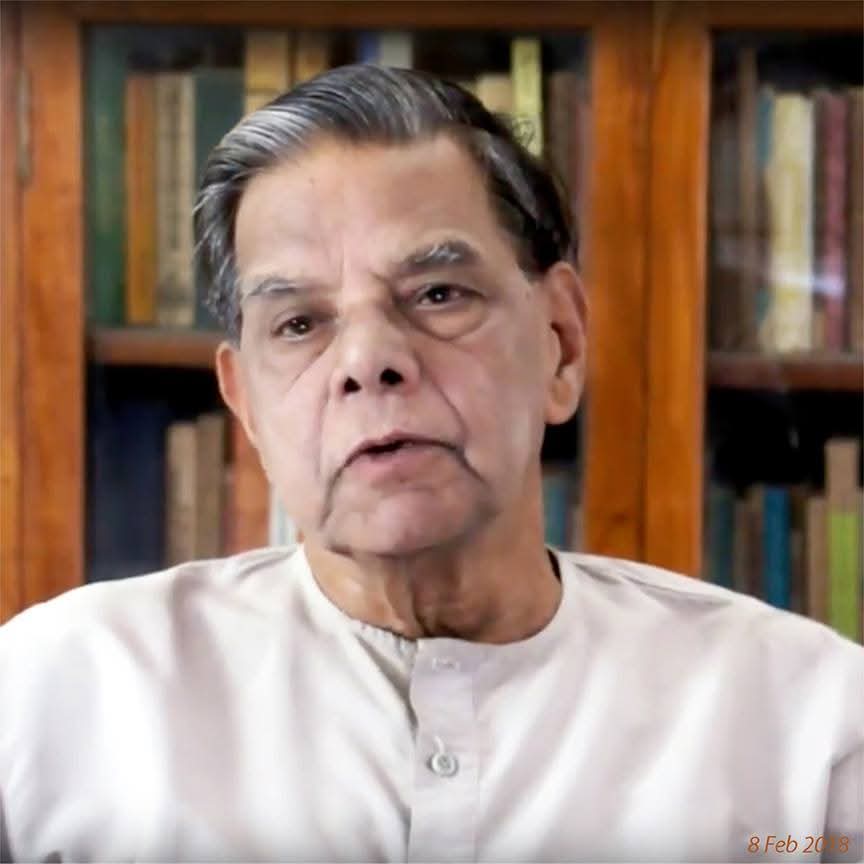
Dr. R.Y. Deshpande was interviewed by Pradip Kumar Sen for All India Radio, Pondicherry, and for JVR Cable TV for programmes broadcast on the occasion of 29 February 2000. The presentation given here combines both the interviews.
Question: In your opinion what is Sri Aurobindo and the Mother’s contribution to the people of Pondicherry, to the country and the whole world? How will the human race be fulfilled in their work? What does the new millennium mean for us?
Your question is very comprehensive and I do not know if it can really be answered in one short session. But I will try to touch upon just a few aspects.
Let us first talk about Pondicherry. And the context is Sri Aurobindo’s arrival here on 4th April 1910, in the afternoon, by the steamer SS Dupleix.
Sri Aurobindo came here and took shelter in Pondicherry. It was apparently to escape from the British clutches that he came here, seeking political safety. But actually he had received the divine command, adesh, and that brought him to Pondicherry. At that point of time, perhaps unknown to him in its details, was the avataric work he had to initiate. In that sense it was not he who took shelter in Pondicherry, but it was Pondicherry that took shelter in him.
Sri Aurobindo called Pondicherry the place of his retreat, the Cave of Tapasya. Pondicherry has that ancient tradition of doing Yogic sadhana. It is said that Rishi Agastya is the guardian spirit of this place. There was a Vedic school of learning here and hence it is also called Veda Puri.
Puducheri or New Town was known as Poduka to the Greek philosopher Ptolemy of the 2nd century A.D.
But with the arrival of Sri Aurobindo Pondicherry became New Town in its true sense. It has undergone a totally different transformation. Prior to his coming here the city was a ghost town. It was a cemetery with its full complement of ghouls. Deserted streets, sleepy population, shops of cheap wine, ruled by ruffians,—that was the condition during the French regime. The ideals of Liberty, Fraternity, Equality were not known to the crude bureaucracy, and poverty and precariousness had full sway over the town. A decadent feudalism had sucked the vitality of the people. The life here was immersed in full tamas. It was a God-forsaken place, without any hope in it.
It is to this place that now honour goes for being one of the most progressive and dynamic centres of activity. Commerce is flourishing; modern industry has taken deep roots, the professional population is increasing and is yet attracting newer and brighter talents from outside, even from abroad. The growth is so fast that it is becoming more difficult to cope with the ever-growing demands of modern industrial organisations. Infrastructure developments need a concerted effort to meet the expectations of these complex operations. Now prosperity is bursting at the seams, to the degree that the official machinery is unable to manage it.
Pondicherry is today a cosmopolitan place and has its own distinct flavour. Great experiments are being constantly tried here. The international City of Dawn, the dream-vision of the Mother that has come to reality in Auroville, has no parallel in the world. Perhaps there is a deeper reason behind this and it may be worthwhile to appreciate it. Even in a most superficial sense we may inquire if it has not given employment to a large number of persons. Has Pondicherry not come on the international map?
When the Mother came here in 1920, returning from Japan to stay here for good, she at once felt that she was entering the aura of Sri Aurobindo,—even as the boat bringing her here was two nautical miles away from the shore. We constantly live in that aura, even perhaps not knowing it.
But the work of Sri Aurobindo and the Mother is not confined only to this place; it is there for the sake of the country as well as for the sake of the world, for humanity. Perhaps, more appropriately, it is all in the will of the Divine.
The world itself has now become a global village. Conquest of space, information technology, genetic sciences, improvement of health, rapid growth in professional fields, the speedy and efficient development in industrialisation, trade, commerce, banking, management, are just a few outer manifestations of the collective mode of life into which more and more we are entering. And this is happening in every nook and corner of the world. Not that there are no problems, of drug trafficking, juvenile crime, terrorism on an unprecedented scale, constant skirmishes and clashes of the worst kind, of pollution, exploitation, human degradation. But from a deeper perspective these seem to be of a transient kind. Not that one should not be vigilant about such matters lest we do stupid things, but there need not be worrisome concern if we are sincere in our basic approach.
A firmer material basis for spiritual growth on such a dimension is something new in the entire history of mankind, something very welcome, something marvellous. The visible signs of the great work are there for all of us to see. Yes, we are living in a new millennium, nava yuga, that has brought a new dynamism of the spirit to our life, into our life. Such vast social changes take place only if a higher power can enter into life and mould it in its operative purpose and determination.
A society is shaped by its rishis and yogis, by mahatmas, swamis, the enlightened leaders, open-minded and open-hearted souls of the future, strong forerunners and pioneers, and it is in their tapasya, in their sacrifices that a new order is born. We are in the period of this renaissance and we must be thankful to the bringers of that prosperity, of every kind, to us. Our thanks have to be shown by living in this Hour of God, by standing in the truth of the purpose, in dedicating ourselves to it in all purity and sincerity and frank fearless candidness to its glory and greatness.
It is with that determination that we must see the work of Sri Aurobindo and the Mother.
But then what exactly was the work of Sri Aurobindo and the Mother? The aim for which they came here and which they unswervingly bore as their God-given mission? They saw in this creation the Will of the Supreme and did long and arduous yogic sadhana to achieve it, they visualised the possibility of the terrestrial evolution stepping into a new mode of growth and expansion in the scheme of operation here, of the arrival of divinity itself in our midst in its widening aspects, of the dawn of satya dharma, conduct in the truth taking the earthly existence to its completest fulfilment.
Well, these are big assertions and it is necessary that we look at them in the totality of their implications. The implications are universal, in fact the implications are divine in nature. Perhaps we may not be really able to gauge their importance and relevance.
This world has always been thought to be a nest of pain, as Keats would say. It is full of evil and falsehood and ignorance and death and these have had their sway all along. The cry of an ardent devotee praying to Govinda for the release of the soul from suffering and distress, to liberate it from this harsh worldly existence, from this death-bound and sorrowful life, bahu duḥkham iti saṁsāram, was one of the ancient ways to come out of the difficulty. Moksha was the cherished aim.
But that left the world as it was, sorrowful and death-bound. The individual soul escaped into the infinity of peace and joy but the world remained where it was. The samādhi of a Rajayogi, or the prema of a Bhakta, the kāyasiddhi of a Tantrik are great spiritual achievements, but these are not sufficient to take care of the problem of the world. Lao Tse spoke of absolute Reality which we cannot understand and about which nothing can be gainfully said. It can be experienced but not realised in life here. At the same time, we must assert that this world is not an illusion, nor can it be simply dismissed as something for ever worthless. There is a will behind this creation and our task is to find that will and live in it. It is a world for the habitation of God, īśa vāsyam idam sarvam, says the Upanishad and, in a way of speaking, we have to make it fit for His habitation. There is the divine will, divya or paraṁ saṁkalpa behind it.
What is the divine will behind this creation? According to Sri Aurobindo it is the universal incarnation of God in the material existence itself, in the body which is presently a nest of pain, bound by death and ignorance. But the body can open itself to divine life and divine knowledge, it can also know and in it become goldenly immortal, brahmavid brahmaiva bhavati as the ancient scriptures says. But how is this going to be achieved? If this is a distinct and realisable possibility, then what is the modus operandi to accomplish it? Sri Aurobindo’s Yoga-Yajna was for this Yoga-Satya. He saw that the only way to do it is to invoke the omnipotent Goddess, Mahadevi, and plead to her to take birth in human form. It is she who alone can work out the transforming miracle. To the earth’s dumb need must be brought down a radiant power which can take charge of this mortality and recreate it in the splendour of Truth and Consciousness and Delight, in Sachchidananda, the Triple Glory of the Transcendent.
Has this happened? Yes, it has happened. This has been the Yogic triumph of the omnipotent Goddess herself, or in avataric terms of Sri Aurobindo and the Mother, in the Will of the Supreme. The Mother always maintained that we are here upon earth to accomplish the work of transformation and in it is the divine fulfilment for endless progress. It is in that certitude that she declared that a new world is born, a wonderful world of delight. The things that were promised have been fulfilled in it. That marks a unique event in the Annals of the World, the epoch-making even of 29 February 1956. This was on a Wednesday, in the Playground, during the evening meditation after the Mother’s class.
Question: Why did the Mother select 29th February of every leap year as a Supramental Manifestation Day? Please explain to our listeners and viewers what exactly happened on this day in 1956.
Let me first dispel the impression that the Mother selected 29th February 1956 as the day of Supramental Manifestation. All that we can say is that it happened on that day, on a Wednesday. On Wednesdays the Mother used to take classes in the Playground and there used to be a brief meditation at the end. It happened during the meditation on this day. She was anticipating that something would happen soon and a few others also had a kind of vague intuition of the event likely to take place in that year. She had given earlier an indication to that effect. But there was never a question of selection, not at all. Celebrating its occurrence, its anniversary every leap year is then quite understandable.
Well, to describe it briefly. During the meditation the Mother saw that there was a golden door separating the world from the Divine. As she looked at the door she at once knew, and willed, in a single movement of consciousness that the time had come. It was a will and not a thought or deliberation. She at once knew that the time had come. Lifting with both hands a mighty golden hammer she struck one blow, one single blow, and the massive door was shattered to pieces. Then the supramental Light and Force and Consciousness rushed down upon earth in an uninterrupted flow. That is how she describes it. She wrote it down on a piece of paper on the same day after returning to her room.
The Upanishadic golden lid was removed and the divine Illumination flooded the subtle physical of the earth. Now in it shall grow here the Law of the Truth, Satya Dharma.
It happened on a Wednesday. In the South there seems to be a belief that Wednesday is more golden than gold. For the sake of Wednesday one will even forgo gold. Well, by taking a sudden leap, that hiranmaya or golden Supermind did manage to be in time to catch the golden Wednesday!
Afterwards the Mother wrote the message which was later distributed in 1960:
Lord, Thou hast willed, and I execute
A new light breaks upon the earth,
A new world is born
The things that were promised are fulfilled.
That is the significance of the great event. Maybe we can appreciate it better in the context of the spiritual history of the earth.
In the deepest sense it is concerned with the possibility of a divine life with all its progressive richness here itself, in this mortal world, mṛtyuloka. There were a few attempts made earlier on an individual level, as an aspect of spiritual realisation but not on a collective level as an aspect of manifestation. In the Vedic times Rishi Agastya tried to transform his body but found it difficult. The body could not hold the transcendental splendour in it; it was atapta tanu, unbaked vessel. The golden body of Agni, hiraṇya tanu or divya tanu, remained only a heavenly grandeur. Rishi Vamadev lived a life of sixteen years in the state of immortality and finally had to give it up. The Greek mystic Pythagoras had a thigh of gold, indicating that a part of the lower subconscient nature had been transformed. Occultists and saints talked about the glorious body but it was a far-off possibility,—meant not to be realised presently. Now the yoga-tapasya of Sri Aurobindo and the Mother has changed the whole thing. Their entire endeavour was to fix the Supermind in the physical. Sri Aurobindo found that it was coming but not staying here lastingly; it was coming and going and could not remain for too long in the body. But then in a supreme Yogic bid he fixed it in his body on 5th December 1950 and made it a permanent base for its universal operation. Not too long after this unparalleled Yogic action, just within six years of this Great Act of Sri Aurobindo, the Mother accomplished the miracle by smashing the golden door that separated the world from the Divine. Such is the spiritual meaning of the action of the incarnate Power, of Mahashakti, the omnipotent Goddess.
Now a new world is waiting at our doorstep, waiting to be called in. To prepare ourselves to receive it, and to be a part of it is our responsibility.
That, in my view, is the significance of this day, 29th February 1956.
Would you please explain in this context the importance of the four aspects of the Divine Mother, the four leading powers and personalities that have stood out in this universe?
You are asking a difficult question. In the tradition of the Upanishads, the disciple approaches the Rishi and solicits him for the Knowledge of the Eternal, Brahmavidya. I do not have any personal knowledge through spiritual experience about these four aspects of the omnipotent Goddess, her powers as Wisdom, Strength, Harmony, Perfection—Maheshwari, Mahakali, Mahalakshmi, Mahasaraswati. I don’t think we can speak about them in the manner of a Rishi. But we may try to understand something of these powers from what Sri Aurobindo has written about them in his little magnum opus The Mother. This answer of mine has therefore severe limitations; it is essentially paraphrasing The Mother. But perhaps it might help us at least to mentally understand something of the eternal Truth given to us by him.
If, en passant, we are to hazard a guess as to which books of Sri Aurobindo will live for the millennia to come, then we might say that these are his supremely revelatory epic Savitri, the grandest formulation of the vision of new humanity given in The Life Divine, and the neo-Tantrik scripture of the integral yoga, his The Mother. It is in this Tantra Vidya that we meet the four great aspects of the supreme executive Power of the Divine not only as presences but also as embodied persons.
The concept, so to say, of the four aspects of the Mother as given to us by Sri Aurobindo is not altogether new. But it puts in focus the active powers that are presently operating in this creation. In the Vedic tradition,—and also in that of the Gita,—it is the Purusha who is represented in his several expressions for upholding the universe. But Sri Aurobindo sees them as mights, powers, aspects of one transcendental Shakti.
The hierarchy of these powers is something like this. At first we have the Original Transcendental Shakti, call her if you like parātpara, Aditi, omnipotent Goddess, Mahadevi, or Consciousness-Force or Chidshakti or the Divine Mother who is closest to us. What we describe as Nature or Prakriti is only the outward aspect of the supreme executive force. Nearer to us but above she is the supramental Mahashakti. She has the power of divine omniscience and divine omnipotence, Knowledge and Will. On an intermediate plane she is Mahashakti of the triple world of Ignorance. It is here that the four powers of this Mahashakti operate and govern the evolutionary world.
Maheshwari is the Power of Wisdom. She, with her knowledge, opens us to the worlds of Sachchidananda. Hers is a personality tranquil and wonderful, calm, one who knows everything, comprehends everything. She is Mother to all, even to the hostile, to gods and to men and to demons. In her wisdom she has always with her the divine concern.
Mahakali is Force and Strength. She rushes with divine impetuosity to shatter all limits, destroy all obstacles. She is the Warrior of the Worlds, her spirit tameless and her action straight and frank. To knowledge she gives a conquering might.
Mahalakshmi is the Power of eternal beauty, of charm, harmony, love, sweetness. In our relationship with her is our profound happiness and she is one who lavishes the riches of the spirit when we open to her. God-plenty and God-abundance are her special gifts to us.
Mahasaraswati is the Mother’s Power of Work. Order and perfection are what she brings to all that she does and supports. Attention to details is her untiring concern. She is strong, she is attentive and conscientious, she is skilful and efficient in all that she undertakes to do. Her work is flawless and in its technicalities and minutiae nothing is forgotten. She is kind, smiling, close, helpful and is the most easily approachable.
We do not have any such description of the Powers of the Supreme in the Veda. The Gita speaks only of Para Prakriti and Yoga Maya. But the elements of these powers can be traced in them also. The Vedic Purusha Sukta is a Hymn of Sacrifice of the Divine Being. When it talks of the four parts of that Being, we then at once see that Maheshwari is his head, Mahakali his arms, Mahalakshmi the heart, and Mahasaraswati the feet. In the four orders of society of the Gita we have a correspondence of Maheshwari as the Brahmin, Mahakali the Kshatriya, Mahalakshmi the Vaishya, and Mahasaraswati the Shudra. It is in this Chaturvarna established since ancient time, as the Gita also declares, that we see psychological justification for the fourfold soul-force operating in the world. That in the present mode of existence is an aspect of the divine functioning itself and behind it there is the eternality of the transcendental Mahashakti herself.
Take any society and any time in the history of civilisation and we recognise that these four aspects have always been present. There have been Brahmins all over the world and workers and businessmen and heroic people and warriors. Men of learning, men of adventure and mighty action, men of commerce and trade, men of professional skills,—where are, or in a dynamic culture, when were they absent? Plato and Einstein were Brahmins; Julius Caesar and Eisenhower were Kshatriyas, Henry Ford and Bill Gates must be considered as Vaishyas, so too the unnamed builders of Hagia Sophia and the New York skyscrapers as Shudras. The essential qualities behind them all are universal and are the manifestations of these Four Powers.
The present degradation of Chaturvarna in India is a totally unacceptable distortion. It has become so because of the heavy tamas that spread over the country for the past several centuries and there is nothing really Indian in it. It has to go. It has, on the basis of what is called caste, which was never there, reduced rather fissured the country into smaller and smaller bits. But this illegitimate division can go away not by choices and preferences, by laws or edicts or ordinance, nor by priority promotions. It has to go by a reorganisation of our society in the values of knowledge, strength, harmony, perfection. Each one has to recognise the basic precept, the dharma, the inner working of one’s own soul and act in it. Well, that is how I understand the role of the four aspects of the Mother in upholding the order of the society. It is based on inalienable psychological principles and any departure from them will have its disharmonious consequences.
But in the Yogic vision and experience of Sri Aurobindo there are also the higher powers of the omnipotent Goddess who have not yet come down into the evolutionary play. These can come down only when the Truth-dynamism of the Transcendent, the creative Supermind, descends into it. This has now happened and there shall be hence the multifold order, far beyond the Chaturvarna System, which shall organise life in the meaning and purpose of the Spirit.
Can you please say something about the contact you had with the Mother?
It is unfortunate that I came in contact with the Mother rather late.
But I am also fortunate in yet another sense. I received blessing directly from the Mother on many occasions; I visited the Ashram several times for the Darshan, received messages, received napkins from her, also groundnuts in the Playground.
Yes, my very first contact with the Mother was on 12th December 1950 when she gave blessings for the first time after Sri Aurobindo’s passing away. The message carried Sri Aurobindo’s calm and triumphant Samadhi picture, of the God of Light sleeping in a mystery-flame. The envelope in which the photo was put has a beautiful painting in oil, of a mountain rising in its tranquil serenity. The message has the Mother’s prayer to the physical body, the inscription that we have now on the Samadhi. It also asserts that whatever Sri Aurobindo had come to do he accomplished fully, that he “attempted all, prepared, achieved all for us.” It is necessary that we recognise it and live in it.
Well, this contact of mine with her may sound like that of 50 years of contact, yet I feel that I came in contact with her rather late. Perhaps that is also her way of showering grace on us!
_________
About the Author: Born on 17 April 1931 Dr. R.Y. Deshpande is a professor, philosopher, author, poet and inmate of Sri Aurobindo Ashram, Pondicherry. After graduating from Osmania University, Hyderabad, he joined the Tata Institute of Fundamental Research, Mumbai as a research physicist in 1955 and worked in this organization till 1957. In 1957 he joined the Bhabha Atomic Research Centre, Mumbai where he worked till 1981 and headed several Atomic Energy and Space Projects in Advance Technology with Dr. Raja Ramanna. Having received his Ph.D. in nuclear physics in 1964, he worked at the Lawrence Berkeley Laboratory, Berkeley, California USA from 1964 to 1965. He has some fifty research papers published in national and international scientific journals. He was also an examiner for a number of Ph.D. theses in the field of Solid State Physics. In 1981 Deshpande joined Sri Aurobindo Ashram of Pondicherry. For thirty years, he taught physics and a few other subjects such as Astrophysics, Savitri, The Future Poetry, Science and Society at the Sri Aurobindo International Centre of Education. For eight years he was the associate Editor of Mother India, a Monthly Review of Culture, published by the Sri Aurobindo Ashram. During 2007-2008 Deshpande was the editor of a web-magazine titled Science-Culture-Integral Yoga founded in Los Angeles. His published works in prose and poetry include titles like Sri Aurobindo and the New Millennium, Vyasa’s Savitri, The Ancient Tale of Savitri, “Satyavan Must Die”, All Life is Yoga, Nagin-bhai Tells Me, The Rhododendron Valley, All is Dream-Blaze, Under the Raintree, Paging the Unknown, The Wager of Ambrosia, Savitri: Notes and Comments, Elements and Evolution, Sri Aurobindo’s Narad, The Birth of the Sun-God, Hymns to Becoming, These Mountains, The Secret Knowledge, Savitri Talks: The Symbol Dawn, Islam’s Contribution to Science, Big Science and India, Running Through Savitri, A Look at the Symbol Dawn: Observations-Comments-Discussions, Savitri: The Poetry of Immortality, and Sanatana Dharma: An Aurobindonian Perspective to name a few. He has also edited the following books: Nirodbaran: Poet and Sadhak, Amal Kiran: Poet and Critic and Perspectives of Savitri.
“But actually he had received the divine command, adesh, and that brought him to Pondicherry”:
‘I may also say that I did not leave politics because I felt I could do nothing more there; such an idea was very far from me. I came away because I did not want anything to interfere with my Yoga and because I got a very distinct adesh in the matter. I have cut connection entirely with politics, but before I did so I knew from within that the work I had begun there was destined to be carried forward, on lines I had foreseen, by others, and that the ultimate triumph of the movement I had initiated was sure without my personal action or presence. There was not the least motive of despair or sense of futility behind my withdrawal. For the rest, I have never known any will of mine for any major event in the conduct of the world affairs to fail in the end, although it may take a long time for the world-forces to fulfil it. As for the possibility of failure in my spiritual work, I shall deal with that another time. Difficulties there are, but I see no cause for pessimism or for the certification of failure.’ [pp. 26-27; Complete Works of Sri Aurobindo, Volume 35 (‘Letters on Himself and the Ashram’)]
‘These are the facts of that departure. I was in the Karmayogin office when I received word, on information given by a high-placed police official, that the office would be searched the next day and myself arrested. (The office was in fact searched but no warrant was produced against me; I heard nothing more of it till the case was started against the paper later on, but by then I had already left Chandernagore for Pondicherry.) While I was listening to animated comments from those around on the approaching event, I suddenly received a command from above in a Voice well known to me, in the three words; “Go to Chandernagore.” In ten minutes or so I was in the boat for Chandernagore. Ramchandra Majumdar guided me to the Ghat and hailed a boat and I entered into it at once along with my relative Biren Ghosh and Mani (Suresh Chandra Chakrabarti) who accompanied me to Chandernagore, not turning aside to Bagbazar or anywhere else. We reached our destination while it was still dark and they returned in the morning to Calcutta. I remained in secret entirely engaged in Sadhana and my active connection with the two newspapers ceased from that time. Afterwards, under the same “sailing orders”, I left Chandernagore and reached Pondicherry on April 4th 1910.
‘I may add in explanation that from the time I left Lele at Bombay after the Surat Congress and my stay with him in Baroda, Poona and Bombay, I had accepted the rule of following the inner guidance implicitly and moving only as I was moved by the Divine. The spiritual development during the year in jail had turned this into an absolute law of the being. This accounts for my immediate action in obedience to the adesh received by me.’ [pp. 89-90, Complete Works of Sri Aurobindo, Volume 36 (‘Autobiographical Notes and Other Writings of Historical Interest’)]
DR. MANILAL: Why did you choose Pondicherry as the place for your sadhana?
SRI AUROBINDO: Because of an Adesh, a Command. I was ordered by a Voice to come here. When I was leaving Bombay for Calcutta, I asked Lele what I should do about my sadhana. He kept silent for a while, probably waiting to hear a voice from within, and then replied, “Meditate at a fixed time and hear the voice in the heart.” I didn’t hear any voice from the heart but a quite different one from above, and dropped meditation at a fixed hour because meditation was going on all the time. When Lele came to Calcutta and heard about all this, he said to me, “The Devil has caught hold of you.” I replied, “If it is the Devil, then I will follow him.” The same Voice from above brought me to Pondicherry.
(Nirodbaran, ‘Talks with Sri Aurobindo’, 10 December 1938)