During my life of more than fifty years in the Sri Aurobindo Ashram, Pondicherry, I have benefitted immensely from the example and advice of my Ashram elders. Below are my impressions of some of them; I have tried to show how they have inspired me to be a better person. At the end, there are a few writings about others outside the Ashram.
The Ashram elders are:
1. Champaklal
2. Dyuman
3. Ambu
4. Simanta
5. Nolini
6. Pujalal
7. Pranab
8. Mona Sarkar
9. Dr. Nadkarni
Those outside the Ashram are:
10. Amalesh
11. Sujaat Khan
12. Swami Chidananda
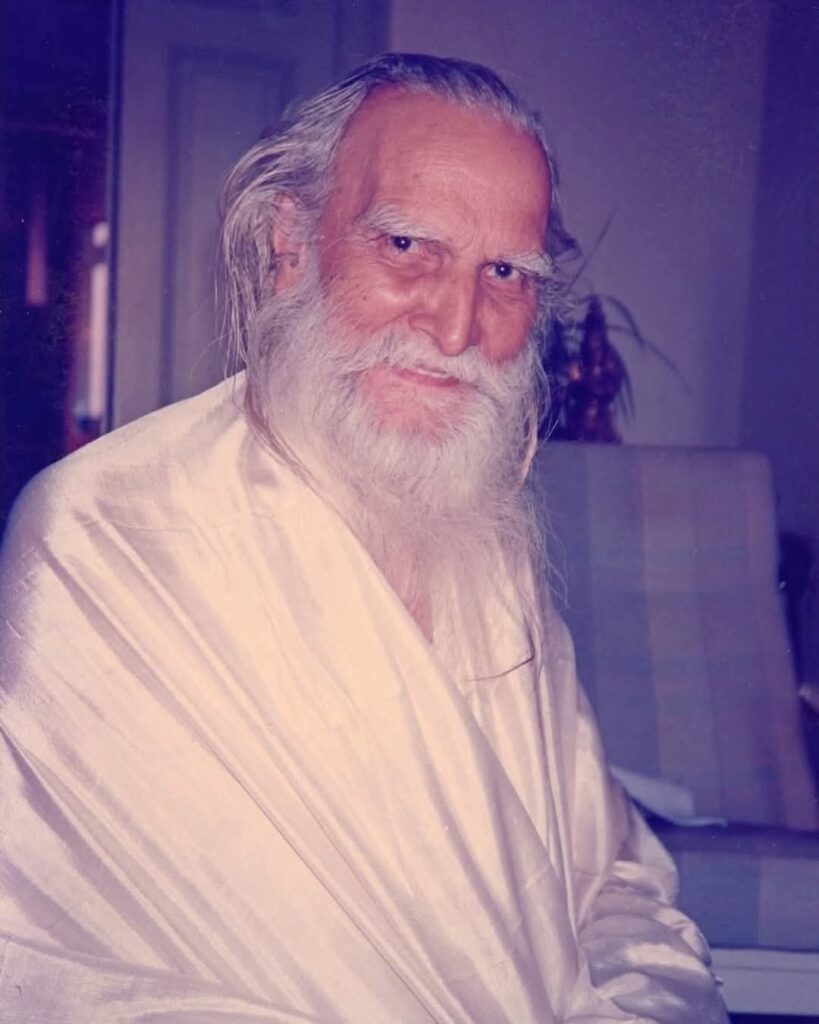
My Time with Champaklal
When I arrived at the Ashram in 1971, Champaklal was a rarely seen, almost legendary figure. He had come to Pondicherry from Gujarat as a young man, worked closely with the Mother from the beginning, attended Sri Aurobindo personally for twenty-five years and then the Mother for nearly as long. I first saw him on December 12th when I went to meet the Mother in her room. Before turning to her I glanced at him and he welcomed me with a big smile. Then after the Mother’s passing in 1973, I often saw him on Saturday evenings at the Playground. Five minutes before the weekly film began, he would burst through the gate dressed in a dhoti, barrel chest boldly stuck out, and stride to his place on the sandy ground. I got to know him personally in 1987, when he called me to do some work for him.
One day late in May 1987, Roshan Dumasia, a Bombay university professor who assisted Champaklal during her vacations, came to my desk at the Archives and said that Champaklal wished to see me. He needed someone to transcribe some manuscripts of Sri Aurobindo, mainly letters and messages. After taking permission from my department head, Jayantilal, I agreed to help. Over the next two years I spent an hour or more with Champaklal on about a dozen occasions. At first I called him “Champaklalji”, but soon it became “Dadaji”, as he was known to those close to him.
The 1987 Meetings
My first task was to type out Champaklal’s own correspondence with Sri Aurobindo. The full correspondence was being prepared by Roshan for a revised edition of the book Champaklal Speaks. On June 3rd I went to his room with a typed copy of the manuscripts he had given for transcription. Champaklal looked at my work slowly and carefully. Now and then he nodded with a smile, a twinkle in his eyes, a lively hand movement. Something of a mime artist, he had a mobile face and a gift for conveying his thoughts and emotions through gestures. I was happy that he took so much time to see my work. Later I found that he took time for almost everything he did.
During the final years of his life Champaklal observed a vow of silence (mauna), so any verbal communication between us had to be done through writing. After checking my work he wrote on a slip of paper, “I admire you”, and handed it to me. I read the words and blushed with embarrassment. Then he took the slip again and added, “You work with love and joy.” Flushed with elation I blurted out, “I admire you too!” and explained, “To me you stand for service, freedom and wideness of mind. You do what you think is right, regardless of what other people say.” I had in mind his recent travels in India and abroad, for which he was quietly criticised in the Ashram; the prevailing view was that he should have stayed at home. In reply to what I told him, Champaklal wrote, “Because of Her abundant Grace.” As I came to learn, it was typical of him to attribute any merit in himself to the Mother.
Sharing a Laugh
On June 12th I went to his room with a second batch of manuscripts and my transcription of them. While Champaklal looked over my work, I peeked around the room. Pictures everywhere — on all four walls, from floor to ceiling, big black-and-white photographs and a few brightly coloured paintings. Mother and Sri Aurobindo all around. A soft yellow-gold carpet covered the floor. Seated on it comfortably, clad only in a white loincloth, with his golden brown skin showing everywhere, Champaklal looked like a happy child. After checking my transcript he wrote, “Mother used to like good work so much. Now even more — must be!” I laughed, pleased with the idea that Mother now appreciates our work more than ever. He also laughed and it was good to hear his chuckles. Then he wrote, “Champaklal respects and admires very much such a person.” Touched by his compliment I said, “Your kind words give me faith in myself.” In response he wrote, “The qwaliti [sic] is Hers.”
The Case of the Missing Photo
The next day Roshan brought a third batch of manuscripts to me for transcription. She also asked me to speak to Jayantilal on a delicate matter. She said that Champaklal had given him a large hand-coloured photograph of the Mother, but it had not been returned and Champaklal wanted it back. Later in the day I asked Jayantilal about this photo. He said that Champaklal had given him a copy of the photo, not the large original but a smaller copy of it, and he had been careful to return the copy, knowing that Champaklal was particular about such things.
A few days later I went to see Champaklal for work and broached the subject of the missing photo. “Jayantilal says he doesn’t have the photo,” I said. “He told me that you gave him a smaller copy of it and he returned it.” Champaklal’s face suddenly darkened and he grimaced; he clearly did not buy this story! The air became heavy with tension as he struggled to contain the rising anger in him. Apparently he thought that Jayantilal still had the photo or had misplaced it and was making an excuse. There was a long, ominous silence. I could hardly breathe. At last the tension lessened, Champaklal’s face relaxed and he gave a weary smile. Picking up a slip of paper, he penned three words and handed the slip to me with a gesture of resignation. “Does not matter,” it said. Maybe not, I thought, but something is not right.
There was another long and heavy silence. Then Champaklal’s whole countenance softened and his face underwent a visible metamorphosis. A growing warmth and joy spread across it, the gravity in the air abated, and I could breathe again freely. He reached for a slip of paper and slowly wrote, “So many things Champaklal has lost — now one more.” Handing me the slip, he smiled with a look of compassion tinged with sorrow. His look was most touching. It seemed to me that he may have thought the missing photo might still be somewhere with Jayantilal, but he was not pressing for it. His unspoken message was: “So many things I have lost in my life. Who am I to get angry and point the finger of blame at someone else?” I felt great sympathy and respect for him. He had passed the test — he had faced the dark cloud of anger in himself and dissolved it. In place of the cloud a radiant glow of tenderness shone on his face; his heart was again at peace. How honest one must be to remain bright and happy.
After a week Champaklal sent a letter of apology to Jayantilal for any anxiety he might have caused. He had not yet found the missing photo, he wrote, but he thought that it must be somewhere with him or perhaps he had given it to someone else. The latter surmise turned out to be true: years later I found the original hand-coloured photograph in the room of my downstairs neighbour!
Only One Sadhana
Towards the end of June I returned the third batch of manuscripts to Champaklal. There was very little work that day, so I spoke to him about something that was bothering me. “Dadaji,” I said, “I do japa to control my mind, but I don’t have a mantra. I have tried so many mantras, but I can’t settle on one. Could you suggest a mantra for me?” He slowly inscribed on a chit: “What I think. Any mantra you say with love and joy is good. But it is not necessary. Only if it comes spontaneously.” As I read his reply, Champaklal watched my face and he could tell that I was not satisfied; in fact I was still hoping that he would give me a mantra. He smiled and wrote, “I myself do not have a mantra.” That did satisfy me—it meant we were both in the same boat! Again he took up his pen and wrote: “To me Mother gave only one sadhana.” Then he pulled out a birthday card that contained a message she had written to him in 1928:
Be simple,
Be happy,
Remain quiet,
Do your work as well as you can.
Keep yourself open always towards me.
This is all that is asked from you.
Champaklal wrote, “I asked her: ‘You say, “This is all that is asked from you.” All? Only this?’ Mother said, ‘Only this.’ I said, ‘Mother, just give me one.’” — that is, just one of the five things she had listed. He ended his note, “By her Grace she has given them all to me. This is my condition. I want nothing.”
At the end of our session he handed me a packet of incense and a Divine Love flower.
The 1988 Meetings
A Controversial Photograph
At the end of the summer of 1987 Roshan left the Ashram to resume her teaching duties in Bombay. When she came back in April 1988, we took up work with Champaklal again. I went to his room on the 28th with a framed photograph he had given me the year before, a little-known photo of the Mother taken on her birthday in 1973. She is wearing a dark red sari embroidered in gold and on her head is a large gold triangular crown with her symbol on it. Her eyes are closed and she is indrawn. When I first saw the photo, I was deeply attracted to it, so he gave it to me! But over the months I had not looked at it much. “I want to return this photo to you,” I said. “I have not been feeling much for it lately.” Happy to see the photo again, he looked intently at it for about two minutes. As he gazed, his face took on an uncanny resemblance to the face of the Mother in the photo; the extent of his identification was remarkable.
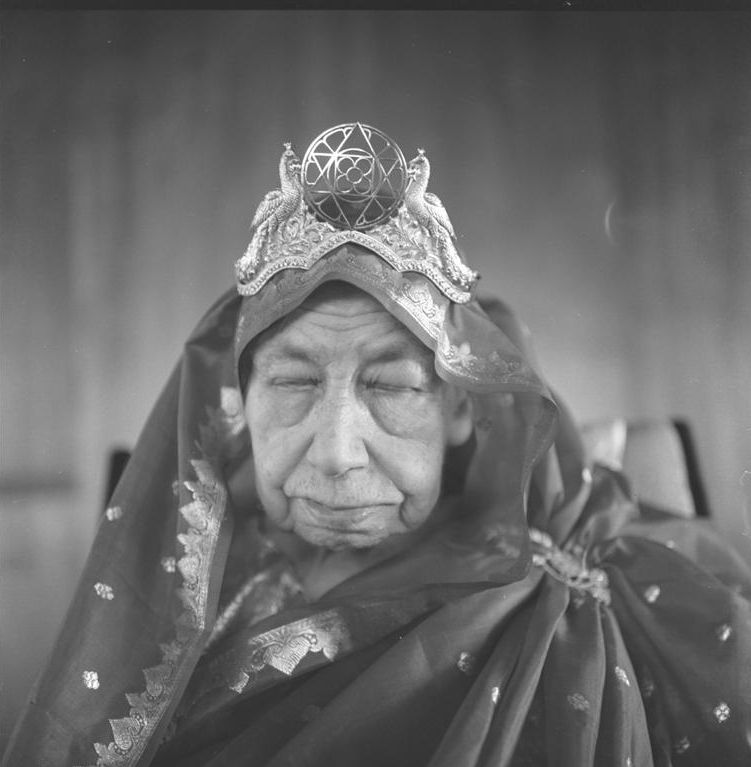
Then he began a forty-minute “discussion” of the photograph, with him writing and me commenting every now and then. “Why don’t people like this photo?” he wrote. I didn’t know what to say. Then he asked me to read out loud something he had written about the photo, a two-page typescript. The gist of it was that although the photograph is not superficially pleasing, it expresses a deep inner state, and if one looks at it for a few minutes one will be drawn deep inside — this was his own experience. The photograph, he wrote, is merely a symbol of the Mother, just as the stone image of Kali worshipped by Ramakrishnadev at Dakshineshwar is a symbol of Mother Kali. By dwelling on the symbol one can enter into the consciousness behind it. At this point Champaklal showed me a coloured print of Jagannath of Puri, with Balaram and Subhadra on either side of him. “Chaitanyadev had darshan of Krishna by seeing this image,” he wrote. Then he asked me a whole series of questions about the Mother’s photo, sometimes supplying the answers himself.
“Why don’t people like it?” he wrote.
“Because Mother is not smiling and she looks so serious,” I said.
“But she is not smiling in other photos,” he countered.
“Her eyes are closed,” I said, “so people don’t know what she is thinking. It makes them afraid.”
Champaklal’s eyes lit up with a gleam. “FEAR,” he wrote. “They are afraid to go within.”
Still absorbed in the subject, he penned, “Is the gold crown not beautiful? Mother liked it very much.” Pointing to the photo, he wrote, “Mother liked it very much. She looked at it happily for a long time in my presence.” And then, “She signed a copy of it for someone and gave her blessings. She never signed if she did not like a photo.” About the copy I had returned, he wrote, “It wanted to come back to me.”
After this unusual session, Champaklal sent me off with a packet of incense and a Divine Love flower.
Preservation of Manuscripts
A week later, on May 5th, I went to see Champaklal at 10.30 in the morning. We had a long discussion on the preservation of manuscripts. I told him that it was not safe for him to keep his manuscripts of Sri Aurobindo and the Mother enclosed in plastic sheets, because the plastic would decompose in time and contaminate the manuscripts with acid, turning them yellow and shortening their lifespan. After questioning me closely, even about the effect of the acids contained in the manuscripts themselves, he agreed to remove the plastic sheets. Later I supplied him with thin acid-free-paper folders for the work.
Dwelling in the Zone
Champaklal was conscientious in his care for material things, deliberate and thorough. Perhaps because he was so solidly grounded, I always felt at ease and secure with him. It took a long time to do things, but it didn’t seem like we were wasting time. I sensed that even while he did things, he dwelt inwardly in a contented spiritual zone. While his outer nature did the work, his inner being remained concentrated within: he was one-fourth outside and three-fourths inside. In his presence I basked in an atmosphere of serenity, removed from the pressing concerns of life. He had learned, I think, the truth of the Mother’s comment, “As soon as one stops hurrying, one enters a truer vibration.”
Little Jokes
My third visit took place on May 12th. We didn’t work much, but it was a joy just to sit there in his presence. Then, towards the end, I got restless and started making gestures to get up and go. Champaklal either ignored them or smiled without giving me a nod to leave, so I sat on. Then someone came who said he needed to see Champaklal for two minutes and asked to be left alone with him. I went into the next room and waited. Ten minutes later the fellow came out and left. I returned to Champaklal’s room. “Why did you leave?” he wrote. “X asked to be alone with you,” I said. He smiled mischievously and wiggled two fingers back and forth, as if to say, “Yes, but only for two minutes!” I thought this was very funny, so I laughed. He also laughed and his eyes sparkled. I think he was happy to have someone to enjoy his little jokes.
That day Champaklal started to get up to bring a flower for me from Sri Aurobindo’s room, but feeling weak he sank back down again. I motioned for him to stay put — no need to send me off with a flower each time. So he just sat there like a child with a big smile on his face, and I left.
Willing Work, No Obligation
Five days later, on May 17th, I went to see him again. There was not much to do, but the time passed easily. We sank into an enjoyable meditative state. After a while Champaklal wrote that he would like to have new photocopies made of his Bonne Fête notebook in which Sri Aurobindo and the Mother had for many years written birthday messages for him. He showed me the old photocopies, which were small and faded, with shadowy lines at the edges. “Very bad job,” he wrote. I asked, “Do you want the new copies to be the same size as the originals?” “If you can,” he wrote. “Of course we can,” I said. “Yes, you can,” he rejoined, “but can he?” “He” was someone who had not shown much enthusiasm for doing such work in the past. We both laughed. Then he wrote, “Do it if he is willing, but not if he feels obliged.” That was Champaklal’s style: he freely asked people to do things for him, but he wanted them done willingly. At the end of the hour he sent me off with incense and a flower.
The Art of Living
My final meeting with Champaklal that year took place the next day, May 18th. That evening he was leaving Pondicherry for a two-month tour of Europe and the United States. I expected him to be very busy, maybe packing, and was prepared to leave early to spare his time. When I arrived at 10.30 he was working as usual with Roshan. I sat on the floor and waited fifteen minutes until they finished their work together. By then I had calmed down. Suddenly old Dikshitbhai, well into his nineties, appeared at the door to wish Champaklal bon voyage for his journey abroad. When Dikshitbhai showed deferential respect to his younger gurubhai, Champaklal put his head down like an embarrassed little boy and said nothing. Dikshitbhai sat down on the carpet and we spent several minutes sitting in silence; then he got up to go. Champaklal came out of his ingathered condition, held Dikshitbhai’s hand warmly and gave him some flowers.
I felt it was time for me to go too and started to get up. Champaklal smiled and motioned to me with his eyes to remain seated. Quickly he sank down again and sunk into an indrawn state. Roshan and I also became indrawn. Five minutes, ten minutes, I kept going deeper and deeper. Then I understood! He was leaving for Europe that evening and had things to do, but no, he was not all tensed up and in a hurry; he was doing the only thing really worth doing, plunging inside, living in the Presence. Indeed, he seemed to have forgotten the time! The minutes passed slowly, but I was so tranquillised that I lost the impulse to go. A great wave of affection arose in me and flowed towards this kindly man who was teaching me by his own example the art of living: Remember the important thing, the inner presence. Don’t be running around all the time. Learn to appreciate and enjoy the Grace.
At last, emerging from the little meditation he had induced in us, Champaklal got up, went into Sri Aurobindo’s room and returned with two kinds of incense and a Divine Love flower. Handing them to me, he smiled sweetly. I stepped out the door as he watched me go.
My Mother Meets Champaklal
That was my last long meeting with Champaklal. In the years that followed, I saw him a number of times, but only briefly. Still, he remembered me and made me feel special. Once, towards the end, I brought my mother to see him. He was weak as a kitten, having suffered a stroke and been through intense pain; he leaned back on the pillows that propped him up. But the kind and gentle eyes were still there. My mother stood before him a while and then, on impulse, held out her hand to him. Champaklal held it a few seconds. When she began to withdraw her hand, he held on and resisted her pull; then he let her hand slowly go towards her and, at the last moment, instead of letting go he tugged it towards himself. My mother broke down crying. Later she told me, “Oh, Rob, that man is very special.” Yes, Mom, he is indeed very special.
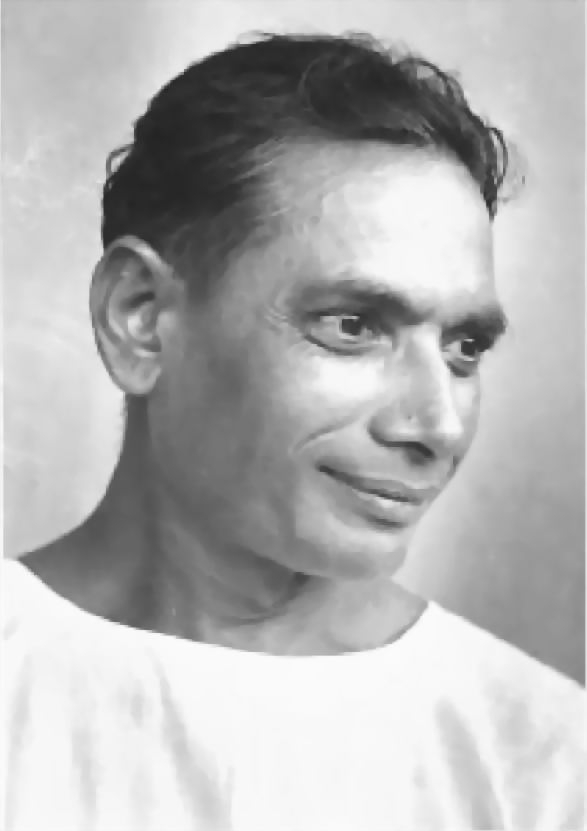
Dyumanbhai
When I came to the Ashram in 1971, Dyumanbhai was a constant presence: he lived in the heart of the Ashram, in a room only a few metres from the Samadhi. Always coming and going with a smile on his face, he couldn’t be missed. In the mid-seventies a closer contact with him emerged. I started working in the Fruit Room and one of my early-morning duties was to take his fruit bag to his room and leave it on top of his foodsafe. Normally I got there a few minutes after six, just when the Hindu arrived. Soon I was browsing through the newspaper every day before returning to my Fruit Room work.
As I read the paper, Dyuman would usually be seated at his desk, signing receipts for donors to the Ashram. Light from a table lamp flooded his desk, and on it were piled the donor’s receipts, a stack of small white envelopes, and a letter pad with “Sri Aurobindo Ashram” printed on top. He would sign each receipt, put it in an envelope, and write the donor’s name and address on the front; sometimes he added a note of thanks. He knew who sent money and how much. His personal touch let the donor know that the contribution had reached the Mother and was appreciated. I liked the fact that he wrote the donor’s name and address himself. He could have had an assistant do that, but he was a hands-on man who connected with people. He made people feel they were family.
Now and then Dyuman talked to me. I listened happily to whatever he said and sometimes asked questions. Once I asked him which State gave the most money to the Ashram. “At first it was the Bengalis,” he told me, “but now it is the Tamils. They have a custom of offering, and most of them give a little something when they come, maybe not much but it all adds up. The Tamils are now the top donors.”
“And of those who give,” I said, “how many give out of love for the Mother and how many give to obtain favours from her?” “I suppose most give for favours,” he replied, “only some out of devotion. But it is not for us to judge; Mother knows why they give and how to help them.” He accepted people as they were.
In time my contact with Dyuman grew closer. Two or three times a year he invited me to accompany him on his daily visit to Gloria Land, the hundred-acre farm he started in the 1960s. In the car on the way to and from the farm, I sometimes asked him questions. His answers form the basis of what I write below.
The Beginning
When Dyuman came to live here in May 1927, the Mother told him, “You do my work and I’ll do your work.” This has been his motto for the last fifty years. When he was introduced to Nolini and Amrita, he said to himself, “There is only one way I can catch up to them: service.” He had the zeal to serve. One evening he finished his work with her just before midnight. The next morning he woke up before four. Rather than sleep longer, he went to her staircase and waited for her to open the door. When she came, she sent him to fetch Nolini, Amrita and Pavitra. When Pavitra came, Mother told Dyuman, “You too come in.” Thus began his work with her upstairs.
Trouble-shooter
Dyuman was one of the Mother’s trouble-shooters. She often turned to him when she needed money. He would ask people to donate, and they would give because they knew their money went straight to the Mother and nowhere else. He himself needed little and lived like a sadhu. His toilet kit consisted of a soap-dish with soap, a toothbrush, a razor and a shaving brush; no shaving cream: he used soap. His standard attire was a dhoti, a thin cotton shirt without buttons or collar, and an old pair of shoes. He ate well, but only because the ladies in Mother’s kitchen looked after him.
Way of Working
Dyuman’s way of working, like the man himself, was direct and simple; he didn’t get lost in mental complications. Millie-di of Art House, explained his approach by comparing him with Pavitra. When the Mother asked Pavitra to do something, he would usually reply, “Yes, Mother, but…” That “but” was some question that immediately came to Pavitra’s mind. When she asked Dyuman to do something, he simply said, “Yes, Mother”, and then figured out how to get the job done. He somehow found the people, the money, the means. He had faith that if Mother asks you to do something, she also gives you the power to do it. Of course, if he needed her help, he would ask for it.
Self-confidence
Dyuman had amazing self-confidence, a confidence that bordered on boldness. Here are two examples. In 1957 he told Udar to purchase the Ashram Theatre for Rs 50,000 without first asking the Mother for approval! In the same way, he purchased Gloria Land for Rs 105,000 rupees without consulting her. When he informed her of the purchase of the farm, her only question was, “Why do you want to call it Gloria Land?” He replied, “Because one day the land will be glorious, Mother.”Dyuman’s confidence was based on his faith in the Mother. He saw himself as an instrument whose value lay in his faith in her, not in his own energy or acumen.
Gloria Land
Dyumanbhai’s greatest joy was Gloria Land. One day he invited me for a visit. Mid-afternoon we climbed into the back seat of an old Ambassador and headed out to Gloria, a half-hour drive. There I met Manindra, the effervescent manager of the farm. We got on together from the start. Like most Bengalis, Manindra was a natural-born storyteller. He made an ordinary day sound special, with many lessons learned. Walking along the inner roads of Gloria, he would regale me with enchanting tales of life on the farm. Over several visits he chronicled the growth of Gloria from a large weedy wasteland without a well into the lush farmland we saw around us. Dyuman trailed along behind, listening to Manindra’s stories or musing on thoughts of his own. The daily dose of fresh air must have him done him good — time in the open to clear his mind. No sun-cap on his head; he kept it simple.
After our round of the farm we would head to the dining table for a sumptuous farmer’s tea—a strong cup of Darjeeling tea, fresh fruits and salty snacks. By sunset, tired and happy, Dyuman and I would pile into the Ambassador and ride back to Pondy. Once I said, “Dyumanbhai, you have so many responsibilities — some days must really be tough. When things go wrong and you get downhearted, what do you do?” He pondered a little and replied, “Well, I find that if I just go to sleep, things are usually okay when I wake up.” That was Dyuman.
Shouldering the Burdens
Dyumanbhai had a quiet radiating energy that he shared with everyone. Strong inside, he didn’t need to lean on others. He knew how to shoulder life’s burdens. Loaded with responsibilities, he never seemed unduly weighed down by them; he give the sense of being on top of things. Far from trudging around doing good works, he clearly enjoyed doing them, maybe because he did things his way. His way of working is more intuitive than rational. It seems to work for him.
Dyumanbhai easily got filled with enthusiasm. When a happy thought popped into his head, he would break out in a beaming smile. Here was a responsible elder who could light up like a child! One day he got excited about Sri Aurobindo’s return to earth. “It won’t be like we think,” he told me. “When Sri Aurobindo comes back, what will he do? Is he going to write Savitri? No, of course not!” he exclaimed. “He will write something else, or maybe he won’t anything at all.” And he laughed, delighted by the idea.
Sometimes his enthusiasm got the better of him. One year he was proud that Gloria was producing a record amount of milk. “Soon there will be a pipeline running from Gloria to the Dining Room,” he gushed. “We will be able to deliver the milk direct.” Whether he really thought this was possible I don’t know, but the idea was surely extravagant. My friend Ambu roundly took him to task for this boastfulness, but I could easily forgive such emotional excess.
Dyuman had a sense of childlike wonder and moved about with a sense of lightness and joy. He had a comforting benevolence in him. Patient, gentle, forbearing and kind, he was good to others. He gave a lot of freedom to those who worked under him and at the same time support. When someone misused the freedom he accorded them, he was not vindictive.” Freedom has to be given,” he told me, “nothing else works.”
The Golden Jubilee Day
On his golden jubilee day, fifty years after he first met the Mother on 12 May 1927, Dyuman invited me to go with him to Gloria. He said the occasion also marked his entrance into the final quarter of his life. He was referring to the four Ashramas or stages of life in the Indian tradition. First, one is a student, then a householder, then a “forest-dweller” partly retired from life, and finally a Sannyasin, the stage of renunciation of the world so that one may devote oneself entirely to the realisation of God. A free, super-social man, the sannyasin is beyond the claims of society.
At the same time, Dyuman was dividing his life into four actual quarters. During the first quarter he was out of the Ashram. During the next two quarters he was in it. As for the fourth quarter, he made a gesture to indicate that the future was unknown.As it turned out, his future proved to be one of involvement, not renunciation. In time he became the Ashram’s managing trustee, with all the responsibilities it entailed.
I asked Dyuman whether the Mother’s way of dealing with people had changed over the years, whether she had become more lenient over the course of time. Dyuman nodded his head “Yes” and then explained: “Mother was necessarily strict at the beginning because she was laying the foundations of her work. At first one must be severe and establish discipline. Then things can grow more freely and there is no need for severity. When a child learns to write, his mother takes his hand and corrects his letters over and over; then she leaves him on his own. But,” he noted, “Mother was strict only with a few. Most people she left to themselves and did not push them. She was hardest on those who were closest to her, because she depended on them to do her work.”
After a long pause Dyuman said, “This Yoga is the easiest of all Yogas and it is also the hardest. It is easy because all you are asked to do is to give yourself; it is hard because to give yourself is very difficult. I try to go step by step, but always a step forward. I have all the reward I could want.”
The Mother’s Supplier
A year later, I again went out to Gloria for a visit. On the way there, I asked Dyumanabout his attitude towards money. Millie-di had called him “the Mother’s supplier”. When Mother needed something, she often turned to him. This meant, of course, that he had to ask for things on her behalf. I said to him, “Dyuman, when you ask people for money, what is your attitude?” “I am not a beggar,” he said. “I don’t beg for money. I give people an opportunity to offer their money for the divine work.”
“And if people are reluctant to give?” I queried. “Then I don’t ask,” he replied. “They must understand for themselves. They must feel the need.” He added, “I am the biggest asker. I am the oldest. I have always asked. But people must feel the need for themselves. If I sense that they don’t feel it, then I don’t ask.”
Generosity
When Dyuman was around, there was an air of happiness and prosperity. He loved celebrations. On special days he went all out. For any commemorative occasion, he arranged something to make the event festive. And once or twice a year we had “napkin distribution”. Standing outside his room with a smile on his face, he would hand out sturdy little cotton napkins, pink or green or blue, woven by our Weaving Department. When he was there, one felt in the air a spirit of generosity. He knew what “family” meant. And this from a man who, in other respects, insisted on economy and discipline. In the early 1930s, he incurred the wrath of the Dining Room workers for disciplining them strictly and restoring order to the D.R. Though castigated by them, it didn’t faze him: he had the Mother’s support and that was enough.
Care for Others
Dyumanbhai had warmth. Like any good administrator he looked after the needs of people, but beyond that he really cared. He liked people, understood their concerns and worked from his heart. People liked that; they trusted him and felt comfortable in his presence. One morning I dropped by his room as usual at six and found him seated deep in his canvas easy-chair, quiet and indrawn. Beside him on the floor sat an elderly lady with a flushed face; she had obviously been crying her heart out. Dyuman said nothing, just sat there looking straight ahead, but on his face was a look of tenderness: he was there for her. In the evenings too I have seen him seated on the doorstep of his room with a lady by his side, both looking at the Samadhi. No words, but he was there.
The Last Few Years
During the last few years of his life, we didn’t talk much. I no longer worked in the Fruit Room, so I didn’t deliver his fruit bag to his room every morning. But a couple times a year we drove out to Gloria. Manindra would take me around, with Dyumanbhai plodding behind us; we would walk a stretch and then wait for him to catch up. On the way back to Pondy he would doze off with a contented look on his face. Gradually with the years he lost energy, fell sick more often and spent more time in the Nursing Home. One day he passed away there without any fuss, active till the end. I heard that his going was good and I don’t doubt it; I imagine he died as he lived, happy in her service.
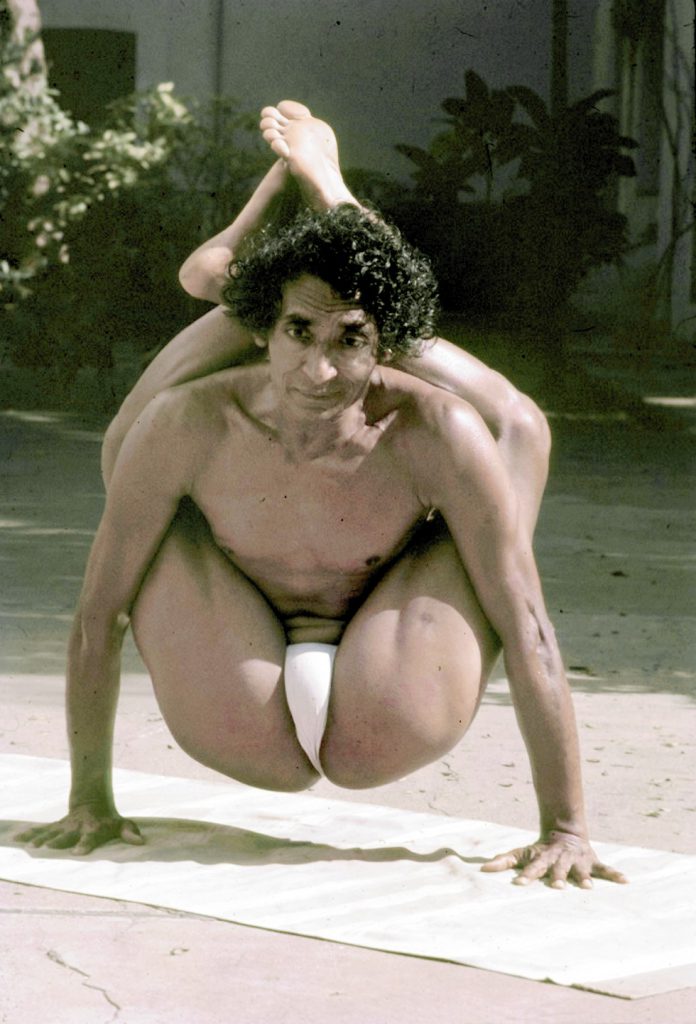
Ambu, the Mother’s Baby
Learning the ABCs
Every month Ambu used to receive a complimentary copy of Mother India, a cultural journal of the Sri Aurobindo Ashram edited by his friend Amal Kiran, and every month Ambu would share with me his opinion of the authors whose articles filled that journal. Flipping rapidly through the pages, Ambu would furrow his forehead and exclaim, “These educated donkeys! Always talking about the Supermind and the transformation of the body. What do they know about them? They don’t even know the ABCs of Yoga!”
Now I knew in a general way what Ambu meant by the ABCs of Yoga — he meant the basics — but what exactly did he mean? One day I mustered courage and said, “Ambu, what are the ABCs of Yoga?” He looked at me scornfully — what a dumb question! — but then, seeing that I was earnest, his face softened. Stepping closer, he held out his left hand and spread his fingers wide. With his right thumb and forefinger he gripped the tip of his little left finger, looked at me and said, “Faith.” Gripping the ring finger he said, “Devotion.” The middle finger, “Aspiration.” The forefinger, “Surrender.” And the thumb, “Sincerity.”
There it was, and that was Ambu. Forget the big stuff. Go back to the basics. Practise them. That is sadhana. And beware of teaching others.
Meeting Ambu
In the spring of 1972, a few months after I had come to the Ashram, Steve Webman introduced me to the resident hathayogi, Ambu. We met in his large, high-ceilinged room on the ground floor of Nanteuil House. Ambu stood at the door, attired in an ochre loincloth wrapped about his waist — and nothing else! Very fleshy he looked, but what lovely skin, a smooth copper brown without lines or wrinkles. Short, but well built, he stood gracefully, hips akimbo, resting his upper body on one leg, as was his wont. His face was good, with a straight nose, large ears, bright eyes and a big toothy smile. Its beauty was marred only by the glasses he wore, thick glasses with minus-24-power lenses that made his eyes look larger than they were.
Ambu and I hit it off right away. He loved to talk and I loved to listen. He could talk all day. Unabashedly frank, he delighted in cutting big shots down to size, but always without malice — he bore no ill-will towards those he castigated! Nava staying in a five-star hotel in Mumbai while soliciting money for Auroville, Dyuman boasting that the Gloria Land cows would soon produce enough milk that it could be delivered through a pipe running from Gloria to the Dining Room. Oh no! Ambu abhorred such pompous living and boastfulness. How could these men be like that? What had they learned in all these years? His heartfelt tirades were touchingly sincere. Transgressions of the dharma hurt his sensibilities. Again and again, he cautioned me to beware of the danger of money, sex, power, name and fame.
Two Lessons
“Never compare yourself with others,” Ambu told me repeatedly. “Each person is different and Mother treats each one in a different way. Never think, ‘Oh, Mother is helping this person so much — why not me?’ Forget how she is treating others! Accept the way she is treating you. She knows best!” Once he gave this example of her inexplicable ways: There was a young man, Dayakar perhaps, who treated material things roughly, but Mother kept supplying him with the best of pens. Some he lost, some he broke, and whenever he broke a pen, Mother would ask Pavitra to fix it. Now Pavitra loved pens, but Mother rarely gave him anything new. Once, when a pen refused to write, he asked her if he could buy a new nib for it, but Mother said, “Oh, can’t you fix this one? Try to make it work.” Ambu concluded: “Who knows why she treated Pavitra like that? Don’t even try to fathom her ways.”
Another thing he stressed was the value of doing your sadhana quietly instead of “broadcasting your ignorance” by publishing stupid articles. Ambu knew all the top Ashram writers of the day, but their learned ponderings left him cold. Actually, he rarely read them — simply a waste of time. Moreover, he saw in those writings the author’s ego, the puffed-up intellect. Now and then I thought about writing something for Mother India, but then I quickly forgot about it, imagining the look on Ambu’s face when he saw my article in print. “Let others write what they want,” he would say; “you do your sadhana.”
Childhood and Youth
Ambu was born Ambalal Devaji Desai on 14 June 1909 in the village of Nadiad, Gujarat. A weak and sickly boy, he regained his health in his teens by joining an Akhara or gymnasium; there he learned traditional bodybuilding exercises, such as dandbaithaks, as well as asanas. Extremely flexible, he excelled in asanas and continued to practise them the rest of his life. When he was seventeen, he left home and travelled to Pondicherry to see his friend Krishnalal. There he met the Mother, who took him in. In his early years the restless young Ambu ran about from dawn to dusk, working for the Mother, and working for others as well. He loved to please people. Early in the morning he would be found plucking flowers off creepers or climbing trees to get them. Some were for the Mother, others were for those who wanted special flowers to paint or to offer to Mother. He also helped out in the Granary and cleaned the Mother’s kitchen vessels. His life was one of hectic service.
Stories of the Old Days
When I met Ambu he had been in the Ashram for forty-four years. What a stock of stories he had about the old days. Though he rarely spoke of Sri Aurobindo, for whom he had the highest reverence, he could not stop talking about the Mother — he simply adored her. Mother on her part called him her “Baby.” We find her addressing him that way in their correspondence of the 1930s. With a mother’s eye she watched over him, guiding, protecting, consoling him. Once in a state of depression, Ambu told her that he was tired of taking care of his body. “It’s not your body,” Mother exclaimed, “it is my body! I am asking you to take care of it for my sake.”
Most of Ambu’s yesteryear tales had as their theme the tragedy of lost opportunity. Mother gave the sadhaks a golden chance to progress, but most of them squandered it due to weakness of character, succumbing to desire and ego. Some fell to the charms of sex (about which Ambu had a number of tantalising tales), others to the desire for comfort, which led them to gain advantages by lying and cheating. Many fell to vanity, wounded pride, inflated self-esteem. Barin left because there was not enough scope for his ego, Dilip left because he lacked faith in the Mother, Anilbaran left out of political ambition, and so on. Over the years any number of people left — though most stayed because they knew that only Mother could help them, so they sought refuge in her compassion and love. Ambu’s tales of her rescue missions were touching, and they revealed his deep love for her.
Mother’s Treatment of Ambu
In 1928, when Ambu arrived in the Ashram, there were less than fifty people and life was intimate. Mother controlled every aspect of the disciples’ lives. They were expected to obey her, but how hard it was at times—the lower nature resisted. Ambu certainly found it hard and often violated her rules. Sometimes he took “outside food” without asking her permission and sometimes he went to the cinemas in town—strictly taboo. Whatever he did, Mother forgave his transgressions. She was lenient towards her Baby because she knew his nature, good at heart but weak in will.
Ambu suffered a lot in the early years. Easy to influence, his friends misled him with wrong suggestions. Highly sensitive, he picked up their discontents and depressions. Attracted to women, he ached when the young lovelies played with him. Eager to please, he got wounded when people misused his regard for them. Thus subjected to psychological assaults, Ambu regularly got confused, depressed, depleted, and often fell ill. His only support, the Mother, picked him up again and again.
Ambu’s Correspondence
When Ambu was in his mid-twenties, he began writing to the Mother and this correspondence continued for several years. Unfortunately he destroyed most of his letters to her, but at least he kept her replies. From them emerges the portrait of a troubled young man, prone to doubt, depression, weakness, illness and more. Mother’s remedy, her repeated advice, was: Be happy. “Happy to hear that my dear Baby is happy,” she once wrote. “Happier shall I be if he becomes still happier.” She also asked him to have faith in her, to believe in her love and care for him, for then she could help him to gain the peace he needed. And finally she asked him to stop running around.
“The doctor says you ought to lead a quieter life,” she wrote, “to take more rest and more food. Will you not try to do so?” Mother urged him to slow down because again and again he exhausted himself. One morning he went “upstairs” for work, as usual. Mother asked him to sit down and tell her in detail what he did during day. Ambu told her that he plucked flowers for this person, fetched food for that one, borrowed library books for a third, and so on. When he finished his narration, Mother took up his activities one by one. For each task she asked, “Who gave you this work? Did I give this work to you?” Each time he replied, “No, Mother. I took up the work on my own.” Then she asked, “And what work have I given you?” “Mother,” he said, “you have asked me to clean the vessels.” “Voila!” she exclaimed. “That is your work and I expect you to do it. As for those other works, you can stop some of them. I don’t want you rushing around and wearing yourself out.”
Ambu’s Breakfast Club
Ambu’s room was a gathering spot for Gujarati’s, and every morning just before eight, from six to a dozen men assembled in his room and sat down in a circle on mats on the floor, quietly bantering, waiting for a cup of tea. A few had breakfast too: bread, banana, tomato, cucumber and achar [pickles]. All were Gujaratis, except Anurakta, a Brit close to Ambu, and Muthulingam, a loveable Tamilian who was the butt of many jokes. There was talk of Indian politics and Ashram affairs, and much fun besides. This was Ambu’s Breakfast Club.
A few weeks after I met him, Ambu invited me to eat with his breakfast group on Sunday morning. I happily accepted, but was trepidant about how I would be received. As we sat together, everyone was cordial, asking me questions about my background to get a better picture of who I was. Ambu set out the food and gave tea to each one, adjusting milk and sugar according to taste. Then, surprise, my test came! Before me was my plate with bread and slices of cucumber and tomato on it. In the centre of the floor, Ambu had set out a dish of green chillies, but I had not taken one. Ashok Patel picked up a sizable chilli, looked at me with a smile and popped the chilli into his mouth, biting its stem off with his front teeth. Then he crushed it, chewed it and swallowed. Though his face flushed up, it didn’t seem to faze him much. “Can you do that?” he asked; “It will really pick you up.”
All the club members looked at me expectantly. I tried to think what to do, but nothing came to mind. I reached out, picked up a middle-sized chilli and held it in front of me, unsure what to do. Would a small bite be enough? A middle-sized bite? Hard to say. Gathering courage, I put the chilli in my mouth, bit off the stem, chomped down on the green fleshy part and started chewing. Fire, fire, fire in the mouth! Body hot too. Perspiration, tears, can’t breathe! Suffocating! I tried to take a breath; my throat went into spasm and I coughed loudly. The guys were dying of laughter, as if they had never seen anything so funny! Albert couldn’t stop laughing. Harikant, not a man given to ostentation, let out a stream of hearty chuckles. Navinchandra, the shy box-maker, smiled sweetly and giggled. And Ashok Patel, leading the way, slapped his palms madly on the floor, absolutely delighted, hugely happy, broken down with laughter. Having regained my breath, I tried to speak, but no words came out. More coughing and choking. Oh, that was funny! Another round of laughs and chuckles. Then some teasing and at last things settled down. “How do you feel?” Ashok asked; “Good, huh?”
Too good really, but in the end it was worth it. I had been a good sport and survived my initiation. For the next twenty years I was a Breakfast Club regular on Sundays, special days and birthdays. After breakfast the club members wandered off, everybody except Harikant and me. Harikant would recline against the bolster on Ambu’s bed while Ambu made him a cup of coffee; after sipping it down, he would say goodbye to Ambu and saunter out the door. I stuck on and took Harikant’s place on Ambu’s bed. His clean-up chores finished, Ambu would amble over and begin his weekly discourse. Over the next hour he drilled into me the basics of the Yoga, replete with stories of men who had lost their way by veering from the straight and narrow path. Like an elder brother, he kept me safe over the years, never speaking from “on high” but rather from his own experience, talking frankly about his own weaknesses. Often as he spoke, I recognised in him the same feelings of inferiority and insecurity I found in myself. Ambu was the anchor man who held me together. In a similar way, I think he kept the Gujarati gang together. On his birthday, a big occasion for which he prepared coffee, all the Gujus came to wish him well—Dyumanbhai, Krishnalal, Tara, Lila and many others.
The Hathayogi
The late afternoon was foreigner’s time. Anurakta, having finished his labours as manager of the Hand Made Paper factory, ensconced himself in a deep canvas chair and plunged into the pile of magazines at his side. “Don’t mind me,” he would tell newcomers; “I’m just part of the furniture.” Most of those who came were Europeans passing through Pondicherry on a tour of India. Ambu greeted them warmly, one and all. As the resident hathayogi, it fell upon him to instruct them in asanas. In this effort the best of the man came out. Kind and gentle, he patiently led his pupils—one or two at a time—through a simple course of asanas. A hands-on instructor, he adjusted their postures and explained how to hold them safely. He also taught them how to stand, lie, breathe and relax. Possessed of a quiet vitality, Ambu himself was a good example of the benefit of asanas. Even in his seventies he remained supple and alert. Photos on the walls showed him elegantly contorted in near-impossible positions. He was a man who had walked his talk.
A Bit of Elegance
A fascinating character, Ambu cut a handsome figure outside the house. When he went out for work in the morning, collyrium lined his eyes and attractive perfumes sometimes wafted from behind his ears. Dressed in a crisp white bush shirt and coloured shorts, he carried four ironed and folded handkerchieves, one for each pocket of his shorts. A large pastel coloured handkerchief adorned his neck, providing a bit of elegance to his attire. He was a favourite of the ladies, who looked after him well.
The Saturday Night Movies
Although he could not see well, Ambu loved the Saturday night movies at the Playground. He would come early and plant himself in front, a little to the left of centre. Anurakta sat to his left and I sat to the left of Anurakta. This ritual went on for many years. In the 1970s and ‘80s the Saturday night cinema was our main form of entertainment for the week. Television came later, not to mention videos, Internet and Youtube. The young school-children would come early to play in front on the sand, happily chasing each other. In their exuberance, they sometimes came too close and kicked sand on our mats. Ambu response was to throw sand back at them, shouting at them to behave. Vintage Ambu. Occasionally tensions escalated as the kids continued to play. Then Captain Mona would come and save the situation by cajoling the children to sit down and contain themselves. This little drama was enacted many times over the years. Such was life in the Ashram then.
The Later Years
Over the years I watched Ambu grow old gracefully. Though he managed to keep up his regulated life, he had less energy. His room started gathering cobwebs, for he spent less time cleaning his substantial collection of oddities acquired over the years. He had more colds and fevers and digestive upsets. How did he deal with them? He cut down on food and took rest. Then Ambu developed cataracts; the operation to remove them succeeded, but recovery took a long time, and even then he complained of seeing a double image. When he poured tea in the morning, part of the fluid landed on the floor. Then he had a hernia operation, but the protracted convalescence sapped his energy. His hands began to shake. He stopped wearing a loincloth and switched to a lungi — easier on and off, I guess, but it restricted his leg movements. All these things he took in stride; though he grumbled now and then, his debilities didn’t seem to affect him much. He suffered quietly and without fuss.
The End
The end came quickly. One morning. I showed up early for breakfast to find Ambu lying on his bed, reclining on his bolster. “I feel a little weak and giddy,” he told me. I sat down to peal the cucumbers and cut the tomatoes. “I will sit with you,” he said, but I told him to lie where he was till the others came. A minute later he got up off the bed and clumsily laid down on the floor on his right side; his body started twitching and he breathed heavily. Alarmed, I went behind him and helped prop him up as he struggled to remove his dentures; when they finally came out, he sighed and said, “Leave me.” I let him down on the floor. He stopped shaking and was quiet. Dazed, I didn’t know what to do. Then Harikant came and called Manoj who lived across the hall. Manoj phoned Dr Datta who showed up with Vishwabandu ten minutes later. They tried to revive Ambu through artificial respiration, but it didn’t work. After a lot of effort Dr Datta looked up and shook his head. Ambu was gone, the victim of a massive stroke.
That day we sat around, somewhat numbed and pensive. Our beloved anchor man was gone; he had left us simply and quietly, without fanfare, as was his way. Hundreds came to the room to see his body as it lay in state. The next morning he was cremated and the morning after that we met for tea and talked about him, but really there wasn’t much talk: one could not help but feel sad. The man who held us together had departed. No one tried to take his place. The Breakfast Club was over.
The Lesson of Life
In April 1933 Sri Aurobindo penned some lines to Ambu. In neat handwriting the Master wrote:
“It is the lesson of life that always in the world everything fails a man — only the Divine does not fail him, if he turns entirely to the Divine. It is not because there is something bad in you that blows fall on you,— blows fall on all human beings because they are full of desire for things that cannot last and they lose them or, even if they get, it brings disappointment and cannot satisfy them. To turn to the Divine is the only truth of life.”
If there is one lesson Ambu wanted me to learn, it is this: turn to the Divine and nowhere else. Do not run after money, power, sex, name and fame. Live for the Divine, live for the Mother, and all else will be given to you.
Remembering Simanta-da
Simanta Narayan Chatterjee, my friend and mentor for more than twenty years, passed away quietly on 3 April 2011 in the Ashram Nursing Home. He was eighty-eight years old. A Bengali gentleman of the old school, Simanta was a high-minded Brahmin, materially poor but rich in culture. He had an inborn nobility, an unassuming dignity, a natural graciousness. When he was young, what mattered to him most was the freedom of the country, in middle age the uplift of the poor, and in the end the finding of his true self and God. I know only the broad outlines of his life, but I have cobbled together a brief sketch of it, along with a few things he told me over the years.
Birth and Upbringing
Simanta was born on 23 December 1922 on his grandfather’s estate near Arrah in Bihar. He grew up in a village in the Nadia district of Bengal. His father, Satyendra Narayan, was a teacher of mathematics at Shantiniketan from 1914 to 1919 and then became an electrical engineer for the Indian Government; often away from home, he worked on construction projects under his British superiors. His wife, Mukulrani, was a homemaker who became deeply devoted to Rabindranath Tagore during the time her husband taught at Shantiniketan. When Simanta was five, his mother sent him to school there and he loved it. During his six-year stay, he imbibed an appreciation of Nature, a love of beauty and a passion for Rabindra Sangeet. Up till the end, he sang Rabindranath’s songs with soul-stirring pathos and exaltation, for they evoked in him the yearning of the soul for the Beloved.
When Simanta was eleven, his mother died. Devastated by her loss, his father fell into a deep depression, lapsed into indifference and became unfit for work. Heeding his sister’s advice, he withdrew young Simanta from Shantiniketan. Learning that the boy was leaving, Tagore exclaimed, “But he is one of my children!” Thus in one year Simanta lost both his mother, whom he adored, and the school he loved. Where he went to school after that, he never told me; his thoughts were always of Shantiniketan. He also had nostalgic memories of his vacations on his grandfather’s estate in a forest area of Bihar.
College and Politics
Simanta was good at studies and went to college in Calcutta, majoring in mathematics. Then, like so many students at the time, he became involved in the struggle for India’s independence and the non-cooperation movement of Mahatma Gandhi. His father gave him the choice between politics and studies. Simanta chose politics, so his father withdrew his financial support. Now on his own, Simanta dropped out of college and immersed himself for years in political activity. Like many in Bengal he became fascinated by Marxism and plunged into left-wing politics. For his anti-British activities he never went to jail, but many of his friends did, some for years, and several of them later rose to top positions in Communist Bengal.
When Simanta learned of the brutal excesses of Stalin, he became disillusioned with Communism. Though he admired its ideal, he saw that it didn’t work in practice. When I knew him, he vehemently denounced the Communists of Bengal as narrow, authoritarian and vulgar; he held them responsible for the decline of Bengali culture. After his disenchantment, Simanta remained on the fringe of the political movement, but never actively involved himself again; rather he moved towards non-violent social reform and worked for years on educational uplift with the Bengal Social Service League.
Books, Eastern and Western
Simanta cared deeply for the country and the poor. He himself lived in poverty for decades, earning a living with piecemeal work as a proof-reader at a couple of Calcutta publishing houses. As a young man he largely read Western literature, especially the English and Russian writers, but in childhood and adolescence he imbibed the Indian tradition. Growing up in a Brahmin village, he got a good grounding in Sanskrit and loved to recite the Vedic verses he knew. Closer to his heart were the austere philosophy of the Upanishads and the many-sided wisdom of the Gita, whose slokas he knew by heart. He also knew dozens of stories from the Mahabharata, Ramayana and Puranas. Later, when his life took a spiritual turn, he studied Patanjali’s Yoga Sutras and the teachings of Ramakrishna and Vivekananda. Thus this man of the mind filled his imagination with the greatness of Indian culture. But a commitment to the life of the spirit had not yet beckoned.
Pondicherry and the Mother
As mentioned, Simanta’s father, distraught by his wife’s demise, fell into a prolonged malaise. Searching for meaning, he started visiting holy places and seeing holy men. Finally he found what he needed in Pondicherry, where he met the Mother, head of the Sri Aurobindo Ashram. Accepting him into the community, she gave him a room and a work and a reason to live. Years later, sick in bed and close to dying, he called his son Simanta to come down from Calcutta to see him. Simanta came, visited with his father for a few days and then said he was returning to Bengal. Indifferent to the Ashram, he had not even bothered to meet the Mother. “Won’t you at least see her?” his father asked. “Just go and stand beneath her balcony when she comes out tomorrow at sunrise to see the disciples.” For his father’s sake, Simanta agreed. The next day, when she appeared on the first-floor balcony, the Mother gazed on the faces of the sadhaks gathered below. When her eyes fell on Simanta, he felt that she was looking at him alone. Soon her gaze turned elsewhere, but she had captured his heart for ever.
Simanta returned to Bengal and took up his life there, but he could not forget the Mother. He began reading her works and those of Sri Aurobindo. The Life Divine was a revelation to him, for in it he found the answers to philosophical questions that had haunted him for years. In this book Sri Aurobindo sets forth an exalted conception of human existence, including the possibility of a divine life on earth. Simanta soaked his mind in this new vision of life. And four times a year he took the long train-ride south to Pondicherry to see the Mother and have her darshan. Sometimes he was also able to see her in her room. When he went to her, she laughed away his troubles and poured her love into him. He began to live for her and thought of her constantly. Back in Calcutta, Simanta wrote regularly to those he knew in the Ashram. His main contact was Nolini Kanta Gupta, whom he respected above all other sadhaks. He also wrote to Janina Stotra, the Polish disciple, who liked this earnest young man. She explained to him how to practise the Yoga in daily life.
So might Simanta have continued to live, his body in Calcutta, his mind and heart in Pondicherry, but one day he received a letter from Nolini-da asking him to come to the Ashram to help him. Nolini-da had translated Savitri into Bengali and needed someone to review his work and see it through the press. Simanta came down to Pondicherry and threw himself into the task. When it ended a few months later, he told Nolini-da that he wished to stay on. Nolini-da gave his consent, but advised him not to join the Ashram because he would feel stifled by the Ashram discipline. Thus for the rest of his life he lived in Pondicherry, in a flat on the second floor of ‘As You Like’, an apartment building about a kilometer from the Ashram. There he spent his time writing articles for Bengali journals, setting down his memories of Shantiniketan, maintaining a diary of his sadhana, teaching Rabindra Sangeet and taking an evening class on Sri Aurobindo’s letters. Early every morning he cleaned his room and walked to the Ashram for an hour of concentration in the Meditation Hall — the best hour of the day he called it. Once or twice a year he took the train to Calcutta to visit old friends and sometimes he visited a niece in New Delhi.
My Studies with Simanta-da
I have no memory of when Simanta and I first met — it was probably in the middle or late 1980s. In time he became a mentor to me. Every Thursday morning we met together in his room for a long talk. I would show up about 9.30 to find him preparing tea for me. Simanta was proud of his tea. He always had a stock of superb Darjeeling tea leaves procured in Calcutta. What a brew! Two cups of boiling water poured into a warmed teapot, two heaping spoonfuls of tea and another half-spoon to top it up. Cover the teapot with a cozy and let the tea steep for fifteen minutes — not four or five minutes but fifteen! Simanta made a kind of Darjeeling truck-driver’s tea and what a fine taste it had! One big mug set me sailing for the morning. Fortified by this Himalayan elixir and transported by Simanta’s hypnotic talk, I flew with him high into the skies of the Spirit. Week after week, companion souls, we managed to rise into a sublimer air. Sharing the same interests, we resonated together. “The most important thing,” he told me over and over, “is to find the Divine. All other things are peripheral. We must take the plunge within and find God. That is the only journey worth taking.”
Simanta had the heart of a bhakta, but being a man of the intellect, he naturally inclined towards the Yoga of Knowledge. He had a way of making the Self seem real and accessible. “There is one Self,” he declared, “and we are part of it. Our true self, which is not the ego, is one in essence with the Self above. Become aware of the Self and you are free.” How to do it? “Calm the mind and concentrate it on the Self,” he advised. “Then the Self will reflect itself in your mind and purify it. In time you will become fit to go beyond the mind and dwell in the consciousness of the Self.” Simanta himself practised this process and it gave power to his words.
My own predilection was towards the Mother. Live for her, remember her, put yourself in her hands. “Isn’t surrender to the Mother the true secret of the Yoga?”, I sometimes asked, just to tease him. “Well, yes it is,” he would answer without hesitation, and in fact he liked it when I reminded him. He himself had come to the Yoga through the Mother, and while she was alive he felt her love filling him with love for her. After her passing, however, he could not feel this love as strongly. Faced with an arid inner condition, he felt that his love for the Mother was no longer enough to sustain his sadhana. Then he turned to Vedanta for support. “The way of Bhakti does not last,” he would tell me. “One day the heart is full of love, the next day it is dry; the mind is more reliable.” But of course, sometimes (especially on his birthday and darshan days) the Mother would pour down her light and love into him. Then when we met, he would relate his experience with the delight of a child.
How did we fill our Thursday morning hours? Usually, after desultory conversation, we took up the study of some book. Most often it was the Gita. Simanta revered its slokas, loved to recite them and revolve them in his mind; I found his English translations of these slokas admirably clear and fluent. Next in regularity came the Gospel of Sri Ramakrishna. From the original Bengali, Simanta would translate the text to me and soon we seemed to be in Ramakrishna’s presence, sitting in the room where he had charmed his listeners, imparting his wisdom and showering his love. Then came the Yoga Sutras of Patanjali. Simanta had an elaborate commentary on the Sutras by a Bengali savant, but it was way over my head. The sense of the Sutras really came to life for me when we began to study Antaryoga, a little Bengali book on Raja Yoga by the Bengali yogi and savant Anirvan, whom Simanta knew personally. All these books and more we studied over the years.
Our base line, of course, was Sri Aurobindo and the Mother. Simanta loved the Master’s letters and read them out to me with deep understanding; his very reading seemed to reveal their import. From time to time we dipped into other great works, such as TheSynthesis of Yoga, The Life Divine and Savitri. Of the Mother’s works he liked the Questions and Answers series of talks in the 1950s. “Listen to this,” he would say, excited as a child; “Mother really catches the thing here,” and then he would read out a passage from one of her talks.
Politics
As a young man, Simanta threw himself passionately into the freedom movement to end British rule in India. For many years he did little else, living a chaotic life, arguing the issues, eating whatever came, sleeping on the floor. Then when Stalin’s atrocities were revealed, Simanta became disenchanted with Marxist practice. He left active politics and turned instead to social reform and the uplift of the poor. In the end the divine hand grabbed him and placed him in Pondicherry. But even here the political man was not yet dead. In the early years and for long after, he could not remain silent when it came to politics. Mention of the Communist Party in Bengal immediately aroused his ire and led to a spirited denunciation of the party’s misled policies and vile tactics. The only alternative at the time was the Congress Party. Simanta credited the Congress with holding the country together, but he could not accept its outlook; its secular socialist policy could never satisfy his spiritual idealism and the hope of a return to India’s spiritual greatness.
Then, towards the end of his life, Simanta grew detached from politics; his assessment of the unfolding national drama became unemotional. From a ranter he became a commentator. In the final few years, he rarely spoke about the burning issues of the day; if I wanted his opinion on a hot topic, I had to ask for it. He is one of the few persons I have known who managed to extricate himself from the thrall of politics.
The Final Years
With the passing of years Simanta grew weary. His energy flagged, his eyesight grew worse, he suffered from frequent fevers. Inwardly too he dropped down; he developed a habit of grumbling, began to have self-doubts and felt that he wasn’t doing enough. He decided to do prolonged meditation and arranged to live in a little house in a village in north Bengal; for six months he tried to meditate all day, but it didn’t work. Time weighed heavy on his head. He returned to Pondicherry.
I told Simanta not to judge himself so harshly. We know so little, really, next to nothing; it is hard to assess our progress, we should simply leave it in the Mother’s hands. He accepted this mentally, but deep down I think he felt that he had failed to make the most of his life. But this is true for all of us; when one looks back, it doesn’t look so good. But back then, one didn’t know what one knows now.
In time Simanta’s health and strength declined, and he suffered a few bad falls. He was given a room in Care, one of our homes for seniors. I would visit him every week, as before, and he looked forward to it. Sometimes we would rise beyond the ordinary outlook, buoyed up by the perception we shared of a higher way of life. Then the boy in him came forward, the dreamer of a better world. One day I went to see him and found he had been taken to the Nursing Home. It turned out to be his final visit. Simanta was still aware, but he was retreating. His once penetrating eyes had a far-off look; yet sometimes, yes, there was recognition and a look of love in them.
One evening Simanta went to sleep and never woke up. The next day his worn-out body was cremated in a quiet ceremony of simple dignity. Early the next morning as the sun came up at the Tennis Ground, I pitched a little bag of his ashes into the sea. For him the going was good, I think, and for us too a new day had dawned.
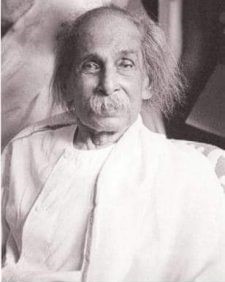
Nolini-da’s Style
Background Music
For about ten years, from 1974 till 1983, I was a member of Nolini-da’s French class, held at nine o’clock on Sunday morning at the Hall of Harmony. I used to call it Nolini-da class because I went there more to study Nolini-da than to learn French. One week he would lead us in translating Savitri into French, the next week he would read out his latest essay in English. So it went, week after week, year after year.
One Sunday I arrived fifteen minutes early for class and took a seat on the floor towards the back. A dozen people were already there, then more came in. About ten minutes to nine, the quiet air suddenly erupted with sound. Loudspeakers from the Foyer du Soldat—the French veterans’ club next door—started blaring out a medley of raucous, high-pitched Tamil film songs. It was quite deafening. Somewhat in shock, we looked at one another with bewildered faces. Nolini-da was due to arrive soon and this music would not do. But no one took courage and got up to go to next door to ask the veterans to lower the volume. Like sheep we waited meekly for our shepherd, wondering what he would do.
Promptly at nine, the grand old man shuffled up the steps to the Hall of Harmony with a sweet little smile on his face, surrounded by a solid wall of sound. Unfazed, he stepped onto the diaz, sat down cross-legged before a little podium and quietly arranged his papers. Then he took his reading glasses out of their case and put them on. At last he looked up and smiled. Breathlessly we waited as his eyes wandered here and there, drinking in the scene. At last his lips parted and he said, “Ah, background music!” We all broke out laughing.
Then Nolini-da proceeded as usual to read out his latest essay slowly and steadily in an even voice moderate in volume. I was unable to hear him at first, but by focussing on his face I was able to create a kind of tunnel of concentration, allowing me to catch his words by closing out the invading sound. For forty minutes Nolini-da read to us, for forty minutes I listened intently and caught most of his words, and that was that. The master had done it his way, barely, but he had done it.
Inconsistencies
In the late 1970s I was editing the Mother’s most famous conversations — her talks of 1929 —for inclusion in Volume 3 of her Collected Works. Nolini-da had already transferred to the Archives his massive collection of manuscripts of Sri Aurobindo and the Mother. Among them was his handwritten copy of the fifteen 1929 conversations, worked up from the notes of an American disciple. Nolini-da’s reports had been meticulously revised by Sri Aurobindo, line by line, with hundreds of alterations large and small, improving the sense and style of the talks; he even added a few new sentences. In editing the talks, I closely followed the revised manuscript and sent the text to the Press for publication.
The final proofreaders for the new volume were Sutapa and Amal, both superb at the work, and both felt strongly that the inconsistencies of capitalisation in the text should be made consistent. Nolini-da had been quite casual in the matter of capitalisation, so there were many inconsistencies, especially in the capitalisation of compound words. Take, for example, the compound “Divine Will”. In any given place, Nolini-da might write “Divine Will”, “Divine will”, “divine Will” or “divine will”! There were dozens of these inconsistencies, but Sri Aurobindo had rarely revised them. Sutapa and Amal wanted it done. I had already considered this question, but I was reluctant to introduce dozens of little editorial changes by adopting a rigid capitalisation policy for these compounds, especially since Sri Aurobindo had so carefully revised the text.
Sutapa and Amal were adamant that the changes should be made, so one morning my boss Jayantilal marched me to the Ashram to settle the matter with Nolini-da. We found him in the front room of his quarters, comfortably ensconced in a chair with his feet up, buried in the Rig-Veda or some big Sanskrit text. As he peered at the book, probing its mysteries, Jayantilal and I stood by docilely, unwilling to disturb his concentration. After two or three minutes Nolini-da raised his head and looked at us. By then — such is the power of his room — I was tranquillised, drenched in the tangible Presence there. Whatever happened was okay with me—or so I thought.
Jayantilal and I explained the problem to Nolini-da, showing him examples from the manuscript, then asked him what to do. Nolini-da sat back at ease and gazed straight ahead. Ten seconds, twenty seconds, thirty seconds, forty—the pressure built up. Unable to bear it any longer, I blurted out, “Nolini-da, how can we make so many changes? Sri Aurobindo himself has seen this text and revised it meticulously!” Nolini-da absorbed my outburst and returned to his musing. More silence, more pressure, but we waited. At last he looked up with a smile on his face and a twinkle in his eye. “Let us leave the text as it is!” he declared. “The readers will not understand — their minds will be baffled!” We all broke out laughing, delighted by this decisive and spirited reply. Jayantilal and I took our leave, completely satisfied.
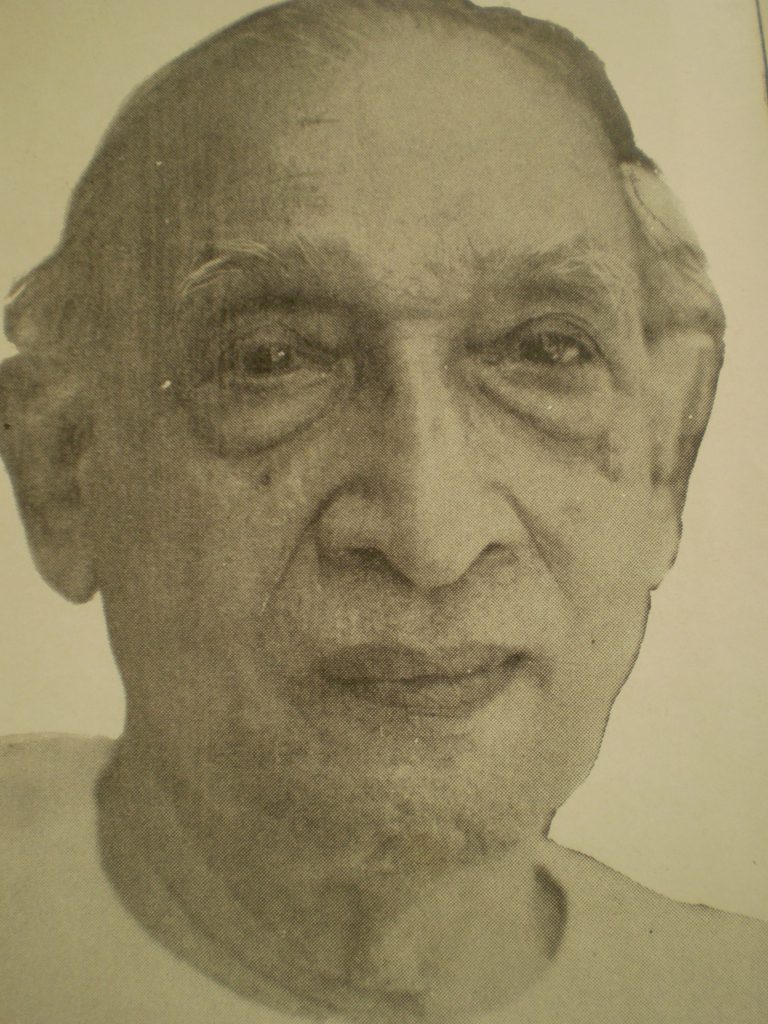
Pujalal’s New Way of Life
For many years I visited Pujalal every few months just to say hello and to bask in the benign atmosphere around him. A couple of times he gave me good advice. Once I was thinking of taking a trip to America—my mother was pressing me to go. “You haven’t been home in ten years,” she said. “Can’t you come for just a few weeks? Your family would love to see you again.” Troubled in heart, I went to him for advice. “How is your sadhana going?” he asked me. “Fine!” I said. “It’s fine. I’m quite happy.” “Well, if things are going smoothly,” he said, “maybe you should stay here. When things are going well, why disturb them?” It was exactly what I wanted to hear, so I stayed!
Four years later, I was bothered again by the same question—my mother wouldn’t give up—and this time I was deeply disturbed, with recurrent distressing dreams at night. I went to him for help again and he immediately said, “Yes, go. Make your mother happy.” And he added, “Be sure to buy a round-trip ticket.”
Another time, when I went to him on my birthday, he handed me a Bonne Fête card on which he had written, “Once given, given for ever.” I cherish those words.
Towards the end of his life, Pujalal suffered unremitting pain for many months—severe sciatica, intense pain radiating constantly through the nerves of his hips and legs. To relieve the pressure, the doctor put him in traction; his legs were often hung up on a pulley at the end of his bed. Now and then I would peep through the door of his room, wondering whether to drop in. I wanted to see him, but I didn’t want to draw on his energy—I figured he needed it to bear the pain.
One day when the urge to see him came up again, I peered into his room. Pujalal seemed to be sleeping and no one else was there. I went in quietly, sat on a chair and just watched him for a while. He looked smaller than before, flushed and tender; I sensed he had suffered much. Then he stirred, slowly turned his head towards me and greeted me with a big smile. “Bob,” he said in a weak but cheerful voice, “where have you been? It’s been a longtime.” What welcome words! There was a moment of silence. Then pointing to his legs suspended in the air, he grinned and said, “Look, I am learning a new way of life.”
“My God,” I thought, “he has been suffering terrible pain for months and now he is joking about it.” We lapsed into silence for a while and then I said goodbye.
That was my last meeting with Pujalal. His parting gift will always remain with me. He showed me how to face the pain and suffering of life: smile and, if you can, laugh about it. When my time comes, I will try. It is the least I can do for him.
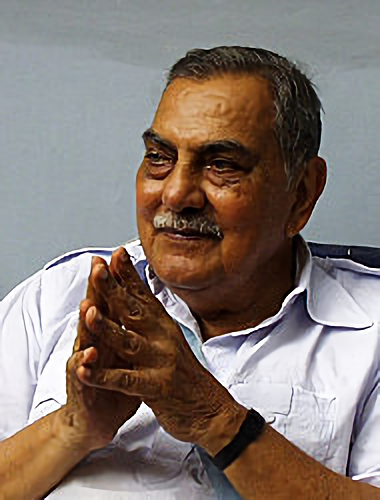
Pranab Kumar Bhattacharya
Dreaming of Dada
My relationship with Pranab-da was always cordial but reserved. I felt a natural attraction towards him, yet I hesitated to approach him and sit in his company. Somehow I never felt quite comfortable, except towards the end. Maybe that is why two dreams of him mean so much to me; they point to a relationship deeper than the one possible in physical life. Now that he has gone to rest, I am setting these dreams down, based on notes I made at the time.
First Dream, 16 October 1996
I woke up at three in the morning after a long, vivid dream of Dada. I was sitting across from a friend at a small table in an airport cafeteria. Anxious passengers in transit scurried up and down the middle aisle with footsteps full of tension and excitement. I felt uneasy.
Suddenly Dada came over to our table and sat down in the chair to my left. His features were not the same as in physical life. He had lost a lot of weight and his skin hung in folds on his face and arms; but the skin was beautiful, a soft velvety golden brown, and fitted him like a comfortable old coat. Far from being frail from loss of flesh, he radiated strength and vitality. His eyes sparkled with good cheer.
As soon as he sat down, Dada started talking to me non-stop. It was all small talk, light banter in a steady stream, nothing important, but immediately my spirits revived. It was clear to me that he had come over to the table precisely to cheer me up. I was moved that he would do this, but what moved me more was that as he spoke he kept reaching out to touch my hand, which was resting on the table, patting it affectionately with little strokes. His fingers were extremely warm, and his strokes infused me with strength. Sitting there, I watched all this unfold with amazement.
Then I woke up with a strong sense of warmth and well-being. I had received a strong dose of Dada’s kindness and affection and I shall always treasure it.
Second Dream, 29 December 2002
I woke up at 2.25 in the morning, having just dreamt of Dada. The dream was not as profound or moving as my first dream, but it seemed to confirm it.
Dada was seated on a folding metal chair, dressed in shorts and a T-shirt. One leg hung over the other and his right hand gripped his left upper arm. Taller than in real life, Dada looked about seventy. His muscles had a fine tone and he was in very good shape for his age. The most striking thing was how lean and trim he was, without an extra ounce of fat on his body.
I sat on a chair several feet away and looked at him with appreciation. We were relaxed, he was smiling, so I said to him jokingly, “My God, Dada, you’re almost as thin as I am!” Dada laughed good-naturedly and was not at all offended that I had taken the liberty of teasing him. Then I woke up, happy that I could be so familiar with him.
Final Thoughts
I may add that whenever I did approach Dada, he treated me graciously. Several times I asked his advice on exercise and diet; he replied with simple, clear, helpful suggestions. One year I suffered from patches of prickly-heat on my body and I asked him what to do. He told me to shower regularly and then apply an eau de cologne called ‘Friction’. I tried it and it worked. Another time I was exercising in the bodybuilding gym at the Playground. Dada sat on the long bench at the end of the narrow gym courtyard watching me. When I came close, he noticed that I had skinned my knee badly, so he called me over to sit by him. Leaning over to see the knee, he asked me how I had skinned it and put his hand just above the knee. A healing warmth radiated from his palm and I felt the wave of empathy that had arisen spontaneously in him.
I think he became kinder as he grew older. Then for me he became Dada.
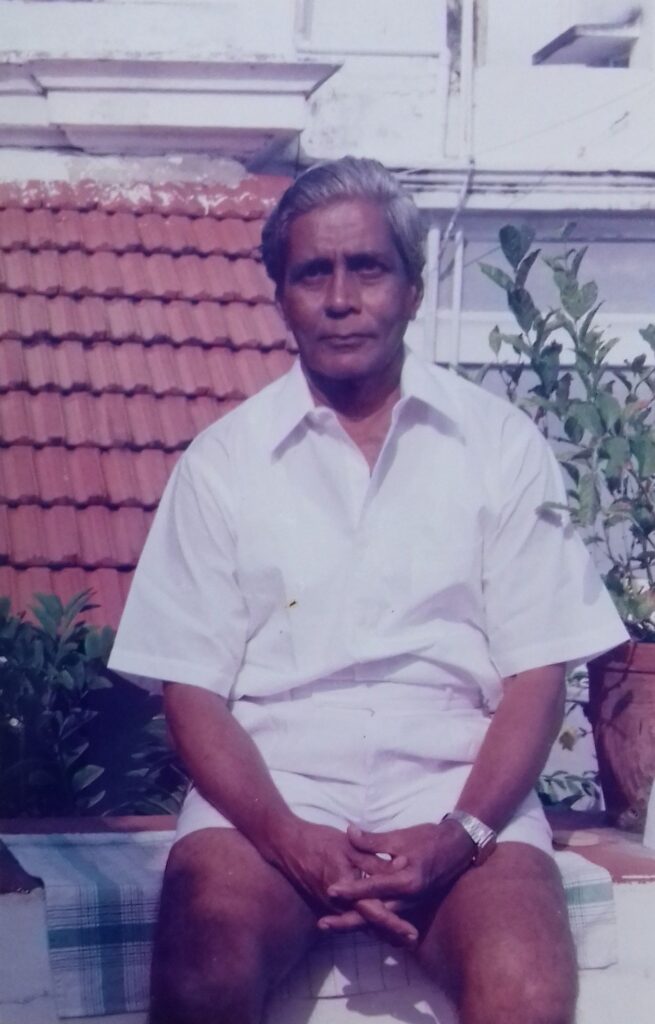
Captain Mona
When I arrived at the Ashram in 1971, more than fifty years ago, young Mona Sarkar was a striking figure with a handsome face, spirited eyes and a beguiling smile. Like a military man he always stood erect. With his broad chest, thick limbs and bulging biceps, he commanded respect. Mona had the charisma of a natural leader. He was one of the Mother’s go-to persons and she counted on him. Over the years he organised many events for her and kept them on track. When the Ashram was attacked in 1965, he was there on the front line and once led a charge down the street to chase off a bunch of ruffians. In 1968 he directed the young Ashram volunteers who managed the inaugural ceremony of Auroville. And year after year he orchestrated the 2nd December programme, our annual demonstration of physical culture.
Mona carried something special and people looked up to him, yet for all the praise that came his way he managed to keep his ego in check. Not all full of himself, he connected with people. He liked them and they liked him. He cared about others and they could feel it. At heart he was a fun-loving boy. Mona loved to tease people, but they always took it well because he meant it well. Teasing was his way of being playful. Yet behind the play there was something serious—a certain earnestness. Whatever he believed, he believed wholeheartedly, and then he stood for it. This earnestness and playfulness were salient features of his personality.
Mona lived only a block away from me, so I saw him often, but I really became close to him only on a sunny morning in the autumn of 1972. The local farm workers had gone on strike at harvest time and the call went out to help bring in the crops. A hundred students and sadhaks hopped into buses and headed to one of our farms to harvest the paddy. Mona was in charge of the operation, keeping an eye on things in his good-natured way. Midway through the morning, he called me over. “Why don’t you play basketball with the boys?” he asked. “Being tall, you’re a natural for the game. Why not give it a try?” Somehow he persuaded me—he had that knack—and it changed my life. I had been exercising on my own, but now I started playing basketball with F Groupers on Mondays and, at tournament time, with D Groupers and captains too. Soon I had a whole new set of friends, bonded together by love for the game. No longer doing just a personal sadhana, I became more active in Ashram life, participating in the social side of the community. It was Mona who nudged me there and I shall always be grateful to him.
In 1986 at the age of forty, I moved from F Group to H Group, made up of older guys—“forty and out” as we used to say. Mona was my new captain. On our compulsory day, Monday, at 7.15 in the evening, we gathered together on the hallowed sands of the Playground where Mona put us through the paces, barking out commands, resolutely trying to shape up our ragtag band of fuddy-duddies into marchers! He never succeeded, but he tried till the end, and I admire him for that. Sometimes, too, he told us stories—tales of Indian freedom-fighters like his father, tales of great Olympic athletes, and tales of the Mother. Mona was a good story-teller, and through his stories he shared with us his hopes and dreams and loves. The Indologist Ananda Coomaraswamy once said that in India education has always been a matter of hero-worship. If that is so, Mona was a good educator because he managed to bring his heroes to life. At darshan time he would give a talk in the evening in the school courtyard—not so much a talk as a reading. Specs perched on his nose, huddled over a table, he would read out to us something the Mother had told him, and as he spoke his voice resonated with her presence; it was as if she was speaking to us. He had that capacity because his life centred around her. After her passing, he was one of those to whom we turned; he carried her vibration of light and love.
Over the years, Mona and I became closer. He invited me to his house and told me stories about his time with the Mother. He plied me with sweets and drinks. And he included me in his birthday parties—gala affairs, with his cronies beside him and a few ladies to brighten things up. The culinary fare was sumptuous and one had to eat it all. Moderation was not an option; forget about exercise and supper. But what fun! When Mona and his buddies got together, it was party time!
And then there was work. Mona knew that I was an editor at the Archives, so he called me to help him in polishing some of the stuff he wrote. I had little to do with the first books he put out, but in 1994 he asked me to work with him on a book that he and Chanda had put together—Sri Aurobindo and the Freedom of India. For many months we worked on that book and it strengthened our bond.
One could never forget Mona. He always seemed to be around, his pockets full of toffees for the children, including older ones like me. At any odd time one might hear his laughter, his banter, his chiding. On Saturday night he would show up at the Playground at 7.30 and vainly try to settle down an excited bunch of kids who kept popping up to run around and play. He also showed his face on occasion at the body-building gymnasium; seated on the parapet ledge, he would do stomach crunches, toning up his impressive abs. But above all, we saw him in November when we practised every day at the Playground and Sportsground for the 2nd December programme.
For sixty years, Mona was in charge of this annual physical demonstration. This programme was, and is, the premiere collective event of our year—a group offering of strength, skill, beauty and joy. Hundreds of Ashram members and school children get together every day in November to practise their drills and skills. It was Mona more than anyone, with his commanding presence and sense of responsibility, who held us together and got us to give our best. Under his watchful eye, we wanted to do well. We knew that he stood for the Mother and her aspiration for excellence. After the demonstration, we would gather around him on the main ground, eager to hear his verdict. How had we done? Year after year, in a simple, honest way, he told uswe had done well. He made us feel proud.
In later years Mona slowed down and mellowed. With a benevolent air of concern, he carried on peacefully and faithfully attended his duties. Our elder brother, he was always there for us. For two or three years he supervised the birthday meditation every day in Sri Aurobindo’s room. It was good to see him on that day, for one sat in the presence of a kind and gracious man, his soul silently radiating there deeming presence that dwelled in him. At the end he gathered himself up quietly and departed. He had done what he could; it was time to rest in the Mother’s arms. But for us he still seems to linger in the atmosphere, for it is hard to forget a man like Mona.
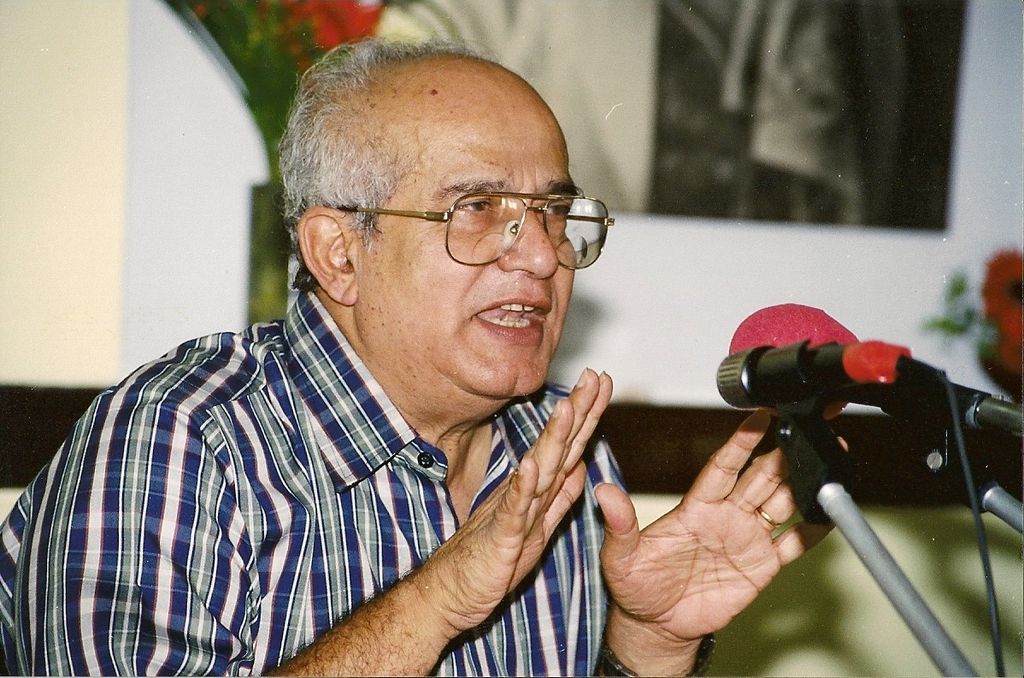
Dr. Nadkarni
The Good Dr. Nad
Contemplation
At seven in the morning I often saw Dr. Nadkarni sitting on the long concrete bench at the entrance of the Samadhi courtyard. He looked a bit like Rodin’s Thinker. His left hand supported his right elbow and upraised arm; his right thumb and middle finger rested on his chin while his index finger played on his lips. Lifting that finger, he would catch my attention and say, “Bob, I want to pick your brain.” Then he would tell me his latest thoughts. Enthused by an idea, puzzled by a problem, he wanted my opinion. I would offer my comments and sometimes, just for fun, poke a hole in his argument. Whatever I said, he took well because he was strong. He enjoyed using his mind to figure things out and tried to keep it high-poised. He wanted to catch the larger picture and learn the secret behind things.
Dr. Nad treated me with respect. I was his young friend and fellow seeker. He valued my inputs. In his last few years, due to my respect for him, I spent quite a bit of time trimming up his talks for publication. He would hand me a double-spaced typed copy of a talk and I would go home and pencil in suggestions for change; then he would go through my suggestions and accept most of them. He treated me like a partner in his efforts; he knew how to share.
Depression
One morning, about a year before he passed away, Dr. Nad surprised me with a confession. “Bob,” he said, “I have been feeling depressed lately, for the last couple of months in fact.” Having travelled widely, giving talks in India and abroad, he felt tired and depleted. “I am spread too thin,” he told me. “I am telling people to try to find their psychic being and I haven’t even found my own. I want to stop lecturing, stay in one place and just sit down. What do you think?”
I advised him to follow the middle path. “Cut down on lecturing,” I said, “but don’t give it up entirely. You like to talk and people like to hear you. But do only what you feel like doing; keep more time for yourself.” He did something like that and found the joy of life again.
Contentment
During his last few months, he confided to me more than once, “You know, I don’t feel like doing anything anymore. I can just sit in my chair and be happy. But the work is piling up.”
“It’s okay,” I said. “Let it pile up. You are blessed, I think. Nowadays you are not just contemplating ideas, but feeling their essence.” The good Doctor was mellowing, content to be quietly happy, no longer so dismayed by the stupidity of life and the slow pace of change.
The Greater Journey
In the final month of his life, Dr. Nad told me two or three times, “I am getting a pain in my heart; I am always tired, but I don’t know what to do.” A week before he left us, he said, “My heart is still troubling me. I think I’ll get it checked up in Delhi; I have a conference there.” Dr. Nad never made it to that conference; he died quietly at home. He had fulfilled his duties and set his affairs in order. He had lived for Sri Aurobindo and the Mother, found refuge in them, and served them as well as he could. He was ready for the greater journey. If there is any sorrow at his passing, it is on our side, for how often do we meet a man so thoughtful and perceptive, so kind and good, so straightforward and humble, so exceptional and yet a friend.
Amalesh-da
One morning in May 1996, I went to the Ashram Tennis Ground to watch the sun come up. There I met Amalesh Bhattacharya, a Bengal devotee who had been staying in the Ashram for several months. “How are you, Amalesh-da?” I asked.
“Bob,” he said, “today I am feeling a bit sad. I have to go back to Calcutta—I leave in the afternoon. I have been so happy here. I have been able to feel the Mother so deeply.”
“Yes, Mother is so strong here,” I said to comfort him. “It must be hard to feel her in Calcutta.”
Suddenly Amalesh-da bristled and his face flushed—I had offended him! In a voice filled with emotion, he said: “Listen to me, Bob. Mother is everywhere. Mother is in Love. When you are in Love, you are in Mother. Love for the Mother is always in my heart. I do not feel alienated from the Mother even in Calcutta.”
The Lifestyle of Shujaat Khan
(The text below is a written version of my remarks on Shujaat Khan, made at a Saturday afternoon programme at the Hall of Harmony on 24 February 1990. The eminent sitar player had played recently at the Ashram Theatre.)
My dear friends, instead of talking about the musicians we have heard recently, I wish to share with you the thoughts of one of them, Shujaat Khan. We spoke together for half an hour at the Seaside Guest House.
Discothèques
Shujaat looked like a typical classical musician — long hair, embroidered kurta, dreamy eyes. He was thirty years old. He surprised me by saying that when he was younger he used to frequent discotheques in his hometown, Delhi — not once or twice but regularly for about three years. His family was not pleased. The son of the illustrious Vilayat Khan was going to dance halls to enjoy Western and Indie pop music!
“Why did you go?” I asked him.
“I wanted the experience,” he said simply. “When I went to the discotheques I enjoyed it, I really enjoyed it. Then after three years I got tired of it; it no longer suited me, so I stopped going. But while I went, I enjoyed it, so I have no regrets.”
“It must have taken a certain courage and independence to do that,” I said.
“Bob,” he replied, “you have to do what you want, what you think is right for you. If you only do what your family wants or your friends want or your teachers want, they will wind up putting you in a box. Then you are not free. Besides, you never get to know who you really are. You may be successful, you may fit in well, but you can never be sure who you are.”
Ambition
“Do you need a lot of ambition to be a top artist?” I asked.
“My ambition is to improve my music,” he said, “not to be number one. Some of my friends tell me, ‘Shujaat, why don’t you have a little more drive? You have a chance of being the top sitar player in India, but you don’t seem to care.’ ‘Look,’ I tell them, ‘at the age of thirty I am already one of the top five sitarists in India. It is good enough for me. Isn’t it good enough for you?’” Then he explained to me what it means to try to be number one. “If you have a driving ambition to reach the top,” he explained, “you have to play a lot, whenever you can, and keep people happy. But it doesn’t suit me; I don’t have that kind of drive. I am fairly happy and content, I have enough money and I have a family. As to whether I become number one, I don’t bother about it.”
Family
I asked Shujaat about his family.
“I am not just a performing artist,” he said, “I am a family man. I have a wife and two children, and they are an important part of my 1ife. When we married, my wife didn’t really know who I was. Still, she accepted me and adjusted. She knows my weaknesses, the ones that don’t show on the outside. She helps me very much. When I am feeling depressed, she is the one who understands and can pick me up.
“I still have to travel, but I spend as much time as I can at home. I used to go on tour three or four months at a time. Now I go out for one month, three times a year. During the other nine months I play concerts close to my home in New Delhi. I perform only ten or twelve times a month. I have learned to say No to requests to perform. My time with my family means a lot to me. I love my wife and children. I was there when my children were born, I was there when they took their first steps and cut their first teeth. I play with them all the time. My wife and I take them on holidays. My family is very important to me.”
Final Thoughts
Shujaat Khan, it seems to me, is not just a fine musician but a fine man, with an active inner life and a clear idea of himself. Instead of leading a hectic life trying to reach the top, he keeps time for himself and his family. He has a quiet, reflective side. I like to think that this quiet way of life will help him to cultivate the deep emotions that move us when we listen to a classical music artist.
Swami Chidananda: Man of Peace
Dissatisfied with life in America I set out for India in 1971. Twenty-five-years old, I was searching for a meaningful way to live. After seven months travelling overland, I reached India. A week later in New Delhi, I took the train north to Rishikesh with a vague idea of doing Yoga. On a bright morning towards the end of July, I entered the office of the Sivananda Ashram and asked if I could stay there. I was told that I needed the permission of Swami Chidananda, who was down in the Dispensary by the Ganges. I went down the staircase beside Lakshman Jhoola Road and reached the Dispensary. Inside it the light was dim, but when my eyes adjusted I saw a tall, thin man clad in muted ochre robes, staff in hand, tending to the sick in a quiet, dignified way.
Half-a-dozen people were waiting for the Swami besides me. This group swelled to more than a dozen in the next ten minutes. When he came out at last, a man stepped forward and bent down to touch his feet. Swamiji, as he was called, quickly stepped back, smiled and grasped the hands of the man as he got up. Others too were eager for his attention. Patiently he satisfied them with a smile, a touch, a few simple words. Two or three young swamis approached him and asked for his advice or his approval on practical matters. I watched this intense little drama closely. Throughout the flurry of activity, Swamiji remained calm, composed and unflustered. A cocoon of peace surrounded him. I was impressed. Hesitantly I stepped forward and asked if I could stay in his Ashram. He smiled and said, “Come to the office with me.”
Leaning on his staff, Swamiji slowly headed for the staircase, with me to his left and others behind. As we approached the steps, I noticed a fly perched on the second step, right where Swamiji’s foot would land. He too saw the fly. Stopping at the staircase, he leaned down, extended his hand and placed his index finger beside the fly. The fly walked onto his fingernail! Slowly he lifted his hand and gently placed it on the wood railing to his right. The fly walked off his fingernail and stayed there! Swamiji withdrew his hand and we continued up the staircase. All this happened so naturally that I doubt whether anyone behind us noticed it. I watched this casual event unfold with amazement. “My God,” I thought, “this guy really has the peace.”
We went to the office and Swamiji sanctioned my stay. I got a spot on the floor of a small, clean room, with five others. Though I remained only a week, it was a momentous time for me. During that week I came to understand that Yoga, the search for God, is a full-time, lifetime quest, and I committed myself to it. Every morning I got up early to meditate, and around nine I headed to the old Meditation Hall for satsang with Swamiji. There sat twenty or twenty-five us, depending on the day, mostly newcomers and visitors. After seating himself, Swamiji would settle us down by chanting the Hare Krishna Mahamantra a few times in a sweet, soulful voice. More than once as he began to chant, I felt a shiver run down my spine, dispelling all my tension and worry. Suddenly it was enough just to be there, basking in the presence of this man of God. Then Swamiji interacted with the group, asking about this one’s health and that one’s length of stay — nothing deep, but he was very considerate and kind.
After a week I decided to shift next door to Yog Niketan, a small Raja Yoga Ashram where I could quietly practice meditation. I found Sivananda Ashram too social — too much tea and talk! When I told Swamiji, he smiled cheerfully and wished me well. He also gave me a copy of his book Fourteen Lessons in Raja Yoga, inscribing on the title page: “OM. To Bob, God bless you with health, long life, prosperity, success and happiness! May HE grant you Peace, Bliss and Illumination. Regards, Swami Chidananda. OM.” How gracious! After all, I was leaving his Ashram for the one next door.
During my three-month stay at Yog Niketan, I stopped by to see Swamiji from time to time, attending his satsang in the Meditation Hall. The sound of his soul-stirring voice chanting the Hare Krishna mantra still lingers in my ears today. And I still remember his humility, kindness, dignity and peace.
I consider Swami Chidananda to be the first realised soul I have been privileged to meet. I sensed that for him God was real and not just an idea or a belief. Somehow he had managed to give up desires, break out of ego, quiet his mind and enter the divine consciousness. He had crossed the river to the land of peace, light, love and joy. Like his Master, he worked tirelessly to share his experience with others, uplifting them through his wisdom, compassion and joy. By his example he showed us what it means to be a man of God.
________________
About the Author: Bob Zwicker visited and eventually joined the Sri Aurobindo Ashram, Pondicherry, in 1971 at the age of twenty-five. In 1973 he joined the Ashram Archives where he has been working ever since. His first big project was to prepare the seventeen volumes of the Mother’s Collected Works around Her Birth Centenary in 1978. He has also played a significant role in preparing the thirty-six volumes of Sri Aurobindo’s writings for the Complete Works of Sri Aurobindo. In recognition of his invaluable contribution in the field of Aurobindonian studies, he was honored with the Sri Aurobindo Puraskar by Sri Aurobindo Samiti, Sri Aurobindo Bhavan, Kolkata, in August 2025.
Excellent, Bob. Thank you for the intimate tone with which the narratives run without a pause. Congratulations. But I don’t think the following should be acceptable. “He had crossed the river to the land of peace, light, love and joy.” Yes, that “peace, light, love and joy” are the gifts of the Spirit on the other side of the River. These must also be there on this side. That is what Savitri did in Book Eleven. And she got the Boon of boons, of a divine life in a divine body in the “significant” earth.
What wonderful – full of wonder – stories, dear Bob. Each paragraph is interwoven with psychic sweetness, love and respect for the persons described so well in detail, giving glimpses of the within and without. These stories are lessons and journeys through the “basics” of the Integral Yoga and take one into the realms from outer to the inner, higher and profound states of consciousness. I find this article deeply touching and it has enriched my look on things and individuals.