Dear Friends,
Considered to be the father of photojournalism, Henri Cartier-Bresson (22 August 1908—3 August 2004) was a world-famous French photographer who co-founded ‘Magnum Photos’ along with Robert Capa, David Seymour, George Rodger and William Vandivert. He spent more than thirty years on assignments for the Life magazine and other journals. He documented some of the great upheavals of the twentieth century which included the Spanish Civil War, the liberation of Paris in 1944, Mahatma Gandhi’s funeral in 1948, the fall of the Kuomintang administration in China, the student rebellion at Paris in 1968 to name a few. His published works include reputed titles like The Photographs of Henri Cartier-Bresson (1947), The Decisive Moment (1952), The Europeans (1955), People of Moscow (1955), China in Transition (1956), Photographs by Henri Cartier-Bresson (1963), About Russia (1973), etc.
In April 1950 Henri Cartier-Bresson had visited Pondicherry and taken several photographs of the Mother and Sri Aurobindo.
An account of Henri Cartier-Bresson recalling his experience of taking Sri Aurobindo’s photographs has been published on the website of Overman Foundation.
With warm regards,
Anurag Banerjee
Founder,
Overman Foundation.
_____________
(I)
Four times a year Sri Aurobindo has darshan with the 700 or so Ashramites. Mother has personal contact with each one with her strong kind and fascinating eyes. Most of the Ashramites are Bengalis or Gujeratis. Pondicherry is a small provincial town with 5 or 6 blocks of well kept beautiful 17th century French houses along a sandy beach, with behind inland the Indian section with smaller houses o f the same period, not as well kept. Pondicherry has the charm of a silent little town: the only other town that has as much charm is Cochin built by the Dutch and Portuguese, (I haven’t see n Goa .)… The streets are deserted, like in the early Chirac or some little towns in northern Italy, except at the hours the disciples go to their gathering places. I must say in that section of town I did not see an ugly building, none of these hideous things built nowadays. The only new building is of such beauty, in the Le Corbusier style: it was built by a young architect half Yugoslav and half American, as a guest house for the Ashram. They call it Golconde—all in perfect proportions.
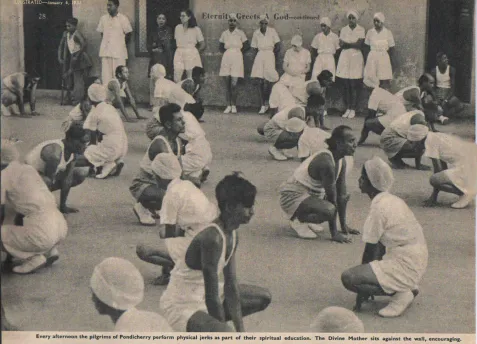
I took pictures of the different activities of the day which consist of the Mother giving and receiving flowers of symbolic significance. Workshop work, as the Ashram does everything itself, printing, binding, carpentry, copper, foundry, bakery etc. … and gymnastics in the evening.
The mysticism is only noticeable in the relations with “Mother” and all the sweet smiles coming from some other world. She has a tremendous personality and the Ashramites say that she is “the manifested aspect of divinity”. She seems to be a very kind person with a tremendous energy which has absorbed the will of all the disciples.
I first took pictures of people reading in the Bibliothéque. I had given my word that I would not take her picture, so I shot the disciples passing in front of her. Then I went to the Ashram workshops, aluminum, foundry of copper and brass, then at the printing shop … then in the carpentry shop, children hired from the town weaving. I took photographs of Golconde, also of the Ashram farms and of the irrigation in the traditional way. The Ashram promised to send you [Magnum Photos] directly figures on the different aspects (number of men, women, children, costs, significance of flowers).
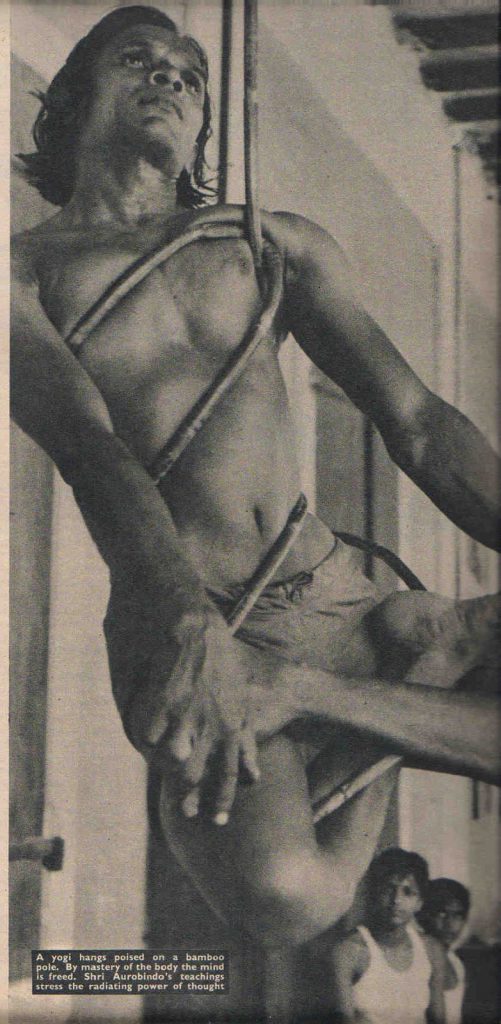
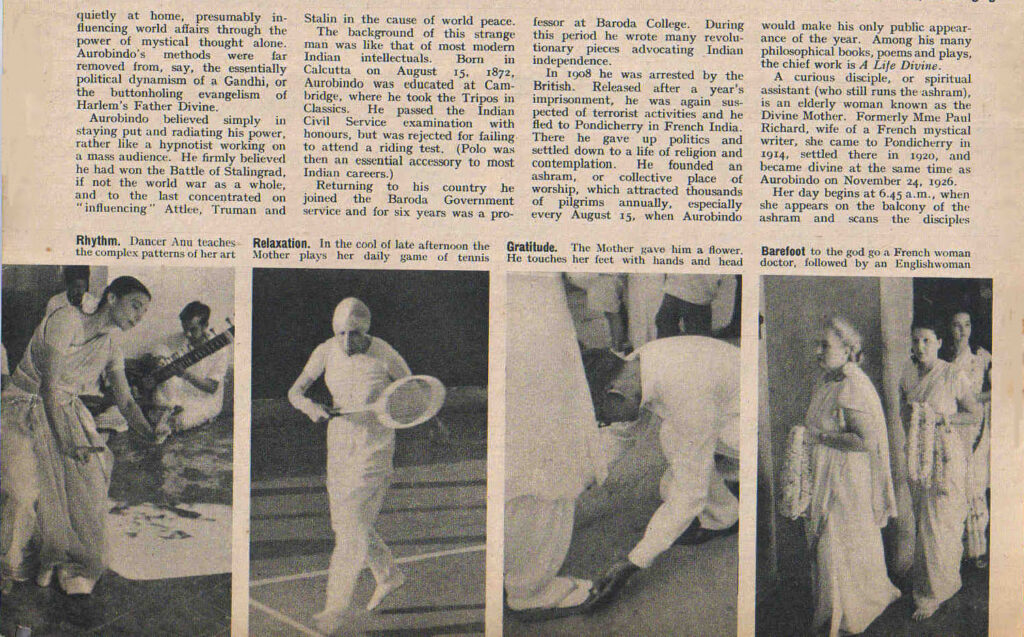
Shots of irrigation, dining hall (the food is pleasant but always the same), caste is not used here. Spotlessly clean; one is requested not to eat with one’s fingers. A devotee (bearded) in front of Golconde—gymnastic exercises. Mother plays tennis at 5 and afterwards attends the gymnastics. Exercises around Malkhamb. Asanas of a yogi called Ambu.
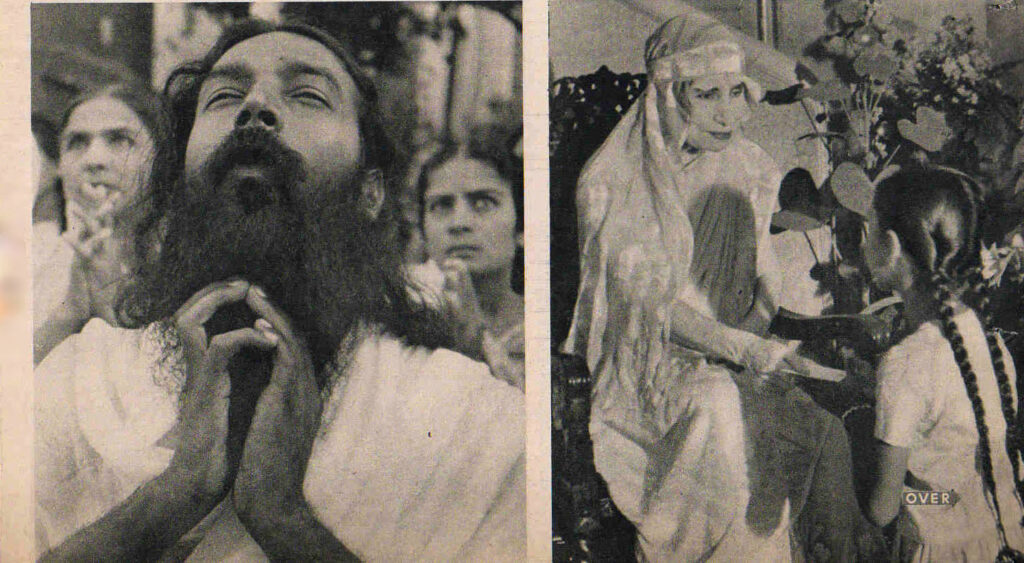
I was allowed after much discussion, in which the Mother and General Secretary listened with much courtesy to my arguments, to take photographs of the Mother, or to put it more precisely to include her in the distance in the rear ground of my pictures. From there it was allowed to come to closer-ups as we got to know each other better. After the gymnastics was over, everybody stood at attention and for 10 minutes meditation, afterwards Mother went into a small adjoining yard to distribute nuts to the children, and after receiving little bouquets, she would choose a flower with a special meaning and give it to a disciple with a long seraphic smile. A few feet in front of her was standing the young physical instructor, a sturdy Bengali.
Saluting Mother, I quickly finished the roll on disciples waiting on the street at the foot of the balcony for the first rituals of the day which repeats itself every morning at 6.45 a.m.
Mother was late that morning, 10 minutes. People waited in concentrated silence when she appeared, all hands joined with ecstatic smiles on their faces. Mother was turning her head at the slowest motion from the extreme right of the street to the other end with an enigmatic smile. This very slow motion gave her time to see exactly who was there, and at the end she disappeared inside as an apparition. Quietly the crowd of disciples broke to have breakfast at the dining hall. But this is a great day, one of the days that Sri Aurobindo appears from his room. Devotees come from all parts of Bengal, Gujerat, and elsewhere (including some devotees who were the week before in Tiruvanamalai). They were buying flowers in the streets.
I had the great privilege to be allowed to take pictures of Sri Aurobindo and the Mother at Darshan if I would keep in my pictures the atmosphere of “artistic darkness’ which Mother had imparted to the recess in which she was sitting. For 2 hours people were passing one by one in front of them…
Back at Golconde I took pictures at 6.30 a.m. The disciples gathering in the street before the balcony appearance of the Mother. I was so struck by the balcony appearance and the audience that I came back a second day and I must say the Mother was very kind to me by moving her head from left to right exceptionally slowly to give me time I am sure to be able to carry on my work properly on the disciples. I am sorry there was no time, but I would have liked to have had a long chat with the Mother on worldly subjects…
The morning after Darshan [i.e. on 25 April] I went to thank the Mother for giving me permission to take their picture at Darshan, but I told her that the conditions of the light there would make the results most unsatisfactory to the disciples who were expecting a portrait as clear as the one in circulation now. She told me that is what they wanted from me, some indistinguishable shadow of themselves; this I had fully succeeded. Mother was so helpful and she convinced Sri Aurobindo and I came in his bedroom with my camera. The room was so neat and tidy and impersonal. Sri Aurobindo did not wink an eye during the entire ten minutes I was watching him, he did not seem to belong to that impersonal setting.
I took pictures of Anu dancing, of the dining hall building, of Dr. Banerjee. More photos of the 1.30 p.m. daily ritual with the Mother. Also of her tossing flowers off the balcony. She gives out candies (very good ones too) to the gymnastiques [sic]. Mother sleeps only 3 or 4 hours a night. The very nice Bengali gentleman who was taking us around, referred often to Mother’s trances such as: “Mother is not coming down now, she might still be in a trance.”
I took pictures of Pondicherry streets at a time when most of the disciples were indoors and the streets were full of heat and silence. I took color shots too in Kodachrome. I took pictures of Nolini Gupta, the Secretary of the Ashram at 5 p.m. I took pictures of the daily tennis game. I took pictures of Pranab, a young strong Bengali Director of Physical Culture in the Ashram. He is one of the persons closest to the Mother. I took pictures of Pavitra, he is a calm person of great affability and kindness.
While children were doing gymnastics Mother in a little room by the Playground was giving a French lesson to some pupils. They were analysing a text; Mother was asking them what is the difference between success and perfection.
The next morning we were leaving Pondicherry. I took pictures of a French family on the platform of the station — you see very few Europeans walking around town.
The following photographs of Henri Cartier-Bresson were published in the Illustrated on 6 January 1951.
(II)
Interview with Henri Cartier-Bresson by Bobbie Voit dated 25 April 1990 at Paris.
My first wife was Indonesian, her education was dancing. Muslim but she was a Vedantist. We both were involved in the United Nations for the independence of Indonesia.
It was Jean Herbert and Liselle Reymond who suggested that I go visit the Ashram, We had just founded Magnum. I stayed in India for one and a half years.
We met Francois Baron who was representing the French Government of India. It was he who introduced me to “La Mere”. It was a delicate matter because Mother was in favour of the Indian independence of Pondicherry.
First I went to Tiruvannamalai—to see Ramana Maharshi who was a completely accomplished being.
A Bharat Natyam dancer who lived in Madras named Chandralekha … a contact.
At Tiruvannamalai I saw a ball of fire moving slowly across the sky. As a practical Frenchman I timed it. Some kid came out and said that Bhagwan (Ramana) died 13 minutes to 9 in the evening.
I think that he was buried vertically. I took pictures with a flash which is something I never do.
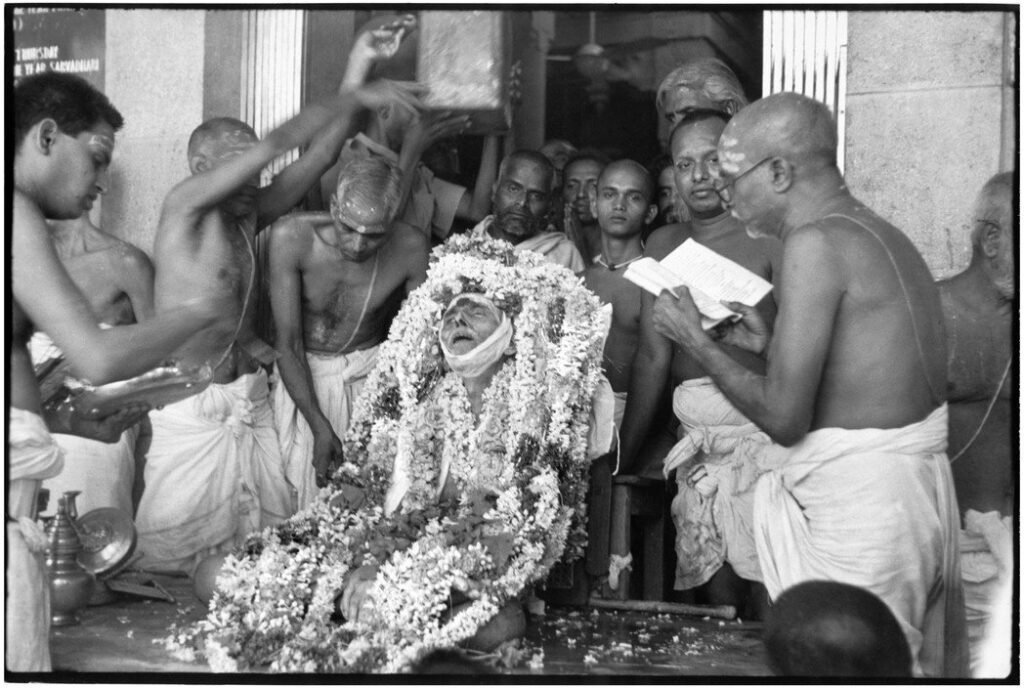
Afterwards I went to Pondicherry. Well received by the Mother. She was teaching gymnastic movement. I noticed that the Ashram was very Westernized. She owned about half of Pondicherry, Very well organized. Again she was extremely nice to us.
I did not come just to take pictures. Camera is a sketchbook, a diary. Not interested in photography.
I do not believe in the past—never been a Christian—moved by Buddhism.
With a small camera you can understand immediately the moment and immediately forget yourself.
The Mother let me photograph everything. Then I asked her, “I am only photographing the female aspect of the Divine. What about the male aspect?” She went up to Sri Aurobindo’s room and came down and said, “You can thank me — you can photograph under very subdued light (artistic shadow).”
I am not sure whether she said I could photograph him now or later.
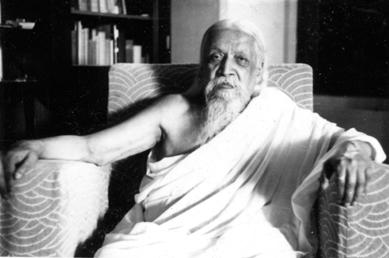
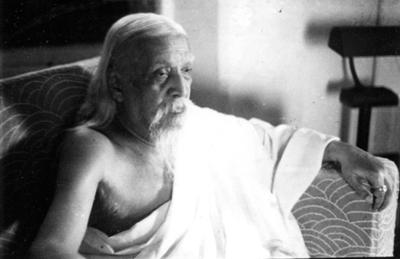
I took photographs in practically pitch dark. I told the Mother this is very embarrassing —the film isn’t fast — people would be disappointed in my reputation and in yours also.
Took more photographs of the Mother playing tennis and the general activities.
Had film developed in Bombay. The Mother wanted to see the contacts. We went through all the contacts together and crossed out certain pictures on the contacts and on the negatives ourselves. The Mother was concerned about her wrinkles and her appearance. All this was done under her supervision, under her direct guidance. Then I went and worked elsewhere in India.
The Mother knew they would be published in Life, Paris Match, Illustrated — in five magazines.
I was not responsible for any of the text that was printed, I only asked of the magazines that captions should not be used with his [Sri Aurobindo’s] photographs.
I kept on working in India. Then one day back in Paris the Mother’s son arrived and explained that the Mother was quite upset by the publication of the Ashram photo in Illustrated — a British magazine. The publisher, an agnostic. wrote the text. I had no control over the text.
She [the Mother] wanted to stop all publication. Robert Capa who was in charge of the business end at Magnum said the only solution is something I never did before in my life, and never did again, that is to sell the negatives. Magnum was created so that the photographer would own the right to the negatives. Capa said. “You do not want to be in trouble with the Mother and Magnum is on the verge of bankruptcy. To stop further publication of the photos, we will sell the negatives to the Mother.”
The price decided upon was what we sold to Illustrated for multiplied by five — as if we had sold it to these five other magazines for the same price.
There was only one other time any of these photos was published — in the photo-portrait book published two years ago by Thames and Hudson..
Also part of the arrangement was that I could keep one set for myself.
That settled the matter. Capa was killed shortly thereafter. Much later, someone I saw in the U.S. accused me of spying…. I am not a disciple of the Mother or a member of the Ashram, but I came with respect and understanding. Pavitra is the one who arranged everything with the Mother.
I feel at home in India spiritually.
After the war I was taking photos of Georges Braque [the French painter] when he escaped from the Germans. Braque gave me the book Zen in the Art of Archery by Herrigel. I consider it a manual in photography. I have been practicing Zen with the camera all along. This brought nee to Buddhism.
Now I am drawing. It is an introverted activity — meditation. Photography is an extroverted form. In photography you are something between a pickpocket and a tightrope walker. We [photographers] always steal something. The Leica is unobtrusive.
I am impatient — I have changed gears into drawing.
To be able to observe you must not be noticed.
My impressions of the Mother — a power woman. Sri Aurobindo was very remote. I had “a tremendous meditation” far away.
Extract of a letter written by Henri Cartier-Bresson to Pavitra dated 13 April 1950. Translated from the original in French:
I represent an association of photographers called Magnum Photos. This agency, whose headquarters are in New York, distributes our photographic reportages to the principal magazines of the world. My own reportages have appeared in Life, Harper’s Bazar, Wallies, Illustrated, etc.
I was introduced to the works of Sri Aurobindo by the translations of lean Herbert…
I and my wife, who is Indonesian, wish very much to come to the Ashram for the next darshan and I would be extremely grateful to you if you could provide me with the authorization to make a photographic testimony of the life of the Ashram at the time of the darshan and during the days that precede it.
Pavitra’s reply dated 18 April 1950 (translated into English):
I have received your letter and shown it to the Mother. You and Madame Cartier-Bresson have been granted permission to attend the next darshan, on Monday, the 24th of April. The Mother also authorizes you to make a photographic-reportage on the Ashram at this time.
A conversation between Madhav P. Pandit and Champaklal, quoted from ‘Champaklal Speaks’, p. 115, Sri Aurobindo Ashram Trust, Pondicherry, 1975:
Madhav Pandit: Champakbhai, do you remember Cartier Bresson who was allowed to take photographs of Sri Aurobindo? If I remember right, he had not been photographed after he retired in 1926. I had heard that when Cartier Bresson stood to photograph Sri Aurobindo and Mother giving Darshan on 24.4.50, his hands shook, and we see it in the Darshan photograph we now have. Do you recollect?
Champaklal: Ah, yes. The day after the Darshan, when the Mother was distributing flower garlands downstairs, he took a number of photographs. Mother had gone down for the function specially early that day.
Later, she came to Sri Aurobindo and spoke something to him. After she combed his hair,
she asked how long it would take to get ready. We said 9 a.m. “Only the bust”, Mother said.
I interjected: If he is coming to photograph, why not the full figure?
Mother: If Sri Aurobindo says so…
Champaklal: If you want it, he will not say no.
Mother: Ask him.
And I asked Sri Aurobindo; he consented.
I asked Sri Aurobindo if I could change his sofa etc. and if the light was enough. He indicated
his approval with a smile.
Then I went down and told the photographer that he could come upstairs earlier to the room and arrange things as he desired.
But he did not come. And when he came at the scheduled time, a number of photographs were taken, though of the full figure he took only one — at any rate he had only one finally.
From ‘Champaklal Speaks’: 27 July 1950
Mother informed Sri Aurobindo that news had come from America about the photographs taken by Cartier Bresson. Tata had been to enquire at the Company and he was told that the film had been received. But as the lady in charge was not there, work had not started yet. They told him of the condition that the photographs must not be shown to any one excepting Sri Aurobindo and Mother, who had to select and return the collection. On receiving them back, they would publish them in some Journal in America and it was only six months thereafter that photos could be issued by us here.
Mother added that she was preparing for an album which would be in great demand.
When I came to Mother, she said: I think the photo of Sri Aurobindo on chair will come out very well.
Champaklal: Mother, he has taken so many of yours; from them some will surely come out well.
Mother: He has taken hundreds. Out of them at least one or two will come out well.
From ‘Champaklal Speaks’: 26 June 1951
Negatives of photographs taken by Cartier Bresson have come, in all 460 of them — some spoiled, some faded. “They are all locked up in my safe”, Mother said.
Extract from letter Cartier-Bresson to Pavitra, 21 December 1950. Translated from the French:
… When I had the privilege of seeing Sri Aurobindo, I had the impression that he was beyond Time….
Note sent to the Mother by Henri Cartier-Bresson in June 1951; translated into English from French:
To the Mother,
In profound gratitude for having allowed me to make these photographs and with the expression of my sincere respects.
Henri Cartier-Bresson
Interview with Jayantilal Parekh: Pondicherry. 27 March 1990. Interviewed by Bobbie Voit.
Bobbie Voit : How did Cartier-Bresson come to photograph the Mother?
Jayantilal Parekh : He came to Pondicherry on 23rd April and made a request to Mother’s secretary, Pavitra his real name being Saint-Hilaire… It was very strange for all of us when we came to know that the Mother gave him permission to take photographs of the Mother and anything else he wanted, because before this she had not allowed a single photograph of herself or Sri Aurobindo to be taken after 1920.
Bobbie Voit : Was she aware of his reputation. Could that have influenced her?
Jayantilal Parekh : Not unless Pavitra had told her something about him, but I don’t think she knew much about him. I also did not know much about his eminence as a photographer.
Bobbie Voit : Did Cartier-Bresson have prior knowledge of Sri Aurobindo before he arrived in Pondicherry?
Jayantilal Parekh : I think he must have come just like that, hearing Sri Aurobindo’s name. He came here and made a request and he was allowed. There were no formalities with the Mother or the Ashram. If the Mother said yes then the matter was over… After he was given permission, he was quite free. During the darshan he took any number of pictures. Then of Sri Aurobindo, when he was in his room, he took any number of pictures. … He took playground pictures, and also when the Mother used to come down for blessings and again when she used to give flowers to people and when she looked at all the fruits and vegetables brought to her from all the gardens.
Bobbie Voit : And you were with him when he was taking his pictures?
Jayantilal Parekh : No. He had freedom to go anywhere, on his own, even when the Mother was giving blessings downstairs. He took pictures on all the occasions. He was completely free. If you see the album with his photographs, apart from Sri Aurobindo’s pictures, there are some pictures of Mother, but not very many. They are mostly when she was doing something. Portraits of her are not there. They are only when she was doing some work or attending to certain things. But in Sri Aurobindo’s case, portraits were taken sitting on the sofa, and I was told that the photographer was quite nervous when he was taking Sri Aurobindo’s picture. But that is what I have heard. I mean nobody can say whether he was nervous or otherwise. But people who were around at the time. Champaklal and others who were there, they said that he was feeling nervous.
So for these three days he was free….
I was going one day with him to the hotel. We were in a rickshaw and he jumped out and began to take pictures. As a photographer he did not confine himself only to Sri Aurobindo’s pictures; whatever his eye caught, he was trying to capture.
On the last one or two days that he was here I talked to him. Since we came to know after his corning that he was a very well-known photographer, I took interest in him and went about with him, and went to the station to see him off. But it was not that I was asked to look after him or any such thing. He was on his own.
Bobbie Voit : Can you remember anything about how Cartier-Bresson worked?
Jayantilal Parekh : Like any other photographer. His theory itself was not to make any kind of prearrangement. You have to find the right moment and then click. It is an instant vision, your vision flashes before your eyes and you click. .
Bobbie Voit : Did you show Cartier-Bresson around Pondicherry?
Jayantilal Parekh : Yes. I moved about a little with him —because he was, I think, for three or four days around Pondicherry not in the beginning when he came, but in the latter part when I heard that he was allowed to photograph. I was looking after him unofficially.
Bobbie Voit : How did you perceive Cartier-Bresson? Was he easy to get along with?
Jayantilal Parekh : Nothing eccentric. He behaved quite normally. I saw him off at the railway station. The train was the only way to get around in India in those days. Later on we saw some of his other photographs…
Bobbie Voit : So when Cartier-Bresson asked the Mother to photograph Sri Aurobindo, he had carte blanche basically?
Jayantilal Parekh : Yes, I think so.
Bobbie Voit : Did she want to have any of the photographs?
Jayantilal Parekh : Once a photographer takes a photograph he would naturally give a copy of the photograph. The only thing I heard about was the condition that the Mother would see the photographs before publication…
Bobbie Voit : So when he left he took the negatives with him?
Jayantilal Parekh : They were not developed. Naturally the exposed films were with him…
Now, as soon as Sri Aurobindo passed away, an article in an American magazine came out with these new pictures. It was not a very complimentary write-up… So when the photographs appeared, we were not very happy. At the very first contact we had of him, he defaulted; he did not show the photographs before they were published.
Bobbie Voit : So he didn’t abide by the agreement?
Jayantilal Parekh : No. The actual understanding we had, that he would show the Mother and the Mother would approve of the pictures, was not observed.
Bobbie Voit : Along with her asking to see the photos before publishing, did she make any arrangement for having as her property some of the negatives?.
Jayantilal Parekh : No. You see, that was not her way of working. She never made such conditions with artists. When she gave permission, it ultimately depended upon the artist to decide how he should go about it — whether he felt he should hand over the originals to her or do it differently. It was only after Sri Aurobindo passed away that the question of acquiring the negatives arose, because there were no other pictures of Sri Aurobindo after 1920. it is at that stage that I came into the picture.. .
At that time we had a friend in America who had started publishing Sri Aurobindo’s books in the U.S.A. The Life Divine had already come out and one or two other books were also getting ready. So I immediately wrote to him that Mother was eager to get the photographs from the people at the Magnum laboratory, which I think even now exists. Tata contacted Magnum and they demanded 56000 or something like that. I am not sure about the figure…
Mr. Tata wanted to bargain, because he didn’t want to pay the price they asked for and he wrote back saying that he was trying to see if Magnum would come down in their price. When Mother heard, this she immediately sent word by telegram telling him not to bargain, although she said ‘that the price was high… So you see, Mother did not bargain with Magnum and she purchased all the negatives. Then some of the negatives were copied here, so that the originals may remain in good condition and the photographers, four or five who were active in those days, could work with them. They were asked to make prints. First sample prints were made, from which those that the Mother selected were to go into an album that she wanted made. In those days, I used to go out to Madras and other places for Ashram’ work. Mother wanted a certain type of material for making the albums. They were to be in green leather. I made arrangements to get certain quantities from Madras and the albums were made here in the Ashram.
Bobbie Voit : You say that the negatives were copied? You had the original negatives and they were copied, so the prints were actually made from second generation negatives?
Jayantilal Parekh : Because there were three or four photographers and the whole Idea was that the original negatives should not be spoiled. In the beginning they did use the original negatives, but then they realized that if they used them constantly they would get scratched, and in fact the scratches began to appear after the first uses. So they kept them aside and later the copied negatives were used. The original albums were made from the first negatives. Three or four photographers were there and the work was good, also the printing. Later they had to turn out hundreds of pictures and make them available. The work of copying negatives was not so good then….
Here the impression has been: Why didn’t the Mother allow her own photographers to do the work? Some of them could have turned out some good photographs. But the question does not arise. In the 1930s two attempts were made by some amateur and inexperienced photographers of taking the Mother’s picture without her knowledge, but the results were not good. These attempts were made with a box camera. The first and last serious attempt was made by Cartier-Bresson.
Interview with Robi Ganguli: Pondicherry, 28 March 1990. Interviewed by Bobbie Voit.
Bobbie Voit : Can you tell us about your recollections of Henri Cartier-Bresson’s visit to Pondicherry?
Robi Ganguli: Well, frankly it’s difficult. I think he Caine in April 1950. He came a little earlier than darshan day. He had come originally to Jaipur to do a wedding. He came from Jaipur to Pondicherry. He had brought some books of his work. In Pondicherry and the Ashram not many people were interested in photography. but the Mother was very much interested.
Bobbie Voit : At the time he was already famous?
Robi Ganguli: He had already become famous — not as much as after his book on China and The Decisive Moment. He had brought two small volumes, one with a French title. I forget the title.
Bobbie Voit : According to Jayantilal he came in April during the darshan.
Robi Ganguli: He came a little earlier.
Bobbie Voit : He stayed at Hotel d’Europe?
Robi Ganguli: Yes, first he stayed there and then he shifted to Golconde. I and a friend of mine were working for Photo Pate! at that time and he came to us and we had a lot of discussions. It was really when Mother saw that book — the book of his photographs that he had brought —that she allowed him to take pictures. Till then she never allowed any pictures to be taken of her or Sri Aurobindo, and even he was not permitted initially to take pictures of Sri Aurobindo. First he took some pictures of Mother giving blessings and one or two rolls were processed in our studio. This was just to see if the results were OK because the light was very contrasty here. He was not accustomed to this type of light. He started taking pictures then — the balcony darshan. In the morning Mother used to come on the balcony at the back of the Ashram, and devotees would gather about six or six-thirty. So first he was allowed to take pictures of the balcony darshan and then after that Mother saw his book of photographs. It was a book that had already become famous at that time. It was one of his first publications; he had not yet published The Decisive Moment or his book on China. When Mother saw that book, she first gave him permission to take pictures of her and of the Ashramites in general.
He and I used to move around together. Not all the time, but often. He was a very, very interesting personality. He was a painter to start with, and when he started photography he used to take portraits with a studio camera. Then suddenly he discovered the Leica, the 35mm miracle. He changed the face of photography altogether….
He would be sitting chatting with us and suddenly before we knew it he was taking our pictures. We were not even aware of it, he was so, unobtrusive.
He was here for about a fortnight, about twenty to twenty-five days. He was here only once. He stayed on for the darshan hoping to get permission to take Sri Aurobindo’s picture. Till the last day we did not know. But on darthan day at the last moment he was called, he was given permission to take pictures of the darshan. Cartier-Bresson, myself and Shivan rushed up. We were just helping him with the stand, because he didn’t carry a stand and the light was very dim, and in those days films were not as fast as those today. One hundred ASA was about the maximum speed you could get. He-exposed a roll.
Next day he was given permission to take pictures in Sri Aurobindo’s room and he went alone there. Sri Aurobindo was sitting on that sofa, just under the clock. We were outside on the staircase. When he came out, he was just perspiring. We asked him, “How did it go?” He said, “I have never seen a man like this. He was sitting there absolutely immobile.” In a sense he felt something, such tremendous quiet and peace. He was very nervous, he said. While he was taking pictures, he moved around a little and he finished one roll. But there was a tremendous sort of elation in him that he had taken the pictures.
It was all one session, the 25th of April —the day after the darshan. Champaklal said that after the session Sri Aurobindo said, “It’s all over.” Cartier-Bresson was really nervous. Sri Aurobindo gave a tremendous smile afterwards which Cartier-Bresson did not tell us about. That’s what we heard from Champaklal. After that he went to some other places in India. I suppose he was still shooting.
Before he left he promised that he would send all the contact sheets. But nothing came. He had said that nothing would be published until Mother had seen the pictures and approved them.
Bobbie Voit : That was at her request?
Robi Ganguli: Yes, yes.
Bobbie Voit : That was the only thing she requested?
Robi Ganguli: I cannot ten you that, but she had insisted on that. He was given permission to take pictures on that condition. But he was telling us before that he was part of this Magnum group and he sent his rolls there. They processed them and all the marketing was done by Magnum. He was all the time on the move. He told us, I don’t know how it is going to work out because I am most of the time on the move. They have promised that they will send the prints here, but I don’t know how exactly it is going to work out.” He was going to talk with his associates. I think he was going to meet Robert Capa. He was one of the five Magnum photographers then…
For a long time there was no news from him. In fact we never again heard from him. But in one German magazine some pictures were published and we got a little upset. The Mother wasn’t angry or anything because the pictures were really very nice. Then Tata, who used to live in the States, took an interest…. Tata was asked to contact Cartier-Bresson and find out what was the matter. In the meanwhile on the 5th of December Sri Aurobindo passed away and then we needed those negatives because there were no pictures. It was really then that we understood why Mother had given him permission to take pictures of Sri Aurobindo when no one else was allowed. Afterwards we managed to get the negatives from the States. The negatives were purchased from this Magnum agency. I have forgotten the price. The Mother was very happy to get the negatives. I think the negatives are still here.
Bobbie Voit : So he never sent the contact sheets?
Robi Ganguli: No, he did not. I was one of the persons making the contact sheets when the negatives came. The contact sheets did not come, but all the negatives were sent.
Bobbie Voit : Magnum may still have some prints?
Robi Ganguli: They may have, but as it was an outright sale they may not. The copyright remains with Cartier-Bresson still.
Bobbie Voit : The copyright remains with Cartier-Bresson?
Robi Ganguli: Yes, because when the negatives came they were all stamped copyright Cartier-Bresson, Magnum agencies. So he has the right to publish; yet he had given all the negatives. You see, he was a very decent man, a perfect gentleman. He came from a very good family in France, one of the aristocratic families of Pans. In regard to photography he completely changed our outlook. It was really a revelation. It was only after his arrival here that we understood what photography is. Elsewhere in India this happened much later, because people were very much steeped in the British pictorialism school. But now he is regarded as the father of modern photojournalism.
He was allowed to lake the darshan pictures at the last moment. It was at the end of the darshan that he was called. I was by his side. He was against using flash during his stay here. He took one or two pictures with flash and he was not happy.
Bobbie Voit : When he took the darshan photographs did he use a tripod?
Robi Ganguli: He used a monopod, and you will see there is a slight shake in the pictures because the light was very dim. And the fastest film in those days was 100 ASA.
Bobbie Voit : But you didn’t use any extra incandescent lights?
Robi Ganguli: No. He was a believer in natural light. have never seen another with such sheerness of vision. The perfect composition every time, every element in place. His photographs stand individually. They’re complete works.
Bobbie Voit : He did not use any lights for the portrait of Sri Aurobindo in the chaise?
Robi Ganguli: No lights.
Bobbie Voit : It must have been a very slow shutter speed.
Robi Ganguli: He was using a tripod then, the next day. He didn’t use one at darshan because it was at the last moment. He was hoping that he would get a chance.
Dyuman on Henri Cartier-Bresson:
From 1920 onwards there was no new photograph of Sri Aurobindo. The Mother arrived in April, 1920. We had only a photograph of her taken in Japan. She forbade any taking of photographs. Once Balubhai tried to photograph her and receive a severe scolding. For thirty years no photograph was taken. But the Divine’s ways are inscrutable. On 23rd April 1950, Cartier-Bresson of Life Magazine arrived. Through Pavitra he obtained permission to photograph Sri Aurobindo and the Mother. From 1.30 p.m. of 23rd -April up to midday of 24th April he took about 300 photographs. The Darshan photograph in which we see Sri Aurobindo and the Mother sitting on the sofa was also taken by him. Had the Mother not permitted, we would have had no Darshan photograph, nor any photograph of Sri Aurobindo after 1920.
After a few months this photographer started to sell the Mother’s photographs. Instead of giving us the negatives, he sent us the message, “Give me six thousand dollars with one hand, take the negatives with the other.” I said that even for that one Darshan photograph I would be willing to pay six thousand dollars. Cartier-Bresson was paid and he gave us all the negatives.
Our photographers, headed by Pranab and Chimanbhai, made prints. They prepared forty albums which were sold for a thousand rupees each. Each photo in each album was numbered and blessed by the Mother. Only by the Divine Grace we got these photographs of the Lord and the Mother. There was a big demand for these forty albums. So we made another five hundred albums and sold them for five hundred rupees each. These albums too were also blessed by the Mother.
[Source: How They Came to Sri Aurobindo and the Mother, Volume One, by Shyam Kumari]
Account of Chimanbhai Patel: Pondicherry, August 1990. Compiled by Arup Mitra from notes.
Cartier-Bresson’s family was known to Mother while she was in France. This family was well-known because of their involvement with the production of thread. Cartier-Bresson called on Mother several times during his stay in Pondicherry. In fact, he took the first series of photographs of the Mother since she arrived here. The ones taken by Darn were of course obtained clandestinely. It was after much persuasion that Mother finally agreed to let Cartier-Bresson take Sri Aurobindo’s photograph.
I heard at the time that when Cartier-Bresson went up to Sri Aurobindo’s room, Champaklalji asked him if he would not like to take pictures of the Master during his day-to-day activities. In that way the photographs might have captured the different moods of Sri Aurobindo. But instead Cartier-Bresson insisted that the Master should sit in his armchair and he went around taking photos from different angles of the same pose.
Regarding some of the pictures that came out unclear and out of focus, Mother herself commented to me that she was not at all surprised, as the hands of the photographer were shaking like leaves in the presence of Sri Aurobindo. He seems to have quickly gone through the process of taking the pictures and hastily retreated as he was alleged to have been quite ill at case in front of the Master. It is indeed sad that there was not another opportunity of getting better photographs of the Master.
Now let me come to the part where I became involved with these photographs. I was away in Madras at the time… Dyuman rang up my host there and left a message urging me to return to Pondicherry as soon as possible. In those days there was no bus service, so I took the train. On reaching Pondicherry. I found someone waiting for me at the station. He told to call on Mother immediately without even going through the formality of a bath. I rushed to her. She showed me the horde of negatives that Cartier-Bresson had sent. Evidently these had not come free of charge. I heard then that it cost Mother almost $20,000 to obtain them, Later I heard the figure was a more realistic $8000 or so.
However, the negatives were there and I was asked by Mother to make prints within half an hour. I said that they could be made ready within half an hour, but they would not he properly washed. Mother instructed me to bring the prints anyway within half an hour without bothering to wash them well. I did this and took the prints to her. I cannot remember what Mother said when she saw these prints.
It may be pertinent to note here that recently while going through Mother’s collection of photographs kept in the room of the late Krishnalal. I discovered these very prints, which may be termed as the original ones. They were in 6×9 size and were yellow with age because the chemicals had not been properly washed out.
As far as my knowledge of the thing goes, the prints made by Cartier-Bresson were published in Life magazine.
Later on, in order to make photographic albums according to Mother’s wish and at the same time not spoil these original negatives, I was asked by her to try and make duplicate negatives. I had to buy a roll of one thousand feet to try this out since shorter roils were not available in the market. After trying out the new technique I succeeded in obtaining good results and made five copies of the entire set. It is beyond doubt that the original negatives of Henri Cartier-Bresson were virtually never utilised at all, and that these are preserved in impeccable condition by Pranab.
Account of Pranab Kumar Bhattacharya, September 1990. Compiled by Arup Mitra from notes.
The photographer Henri Cartier-Bresson’s visit was arranged through Pavitra-da. Cartier-Bresson was the representative of an American press agency, the name of which I have forgotten.
At the time of this Frenchman’s visit to Pondicherry, a rumour had spread somehow in the West that Sri Aurobindo was no more, and that during the occasions of darshan, the sage’s dummy would be propped up beside the Mother to create an eye-wash that he was still alive.
Hence, Mother thought that it would be a good idea to allow this famous photographer to obtain pictures of Sri Aurobindo so that he could carry back home real proof that Sri Aurobindo was still alive.
In regard to what Chimanbhai has said about Champaklas suggestions to Cartier-Bresson, I would like to say that in those days it was the Mother who took all the decisions about matters related to Sri Aurobindo. So, it would hardly seem plausible that Cliampaklal could take such an important decision and invite Cartier-Bresson to take the pictures of the Master during his day-to-day activities without the knowledge of the Mother. At least I had not heard of such a suggestion at that time or after that.
It was agreed between Mother and the photographer that once the negatives of the pictures that the photographer took were developed, they would be sent to her. After the session of photography was completed, I remember Chimanbhai offering to develop the film in his studio. Cartier-Bresson refused this flatly, saying “I am sure that Mother would not like it.” This way he got away with it.
Months passed but the negatives did not arrive. Pavitra-da was asked to write to him and follow-up the matter. Still, no reply was received. In the meantime some French and English magazines began to publish these recent photos of Sri Aurobindo, which had not been seen or approved by the Mother. Even the Illustrated Weekly of India printed the photographs in one of their issues. Then Pavitrada wrote a strong letter urging Cartier-Bresson to send the original negatives, in reply to which, a set of small prints was sent. But the curious part about these prints was that the faces of Sri Aurobindo and the Mother were deliberately erased. This obviously was a ploy to make copying impossible.
Some time after Sri Aurobindo left his body it became dear that the photographer himself or his employers in the United States were after money. So a letter was drafted saying that money was no criterion and that they should inform us of the exact amount they expected.
In all a sum of 18,000 had to be paid. I am quite sure of the figure but not sure about whether it was dollars or rupees. As it was an exorbitant price. Mother decided to make albums of these photographs to be sold for Rs. 1000 and Rs. 500. This way, the cost could be recovered. This scheme proved very fruitful. It is worth noting that even to this day these last pictures of Sri Aurobindo are selling very well. Chimanbhai was asked to make five sets of copy negatives from the originals to enable the five photographers of the Ashram, namely. Vidyavrata, Venkatesh, Chimanbhai, myself and another to make photographs for the albums. Also, this way, the original negatives could be prevented from being over-used. These original negatives are in my custody. We use the originals only for making very big enlargements or to make good prints for making negatives.
However, to come back to the main story. It was much after Sri Aurobindo’s passing away that the Cartier-Bresson negatives were received. There were seventeen negatives of Sri Aurobindo alone (and one of his room) and ten darshan negatives. Only one of the darshan negatives was clear enough to print. I cannot remember the exact date or month that the negatives were received.
I have learnt one lesson from this regrettable incident and that is never again to trust press photographers.
Let me add an interesting anecdote related to this matter. Much later, one day, the Mother alluded to the pictures taken by Cartier-Bresson. She said, “You know, had I allowed the Ashram photographers to take the photos of Sri Aurobindo, I am quite sure they would have done a better job!”