
Rishabhchand Samsukha was born on 3rd December 1900 in his maternal uncle’s residence at Jiaganj situated in the district of Murshidabad in West Bengal. He was the eldest son of Puranchand Samsukha (hailed as one of the finest exponents of Jainism who had authored a number of books on Jain religion and philosophy in Bengali) and Maina Kumari. He received his early education in M.E. School at Azimganj. Afterwards he joined the illustrious Presidency College of Kolkata to study for his Intermediate Arts. It was at Presidency College that he became a favourite of Professor Manmohan Ghose who—apart from being a reputed poet and a well-known professor of English—was Sri Aurobindo’s elder brother. Following the completion of his Intermediate Arts course the final examination of which he passed with flying colours, he joined the Krishnanath College of Berhampur to study English Literature for his Bachelor of Arts course. Considering the fact that Rishabhchand had a brilliant academic record, it was expected that he would complete his graduation with flying colours. But it was not destined to be so; in spite of having completed his Bachelor of Arts course, did not appear for the final examination.
Like innumerable youngsters of his age, Rishabhchand joined the Non-Cooperation Movement launched by Mahatma Gandhi and left his studies midway. He busied himself in picketing and collection of money for the Swadeshi fund. Puranchand insisted that Rishabhchand should opt for a Government job but Rishabhchand was adamant—he would not serve the members of the alien race who were ruling and exploiting his motherland. It was this fire of patriotism in his young heart which made him decide not to work under the British Government. Instead, established in 1926 a small sari shop at Cornwallis Street in Kolkata which he named the Indian Silk House. He dealt primarily in hand-woven silk from Murshidabad—the district being famous for its silk saris. Gradually he also began to deal in various other varieties of silk like Garad, Tassar, Matka and Banarasi.
During daytime Rishabhchand supervised the business-affairs of Indian Silk House with unsurpassable integrity. But after the day’s activities were over, he would retire after dinner to his apartments to read the writings of Sri Aurobindo for whom he had developed a profound attraction since the time of the publication of the Arya where Sri Aurobindo’s philosophical and sociological writings were being serialized. A careful study of Sri Aurobindo’s books, especially Yoga and Its Objects, had opened up new vistas in his inner life.
In 1931 Rishabhchand left Kolkata for South India and arrived at Pondicherry to have the Darshan of Sri Aurobindo and the Mother which he did have on 21 February. The Darshan of Sri Aurobindo and the Mother made Rishabhchand realize that they were the Ones under whose spiritual aegis he would love to spend the rest of his life and that the Ashram was his real home. He decided not to go back to Kolkata. Sri Aurobindo and the Mother fulfilled his aspiration and he was accepted as a permanent inmate of the Ashram. Thus, Rishabhchand became the first member of the Jain community to join Sri Aurobindo Ashram, Pondicherry. Rishabhchand was initially given work in the House Maintenance Service Department of the Ashram. Afterwards he was made the in-charge of the Furniture Service Department. The Mother put to good use his ‘sense of organization and his skill in dealing with workers.’
Following the invitation of the editors of the journals like Mother India, The Advent, Sri Aurobindo Circle and Sri Aurobindo Mandir Annual, Rishabhchand began to contribute articles on the philosophy and teachings of Sri Aurobindo and the Mother. Gradually his books like In The Mother’s Light, The Integral Yoga of Sri Aurobindo and The Divine Collaborators saw the light of day. But the masterpiece for which Rishabhchand would always be remembered with gratitude was the biography he wrote of Sri Aurobindo. It is interesting to note that he did not choose this grand work; it was the Mother who had chosen him for this task. But how to write about Sri Aurobindo when he himself has remarked that none could write about his life as it had not been on the ordinary surface for man to see! So, he wrote to the Mother requesting for some guidelines so that he could proceed based on them. The Mother replied: ‘Write His life as much as possible in His own words.’ Thus he accepted the monumental work of writing Sri Aurobindo’s biography as his life’s offering to his Guru. Thus, in the August 1960 issue of the Bulletin of Sri Aurobindo International Centre of Education, Rishabhchand’s biography of Sri Aurobindo appeared under the title of Sri Aurobindo: His Life and Work. The last installment of this series appeared in February 1971, ten months after the demise of Rishabhchand. It finally saw the light of day in book-form in 1981 when it was published under the title of Sri Aurobindo: His Life Unique.
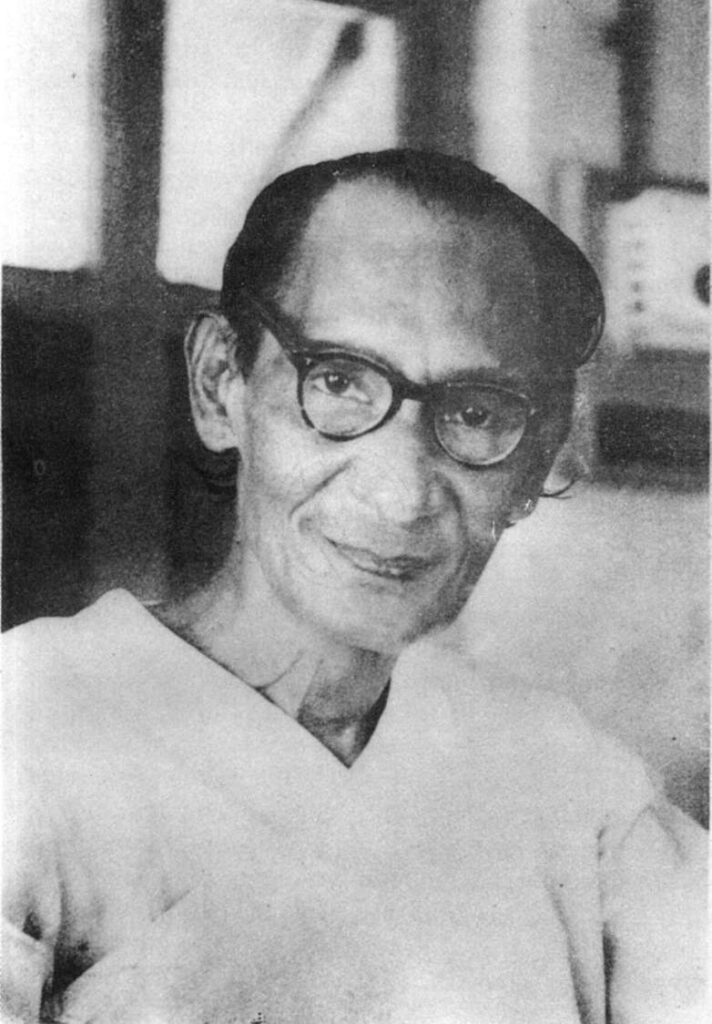
Rishabhchand had devoted the last decade of his life to the completion of his biography of Sri Aurobindo. Owing to his heavy work-load at the Furniture Service Department as well as the labour he had put in to complete Sri Aurobindo’s biography, he suffered from physical exhaustion and mental stress. Due to lack of adequate rest, his health began to fail. He suffered from insomnia and severe constipation. He also developed tuberculosis but he recovered from it. In a letter to the Mother dated 21 August 1964, he informed her that he was feeling very tired for the past few days and that his liver was upset. He had thought that the more work and exercise he did, the better would he feel so he had started taking long walks. But the outcome was that he began to find walking tiresome and the slightest exercise too made him feel weaker. The Mother wrote back: ‘The mind always tends to want to impose its rule on the body. But that rule is not necessarily the divine wisdom, and so the body suffers. Now you must give your body the rest it needs in order to recover its balance. With my blessings.’ (Collected Works of the Mother, Volume 17, p. 340.)
Around 1968-1969, Rishabhchand developed a heart ailment. The Mother, who kept a keen eye on his health, at one point of time told him that his heart-condition was getting ‘progressively worse’. Rishabhchand stopped taking the medicine prescribed to him and decided to take only what the Mother would tell him to take. In a letter written to Her around this time, he informed Her: ‘But if you want me not to take any medicine at all and to open myself exclusively to Your Omnipotence, I will do so gladly.’ The Mother replied: ‘The body needs to be cared for with physical but enlightened remedies.’ (Collected Works of the Mother, Volume 17, p. 349)
But when his health continued to deteriorate further, Rishabhchand appealed to the Mother: ‘I ardently pray to You to pull me out of this condition of bad health and make me progress integrally. You know that my soul’s only aspiration is to love You and serve You. Make me physically active in Your service.’ The Mother answered:
‘You have been and still remain a faithful servitor. Do not worry: if your body is no longer fit for physical work, take advantage of all the time at your disposal to develop your inner consciousness and unite more and more consciously with the Divine.
‘Reading, meditation, contemplation, self-giving, in silence and concentration, to the Divine who is always present to hear you and guide you. Blessings.’
Following the Mother’s approval, Rishabhchand started to take a sleeping-pill prescribed by Dr. Satyabrata Sen. But he was unable to work as diligently as before owing to his rapidly failing health. As he was suffering a lot, quite often he would pray to the Mother requesting Her to discard his physical body so that he could take up a new one. And this he did for a whole year. The Mother speaks about his will to leave to Satprem during the course of a conversation on 29 April 1970:
‘For almost a year he had asked me to leave. So, when he asked me to leave (he asked quite in earnest: he was suffering a lot, quite miserable), I did what I always do: I presented his request to the Supreme Lord and said to Him… And then, he didn’t leave. He recovered. He recovered and for some time he was much better. But his will to go remained.’ (The Mother’s Agenda, Volume XI)
On 24 April 1970 the Mother gave her Darshan on the occasion of the fiftieth anniversary of her final arrival at Pondicherry. Rishabhchand was in his room in the evening of that day. In the early hours of the following day, Rishabhchand was not found in his apartments. Considering his severely weakened health, one wondered how could he climb down the staircase and go out of his residence. Rishabhchand’s granddaughter Mounnou and Abhay Singh Nahar (youngest son of Prithwi Singh Nahar) cycled across the white town of Pondicherry to find Rishabhchand. While the search was going on, Rishabhchand’s lifeless body was discovered near the sea-shore, on the sand in front of the Distillery. The general suspicion was that he got drowned in the sea. But what bewildered many Ashramites was the fact that how did Rishabhchand — who could hardly walk a few steps without feeling giddy — climb down the staircase and walk all the way to the sea-shore which was situated at quite a distance! While many suspected that it was a case of suicide the autopsy report silenced such wild presumptions as no sea-water was found in his stomach. Four days later, on 29 April 1970, the Mother revealed to Satprem and Sujata Nahar the truth behind Rishabhchand’s demise: he was led by a secret hand to a fixed spot on the sea-shore where he saw the Lord and his soul was taken away by Him. According to her, Rishabhchand chose to leave his body as he had become tired of the age-related physical sufferings. To quote the Mother’s own words: ‘The Lord asked him to come and meet Him, and he got up—he got up, feeling it was the Lord calling him; he left his room and went to bang his head on the rocks — the Lord led him…
‘… You understand, he was really imploring to go, and he went out—he must have been guided where he had to go…
‘But I found it was… it was all guided so wonderfully! It was… (how can I put it?), to make myself understood, I prayed: I prayed that if it were really possible, well, let him be helped to leave. And that’s what was done (but I had done it the previous time).
‘It came just at the right time.
‘He had completed his work; you see, the first time when he asked to leave, he hadn’t completed his Life of Sri Aurobindo, while this time he had completed it — he had nothing more to say.’
When Sujata Nahar inquired whether Rishabhchand had come to the Mother after his departure, she replied:
‘Not in a form. I had an impression… Just when he left, I had… (I didn’t know anything about it, I was in my bed — I don’t sleep, of course), but I had a strange vision. I was someone (and afterwards I thought it was he, I was with him—I say “I” because that’s how it presented itself in the night, but I knew it wasn’t me: I knew it was someone else). The Lord had asked me to come and meet Him atop a mountain; so I went there, but I didn’t want others to know… (let me add one thing: it was in the night, just when the thing was taking place, which means that even physically, materially I didn’t know anything). I went to the meeting place, but I didn’t want others to see me, so I went to the top of the mountain and… I couldn’t see the Lord. I said, “How? He is there and I don’t see Him, how? He is hiding well.” And finally: “Now it’s time, I can no longer see Him….” And I went back down — I went back down, I met people and didn’t want them to stop me; then I had some difficulties, I saw people, and then I felt as if those people, the mountain and everything… were fading away, fading away more and more.And then, when the thing had faded away, it was time for me to get up, which means it was 4:30.
‘I was very preoccupied by that vision. Preoccupied, I wondered, “What can it be? What can it be, someone whom the Lord had asked to come and meet Him but who could not see Him?…” Then a few hours later, they told me (told me with the usual brutality), “Rishabhchand killed himself last night.”…
‘Then they explained: “His servant came, entered his room, and found Rishabhchand wasn’t there. No one had seen him go out, and the servant found him drowned on the seaside….’
‘I didn’t say anything, I strongly felt, IT’S NOT TRUE. Then afterwards — long afterwards — they told me about the police and how, finally, he was half in the water, half on the shore, and with a blow to the head. Then I understood. I understood that the Lord had asked him to come and meet Him… (Mother gestures as if taking Rishabhchand by the hand), had him leave his house. But in his consciousness (my “dream” must have stopped at the point where he physically lost consciousness), in his PHYSICAL consciousness, he could not see Him. Then it became clear!’
‘You know, I found that so marvelous! Because the experiences I have now… I never had such precise and concrete experiences, because these are experiences of the body. I had that experience, and when I got up in the morning, I wondered, “What on earth can this mean?…” I knew it wasn’t me, but I couldn’t know who it was. I knew it wasn’t me. “The Lord asked me to come and meet Him, I went to meet Him, and I could not see Him…”—his body left, and he saw Him.
‘Very interesting! I haven’t told anyone, I am only telling you.
‘I found it… You know, when I had the material proof that it was true, that he didn’t drown himself but died of an accident… but an accident that wasn’t an accident: he was led by the hand, “one” led him to the place where he banged his head.
‘It’s a magnificent thing…
‘And as I was identified with his physical consciousness, I felt the anguish he must have felt: “The Lord asked me to come and meet Him, but I cannot see Him….” And he didn’t want to be seen: “People must not see me, people must not see me….”’ (The Mother’s Agenda, Volume XI, conversation dated 29 April 1970.)
Such was the life and death of Rishabhchand — ‘all guided so wonderfully’—whom we fondly remember on the occasion of his 125th Birth Anniversary today.
____________
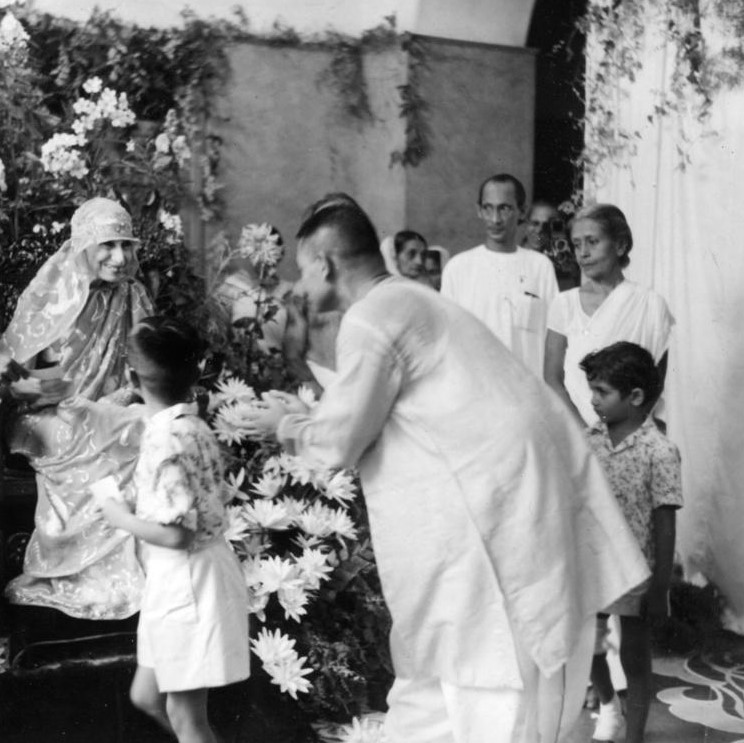
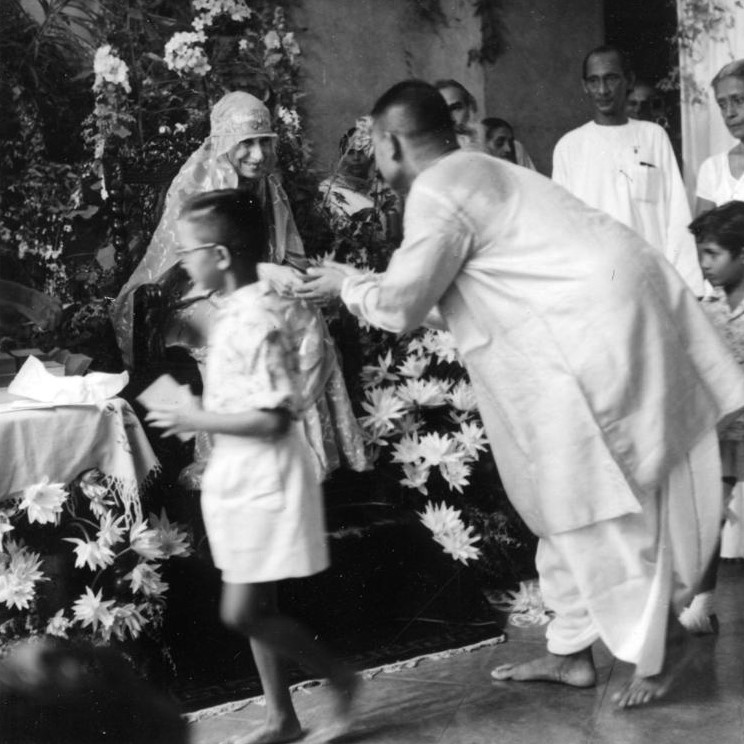
The following two photographs were taken on 11 October 1954. The Mother is seen here with Charu Chandra Dutt’s son and grandson, Amiya Devi, Rishabhchand Samsukha and Taralakshmi.
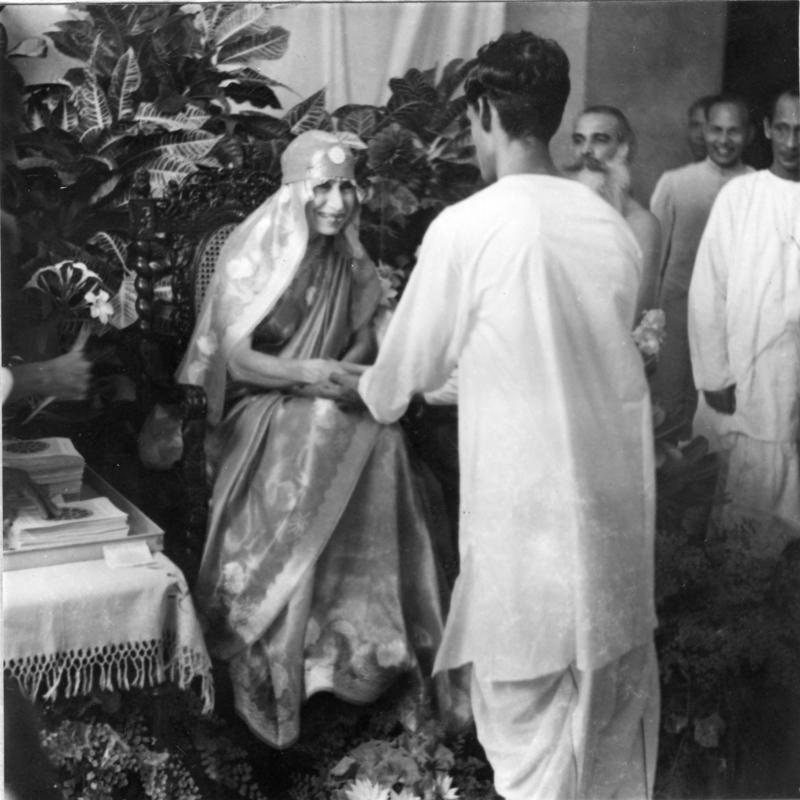
The Mother with Manoj Dasgupta, Rishabhchand Samsukha and Dr. Indra Sen on 1 November 1954.
________
About the Author: Born on 13th October 1984 to Jayanta and Sanghamitra Banerjee (eminent actress of Bengali cinema), Anurag Banerjee is a multiple award-winning poet, essayist, researcher, biographer and translator. A former faculty at NexGen Institute of Business and Technology, Kolkata and Sri Aurobindo Centre for Advanced Research (SACAR), Pondicherry, he established the Overman Foundation, one of India’s leading research institutes dedicated to the ideals of Sri Aurobindo and the Mother, at the age of twenty-five in March 2010. He has lectured in several national symposiums and seminars organized by Sri Aurobindo Centre for Advanced Research, Sri Aurobindo Bhavan (Kolkata), National Council of Education and Jadavpur University and authored more than two hundred and fifty research papers which have been published in anthologies and journals of repute. He is a Trustee of Sri Aurobindo Sakti Centre Trust which runs the Sri Aurobindo Bal Mandir School at New Alipore, Kolkata, and editor of Srinvantu, one of the oldest bi-annual journals of West Bengal dedicated to an exposition of the teachings of Sri Aurobindo and the Mother. In April 2011, he received the prestigious Nolini Kanta Gupta Smriti Puraskar awarded by ‘Srinvantu’ and Sri Aurobindo Bhavan, Kolkata. In December 2021 he received the Shiksha Bharati Award from the Indian Achievers’ Forum ‘in Recognition of Outstanding Professional Achievement & Contribution in Nation Building’. In 2024 he received the Golden Book Award (declared Asia’s most prestigious book award by the Business Standard newspaper) for his magnum opus, Sri Aurobindo and His Ashram in Contemporary Newspapers. On 15 August 2025, he was awarded the prestigious Sri Aurobindo Puraskar by Sri Aurobindo Samiti, Sri Aurobindo Bhavan, Kolkata, for his contributions to Aurobindonian Studies in Bengali.
What a beautiful life spent by Rishabhchand in the company of the Holy Mother and Sri Aurobindo.
The departure of his soul was indeed sad and painful, but blessed by God.
Thank you, Anurag, for sharing this excellent article.
Rishabhchand was a disciple worthy of Mother and Sri Aurobindo in terms of the work he accomplished and the qualities he offered. Thank you for your always insightful comments. Christian.
The ‘small sari shop’ became the largest one in Kolkata because Rishabhchand reduced profits to the minimum. But he left family and successful business and became an ashramite – the first of them who joined, following the stern discipline of the 30ies. Sadhana proceeded at full speed and Sri Aurobindo expected the supramental descent, hadn’t WWII interrupted the process for years.
Besides the biography, the Mother also asked Rishabhchand to write a compendium to introduce Sri Aurobindo to America. The Ashram still reprints the book, another masterpiece.
So great intellectual had a humble friend, Purod-da, a hard worker like him. Every evening Rishabhchand read aloud Sri Aurobindo’s poetry; when he reached the climax he turned to his friend… and invariably saw his friend deeply asleep, exhausted, his granddaughter Mounnou told me…
Rishabhchand was the brother-in-law of Jiji Kiran Kumari, the yogini who from the age of 18 onward assisted Mother in her room. For three months I lived with Jiji, with a special permission of the Ashram Trust. He was no more, but the halo of his presence was palpable; every afternoon I typed in Rishabhchand’s room, on his typewriter, passages from the manuscript of this explosive biography, still unpublished, making my bond with Sri Aurobindo-the-revolutionary unbreakable. The biography, and “The Doctrine of Passive Resistance” by the Master, were my initiation.
Heartfelt and grateful thanks for sharing this. Much valued.
Miel
SAICE, HC ’81
Awesome story of deep surrender despite apparent suffering. Evolution in and from the Matter is a super complex multidimensional phenomenon. Thank you, Anurag.