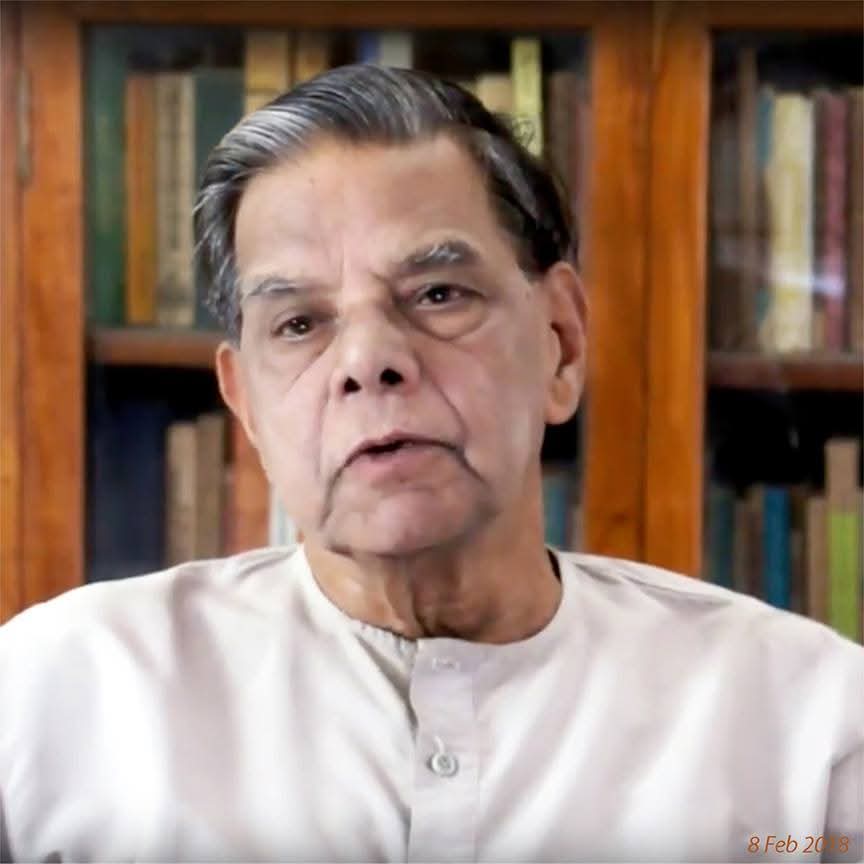
Dr. R.Y. Deshpande was interviewed by Pradip Kumar Sen for All India Radio, Pondicherry, and for JVR Cable TV for programmes broadcast on the occasion of 29 February 2000. The presentation given here combines both the interviews.
Question: In your opinion what is Sri Aurobindo and the Mother’s contribution to the people of Pondicherry, to the country and the whole world? How will the human race be fulfilled in their work? What does the new millennium mean for us?
Your question is very comprehensive and I do not know if it can really be answered in one short session. But I will try to touch upon just a few aspects.
Let us first talk about Pondicherry. And the context is Sri Aurobindo’s arrival here on 4th April 1910, in the afternoon, by the steamer SS Dupleix.
Sri Aurobindo came here and took shelter in Pondicherry. It was apparently to escape from the British clutches that he came here, seeking political safety. But actually he had received the divine command, adesh, and that brought him to Pondicherry. At that point of time, perhaps unknown to him in its details, was the avataric work he had to initiate. In that sense it was not he who took shelter in Pondicherry, but it was Pondicherry that took shelter in him.
Sri Aurobindo called Pondicherry the place of his retreat, the Cave of Tapasya. Pondicherry has that ancient tradition of doing Yogic sadhana. It is said that Rishi Agastya is the guardian spirit of this place. There was a Vedic school of learning here and hence it is also called Veda Puri.
Puducheri or New Town was known as Poduka to the Greek philosopher Ptolemy of the 2nd century A.D.
But with the arrival of Sri Aurobindo Pondicherry became New Town in its true sense. It has undergone a totally different transformation. Prior to his coming here the city was a ghost town. It was a cemetery with its full complement of ghouls. Deserted streets, sleepy population, shops of cheap wine, ruled by ruffians,—that was the condition during the French regime. The ideals of Liberty, Fraternity, Equality were not known to the crude bureaucracy, and poverty and precariousness had full sway over the town. A decadent feudalism had sucked the vitality of the people. The life here was immersed in full tamas. It was a God-forsaken place, without any hope in it.
It is to this place that now honour goes for being one of the most progressive and dynamic centres of activity. Commerce is flourishing; modern industry has taken deep roots, the professional population is increasing and is yet attracting newer and brighter talents from outside, even from abroad. The growth is so fast that it is becoming more difficult to cope with the ever-growing demands of modern industrial organisations. Infrastructure developments need a concerted effort to meet the expectations of these complex operations. Now prosperity is bursting at the seams, to the degree that the official machinery is unable to manage it.
Pondicherry is today a cosmopolitan place and has its own distinct flavour. Great experiments are being constantly tried here. The international City of Dawn, the dream-vision of the Mother that has come to reality in Auroville, has no parallel in the world. Perhaps there is a deeper reason behind this and it may be worthwhile to appreciate it. Even in a most superficial sense we may inquire if it has not given employment to a large number of persons. Has Pondicherry not come on the international map?
When the Mother came here in 1920, returning from Japan to stay here for good, she at once felt that she was entering the aura of Sri Aurobindo,—even as the boat bringing her here was two nautical miles away from the shore. We constantly live in that aura, even perhaps not knowing it.
But the work of Sri Aurobindo and the Mother is not confined only to this place; it is there for the sake of the country as well as for the sake of the world, for humanity. Perhaps, more appropriately, it is all in the will of the Divine.
The world itself has now become a global village. Conquest of space, information technology, genetic sciences, improvement of health, rapid growth in professional fields, the speedy and efficient development in industrialisation, trade, commerce, banking, management, are just a few outer manifestations of the collective mode of life into which more and more we are entering. And this is happening in every nook and corner of the world. Not that there are no problems, of drug trafficking, juvenile crime, terrorism on an unprecedented scale, constant skirmishes and clashes of the worst kind, of pollution, exploitation, human degradation. But from a deeper perspective these seem to be of a transient kind. Not that one should not be vigilant about such matters lest we do stupid things, but there need not be worrisome concern if we are sincere in our basic approach.
A firmer material basis for spiritual growth on such a dimension is something new in the entire history of mankind, something very welcome, something marvellous. The visible signs of the great work are there for all of us to see. Yes, we are living in a new millennium, nava yuga, that has brought a new dynamism of the spirit to our life, into our life. Such vast social changes take place only if a higher power can enter into life and mould it in its operative purpose and determination.
A society is shaped by its rishis and yogis, by mahatmas, swamis, the enlightened leaders, open-minded and open-hearted souls of the future, strong forerunners and pioneers, and it is in their tapasya, in their sacrifices that a new order is born. We are in the period of this renaissance and we must be thankful to the bringers of that prosperity, of every kind, to us. Our thanks have to be shown by living in this Hour of God, by standing in the truth of the purpose, in dedicating ourselves to it in all purity and sincerity and frank fearless candidness to its glory and greatness.
It is with that determination that we must see the work of Sri Aurobindo and the Mother.
But then what exactly was the work of Sri Aurobindo and the Mother? The aim for which they came here and which they unswervingly bore as their God-given mission? They saw in this creation the Will of the Supreme and did long and arduous yogic sadhana to achieve it, they visualised the possibility of the terrestrial evolution stepping into a new mode of growth and expansion in the scheme of operation here, of the arrival of divinity itself in our midst in its widening aspects, of the dawn of satya dharma, conduct in the truth taking the earthly existence to its completest fulfilment.
Well, these are big assertions and it is necessary that we look at them in the totality of their implications. The implications are universal, in fact the implications are divine in nature. Perhaps we may not be really able to gauge their importance and relevance.
This world has always been thought to be a nest of pain, as Keats would say. It is full of evil and falsehood and ignorance and death and these have had their sway all along. The cry of an ardent devotee praying to Govinda for the release of the soul from suffering and distress, to liberate it from this harsh worldly existence, from this death-bound and sorrowful life, bahu duḥkham iti saṁsāram, was one of the ancient ways to come out of the difficulty. Moksha was the cherished aim.
But that left the world as it was, sorrowful and death-bound. The individual soul escaped into the infinity of peace and joy but the world remained where it was. The samādhi of a Rajayogi, or the prema of a Bhakta, the kāyasiddhi of a Tantrik are great spiritual achievements, but these are not sufficient to take care of the problem of the world. Lao Tse spoke of absolute Reality which we cannot understand and about which nothing can be gainfully said. It can be experienced but not realised in life here. At the same time, we must assert that this world is not an illusion, nor can it be simply dismissed as something for ever worthless. There is a will behind this creation and our task is to find that will and live in it. It is a world for the habitation of God, īśa vāsyam idam sarvam, says the Upanishad and, in a way of speaking, we have to make it fit for His habitation. There is the divine will, divya or paraṁ saṁkalpa behind it.
What is the divine will behind this creation? According to Sri Aurobindo it is the universal incarnation of God in the material existence itself, in the body which is presently a nest of pain, bound by death and ignorance. But the body can open itself to divine life and divine knowledge, it can also know and in it become goldenly immortal, brahmavid brahmaiva bhavati as the ancient scriptures says. But how is this going to be achieved? If this is a distinct and realisable possibility, then what is the modus operandi to accomplish it? Sri Aurobindo’s Yoga-Yajna was for this Yoga-Satya. He saw that the only way to do it is to invoke the omnipotent Goddess, Mahadevi, and plead to her to take birth in human form. It is she who alone can work out the transforming miracle. To the earth’s dumb need must be brought down a radiant power which can take charge of this mortality and recreate it in the splendour of Truth and Consciousness and Delight, in Sachchidananda, the Triple Glory of the Transcendent.
Has this happened? Yes, it has happened. This has been the Yogic triumph of the omnipotent Goddess herself, or in avataric terms of Sri Aurobindo and the Mother, in the Will of the Supreme. The Mother always maintained that we are here upon earth to accomplish the work of transformation and in it is the divine fulfilment for endless progress. It is in that certitude that she declared that a new world is born, a wonderful world of delight. The things that were promised have been fulfilled in it. That marks a unique event in the Annals of the World, the epoch-making even of 29 February 1956. This was on a Wednesday, in the Playground, during the evening meditation after the Mother’s class.
Question: Why did the Mother select 29th February of every leap year as a Supramental Manifestation Day? Please explain to our listeners and viewers what exactly happened on this day in 1956.
Let me first dispel the impression that the Mother selected 29th February 1956 as the day of Supramental Manifestation. All that we can say is that it happened on that day, on a Wednesday. On Wednesdays the Mother used to take classes in the Playground and there used to be a brief meditation at the end. It happened during the meditation on this day. She was anticipating that something would happen soon and a few others also had a kind of vague intuition of the event likely to take place in that year. She had given earlier an indication to that effect. But there was never a question of selection, not at all. Celebrating its occurrence, its anniversary every leap year is then quite understandable.
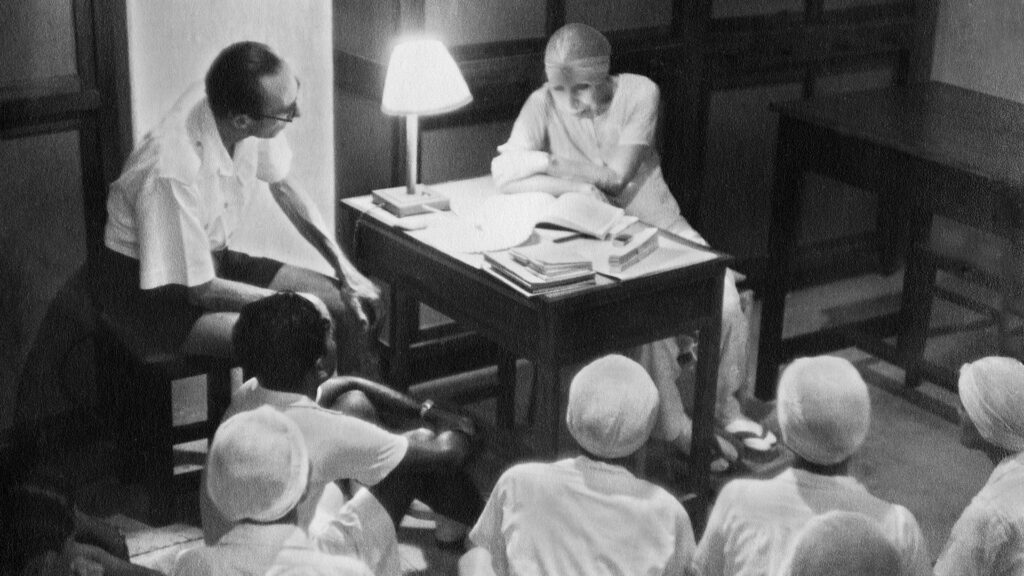
Well, to describe it briefly. During the meditation the Mother saw that there was a golden door separating the world from the Divine. As she looked at the door she at once knew, and willed, in a single movement of consciousness that the time had come. It was a will and not a thought or deliberation. She at once knew that the time had come. Lifting with both hands a mighty golden hammer she struck one blow, one single blow, and the massive door was shattered to pieces. Then the supramental Light and Force and Consciousness rushed down upon earth in an uninterrupted flow. That is how she describes it. She wrote it down on a piece of paper on the same day after returning to her room.
The Upanishadic golden lid was removed and the divine Illumination flooded the subtle physical of the earth. Now in it shall grow here the Law of the Truth, Satya Dharma.
It happened on a Wednesday. In the South there seems to be a belief that Wednesday is more golden than gold. For the sake of Wednesday one will even forgo gold. Well, by taking a sudden leap, that hiranmaya or golden Supermind did manage to be in time to catch the golden Wednesday!
Afterwards the Mother wrote the message which was later distributed in 1960:
Lord, Thou hast willed, and I execute
A new light breaks upon the earth,
A new world is born
The things that were promised are fulfilled.
That is the significance of the great event. Maybe we can appreciate it better in the context of the spiritual history of the earth.
In the deepest sense it is concerned with the possibility of a divine life with all its progressive richness here itself, in this mortal world, mṛtyuloka. There were a few attempts made earlier on an individual level, as an aspect of spiritual realisation but not on a collective level as an aspect of manifestation. In the Vedic times Rishi Agastya tried to transform his body but found it difficult. The body could not hold the transcendental splendour in it; it was atapta tanu, unbaked vessel. The golden body of Agni, hiraṇya tanu or divya tanu, remained only a heavenly grandeur. Rishi Vamadev lived a life of sixteen years in the state of immortality and finally had to give it up. The Greek mystic Pythagoras had a thigh of gold, indicating that a part of the lower subconscient nature had been transformed. Occultists and saints talked about the glorious body but it was a far-off possibility,—meant not to be realised presently. Now the yoga-tapasya of Sri Aurobindo and the Mother has changed the whole thing. Their entire endeavour was to fix the Supermind in the physical. Sri Aurobindo found that it was coming but not staying here lastingly; it was coming and going and could not remain for too long in the body. But then in a supreme Yogic bid he fixed it in his body on 5th December 1950 and made it a permanent base for its universal operation. Not too long after this unparalleled Yogic action, just within six years of this Great Act of Sri Aurobindo, the Mother accomplished the miracle by smashing the golden door that separated the world from the Divine. Such is the spiritual meaning of the action of the incarnate Power, of Mahashakti, the omnipotent Goddess.
Now a new world is waiting at our doorstep, waiting to be called in. To prepare ourselves to receive it, and to be a part of it is our responsibility.
That, in my view, is the significance of this day, 29th February 1956.
Would you please explain in this context the importance of the four aspects of the Divine Mother, the four leading powers and personalities that have stood out in this universe?
You are asking a difficult question. In the tradition of the Upanishads, the disciple approaches the Rishi and solicits him for the Knowledge of the Eternal, Brahmavidya. I do not have any personal knowledge through spiritual experience about these four aspects of the omnipotent Goddess, her powers as Wisdom, Strength, Harmony, Perfection—Maheshwari, Mahakali, Mahalakshmi, Mahasaraswati. I don’t think we can speak about them in the manner of a Rishi. But we may try to understand something of these powers from what Sri Aurobindo has written about them in his little magnum opus The Mother. This answer of mine has therefore severe limitations; it is essentially paraphrasing The Mother. But perhaps it might help us at least to mentally understand something of the eternal Truth given to us by him.
If, en passant, we are to hazard a guess as to which books of Sri Aurobindo will live for the millennia to come, then we might say that these are his supremely revelatory epic Savitri, the grandest formulation of the vision of new humanity given in The Life Divine, and the neo-Tantrik scripture of the integral yoga, his The Mother. It is in this Tantra Vidya that we meet the four great aspects of the supreme executive Power of the Divine not only as presences but also as embodied persons.
The concept, so to say, of the four aspects of the Mother as given to us by Sri Aurobindo is not altogether new. But it puts in focus the active powers that are presently operating in this creation. In the Vedic tradition,—and also in that of the Gita,—it is the Purusha who is represented in his several expressions for upholding the universe. But Sri Aurobindo sees them as mights, powers, aspects of one transcendental Shakti.
The hierarchy of these powers is something like this. At first we have the Original Transcendental Shakti, call her if you like parātpara, Aditi, omnipotent Goddess, Mahadevi, or Consciousness-Force or Chidshakti or the Divine Mother who is closest to us. What we describe as Nature or Prakriti is only the outward aspect of the supreme executive force. Nearer to us but above she is the supramental Mahashakti. She has the power of divine omniscience and divine omnipotence, Knowledge and Will. On an intermediate plane she is Mahashakti of the triple world of Ignorance. It is here that the four powers of this Mahashakti operate and govern the evolutionary world.
Maheshwari is the Power of Wisdom. She, with her knowledge, opens us to the worlds of Sachchidananda. Hers is a personality tranquil and wonderful, calm, one who knows everything, comprehends everything. She is Mother to all, even to the hostile, to gods and to men and to demons. In her wisdom she has always with her the divine concern.
Mahakali is Force and Strength. She rushes with divine impetuosity to shatter all limits, destroy all obstacles. She is the Warrior of the Worlds, her spirit tameless and her action straight and frank. To knowledge she gives a conquering might.
Mahalakshmi is the Power of eternal beauty, of charm, harmony, love, sweetness. In our relationship with her is our profound happiness and she is one who lavishes the riches of the spirit when we open to her. God-plenty and God-abundance are her special gifts to us.
Mahasaraswati is the Mother’s Power of Work. Order and perfection are what she brings to all that she does and supports. Attention to details is her untiring concern. She is strong, she is attentive and conscientious, she is skilful and efficient in all that she undertakes to do. Her work is flawless and in its technicalities and minutiae nothing is forgotten. She is kind, smiling, close, helpful and is the most easily approachable.
We do not have any such description of the Powers of the Supreme in the Veda. The Gita speaks only of Para Prakriti and Yoga Maya. But the elements of these powers can be traced in them also. The Vedic Purusha Sukta is a Hymn of Sacrifice of the Divine Being. When it talks of the four parts of that Being, we then at once see that Maheshwari is his head, Mahakali his arms, Mahalakshmi the heart, and Mahasaraswati the feet. In the four orders of society of the Gita we have a correspondence of Maheshwari as the Brahmin, Mahakali the Kshatriya, Mahalakshmi the Vaishya, and Mahasaraswati the Shudra. It is in this Chaturvarna established since ancient time, as the Gita also declares, that we see psychological justification for the fourfold soul-force operating in the world. That in the present mode of existence is an aspect of the divine functioning itself and behind it there is the eternality of the transcendental Mahashakti herself.
Take any society and any time in the history of civilisation and we recognise that these four aspects have always been present. There have been Brahmins all over the world and workers and businessmen and heroic people and warriors. Men of learning, men of adventure and mighty action, men of commerce and trade, men of professional skills,—where are, or in a dynamic culture, when were they absent? Plato and Einstein were Brahmins; Julius Caesar and Eisenhower were Kshatriyas, Henry Ford and Bill Gates must be considered as Vaishyas, so too the unnamed builders of Hagia Sophia and the New York skyscrapers as Shudras. The essential qualities behind them all are universal and are the manifestations of these Four Powers.
The present degradation of Chaturvarna in India is a totally unacceptable distortion. It has become so because of the heavy tamas that spread over the country for the past several centuries and there is nothing really Indian in it. It has to go. It has, on the basis of what is called caste, which was never there, reduced rather fissured the country into smaller and smaller bits. But this illegitimate division can go away not by choices and preferences, by laws or edicts or ordinance, nor by priority promotions. It has to go by a reorganisation of our society in the values of knowledge, strength, harmony, perfection. Each one has to recognise the basic precept, the dharma, the inner working of one’s own soul and act in it. Well, that is how I understand the role of the four aspects of the Mother in upholding the order of the society. It is based on inalienable psychological principles and any departure from them will have its disharmonious consequences.
But in the Yogic vision and experience of Sri Aurobindo there are also the higher powers of the omnipotent Goddess who have not yet come down into the evolutionary play. These can come down only when the Truth-dynamism of the Transcendent, the creative Supermind, descends into it. This has now happened and there shall be hence the multifold order, far beyond the Chaturvarna System, which shall organise life in the meaning and purpose of the Spirit.
Can you please say something about the contact you had with the Mother?
It is unfortunate that I came in contact with the Mother rather late.
But I am also fortunate in yet another sense. I received blessing directly from the Mother on many occasions; I visited the Ashram several times for the Darshan, received messages, received napkins from her, also groundnuts in the Playground.
Yes, my very first contact with the Mother was on 12th December 1950 when she gave blessings for the first time after Sri Aurobindo’s passing away. The message carried Sri Aurobindo’s calm and triumphant Samadhi picture, of the God of Light sleeping in a mystery-flame. The envelope in which the photo was put has a beautiful painting in oil, of a mountain rising in its tranquil serenity. The message has the Mother’s prayer to the physical body, the inscription that we have now on the Samadhi. It also asserts that whatever Sri Aurobindo had come to do he accomplished fully, that he “attempted all, prepared, achieved all for us.” It is necessary that we recognise it and live in it.
Well, this contact of mine with her may sound like that of 50 years of contact, yet I feel that I came in contact with her rather late. Perhaps that is also her way of showering grace on us!
_________
About the Author: Born on 17 April 1931 Dr. R.Y. Deshpande is a professor, philosopher, author, poet and inmate of Sri Aurobindo Ashram, Pondicherry. After graduating from Osmania University, Hyderabad, he joined the Tata Institute of Fundamental Research, Mumbai as a research physicist in 1955 and worked in this organization till 1957. In 1957 he joined the Bhabha Atomic Research Centre, Mumbai where he worked till 1981 and headed several Atomic Energy and Space Projects in Advance Technology with Dr. Raja Ramanna. Having received his Ph.D. in nuclear physics in 1964, he worked at the Lawrence Berkeley Laboratory, Berkeley, California USA from 1964 to 1965. He has some fifty research papers published in national and international scientific journals. He was also an examiner for a number of Ph.D. theses in the field of Solid State Physics. In 1981 Deshpande joined Sri Aurobindo Ashram of Pondicherry. For thirty years, he taught physics and a few other subjects such as Astrophysics, Savitri, The Future Poetry, Science and Society at the Sri Aurobindo International Centre of Education. For eight years he was the associate Editor of Mother India, a Monthly Review of Culture, published by the Sri Aurobindo Ashram. During 2007-2008 Deshpande was the editor of a web-magazine titled Science-Culture-Integral Yoga founded in Los Angeles. His published works in prose and poetry include titles like Sri Aurobindo and the New Millennium, Vyasa’s Savitri, The Ancient Tale of Savitri, “Satyavan Must Die”, All Life is Yoga, Nagin-bhai Tells Me, The Rhododendron Valley, All is Dream-Blaze, Under the Raintree, Paging the Unknown, The Wager of Ambrosia, Savitri: Notes and Comments, Elements and Evolution, Sri Aurobindo’s Narad, The Birth of the Sun-God, Hymns to Becoming, These Mountains, The Secret Knowledge, Savitri Talks: The Symbol Dawn, Islam’s Contribution to Science, Big Science and India, Running Through Savitri, A Look at the Symbol Dawn: Observations-Comments-Discussions, Savitri: The Poetry of Immortality, and Sanatana Dharma: An Aurobindonian Perspective to name a few. He has also edited the following books: Nirodbaran: Poet and Sadhak, Amal Kiran: Poet and Critic and Perspectives of Savitri.
“But actually he had received the divine command, adesh, and that brought him to Pondicherry”:
‘I may also say that I did not leave politics because I felt I could do nothing more there; such an idea was very far from me. I came away because I did not want anything to interfere with my Yoga and because I got a very distinct adesh in the matter. I have cut connection entirely with politics, but before I did so I knew from within that the work I had begun there was destined to be carried forward, on lines I had foreseen, by others, and that the ultimate triumph of the movement I had initiated was sure without my personal action or presence. There was not the least motive of despair or sense of futility behind my withdrawal. For the rest, I have never known any will of mine for any major event in the conduct of the world affairs to fail in the end, although it may take a long time for the world-forces to fulfil it. As for the possibility of failure in my spiritual work, I shall deal with that another time. Difficulties there are, but I see no cause for pessimism or for the certification of failure.’ [pp. 26-27; Complete Works of Sri Aurobindo, Volume 35 (‘Letters on Himself and the Ashram’)]
‘These are the facts of that departure. I was in the Karmayogin office when I received word, on information given by a high-placed police official, that the office would be searched the next day and myself arrested. (The office was in fact searched but no warrant was produced against me; I heard nothing more of it till the case was started against the paper later on, but by then I had already left Chandernagore for Pondicherry.) While I was listening to animated comments from those around on the approaching event, I suddenly received a command from above in a Voice well known to me, in the three words; “Go to Chandernagore.” In ten minutes or so I was in the boat for Chandernagore. Ramchandra Majumdar guided me to the Ghat and hailed a boat and I entered into it at once along with my relative Biren Ghosh and Mani (Suresh Chandra Chakrabarti) who accompanied me to Chandernagore, not turning aside to Bagbazar or anywhere else. We reached our destination while it was still dark and they returned in the morning to Calcutta. I remained in secret entirely engaged in Sadhana and my active connection with the two newspapers ceased from that time. Afterwards, under the same “sailing orders”, I left Chandernagore and reached Pondicherry on April 4th 1910.
‘I may add in explanation that from the time I left Lele at Bombay after the Surat Congress and my stay with him in Baroda, Poona and Bombay, I had accepted the rule of following the inner guidance implicitly and moving only as I was moved by the Divine. The spiritual development during the year in jail had turned this into an absolute law of the being. This accounts for my immediate action in obedience to the adesh received by me.’ [pp. 89-90, Complete Works of Sri Aurobindo, Volume 36 (‘Autobiographical Notes and Other Writings of Historical Interest’)]
DR. MANILAL: Why did you choose Pondicherry as the place for your sadhana?
SRI AUROBINDO: Because of an Adesh, a Command. I was ordered by a Voice to come here. When I was leaving Bombay for Calcutta, I asked Lele what I should do about my sadhana. He kept silent for a while, probably waiting to hear a voice from within, and then replied, “Meditate at a fixed time and hear the voice in the heart.” I didn’t hear any voice from the heart but a quite different one from above, and dropped meditation at a fixed hour because meditation was going on all the time. When Lele came to Calcutta and heard about all this, he said to me, “The Devil has caught hold of you.” I replied, “If it is the Devil, then I will follow him.” The same Voice from above brought me to Pondicherry.
(Nirodbaran, ‘Talks with Sri Aurobindo’, 10 December 1938)
‘Sri Aurobindo called Pondicherry the place of his retreat, the Cave of Tapasya. Pondicherry has that ancient tradition of doing Yogic sadhana. It is said that Rishi Agastya is the guardian spirit of this place. There was a Vedic school of learning here and hence it is also called Veda Puri.’—R.Y. Deshpande
‘In those days there was in the College de France [sic] in Pondicherry a French professor named Jouveau Dubreuil — later on he became quite a well-known name — who had been engaged in research in ancient history and archaeology. We knew him quite well. He was at that time working on the early history of Pondicherry. From a study of the ancient documents and inscriptions he discovered that the city of Pondicherry, which I have called a city of the dead, had at one time been known as a city of the Veda, veda-puri. That is to say, it had a centre of Vedic learning. And this Vedic college, our professor found from ancient maps and other clues, was located exactly on the spot where the main building of our Ashram now stands.
‘According to ancient tradition, the Rishi Agastya came to the South to spread the Vedic lore and the Aryan discipline. His seems to have been the first project for the infusion of Aryan culture into the Dravidian civilisation.’
Nolini Kanta Gupta, ‘Reminiscences’ (Pondicherry: Sri Aurobindo Ashram, 1969), p. 47. (Translated from the Bengali).
‘According to the archaeologist, Prof. Dubreuil of Pondicherry, on this very site there stood thousands of years ago, a Vedic College, a centre of culture. The legendary Patron of the city was the great sage Agastya.
‘Dubreuil further says that the town’s real name was Puducheri, which meant a new town. But it was quite ancient. It is not known exactly how old it is. From what is engraved on the stone wall of the temple of Vedapurishwara, we know Pondicherry was once called Vedapuri, that is, a city of Vedic culture.’
Narayan Prasad, ‘Life in Sri Aurobindo Ashram’ (Pondicherry: Sri Aurobindo Ashram, 1965), p. 7.
‘A French savant, Professor Jouveau Dubreuil, who was then at the College du France [sic] in Pondicherry, did some valuable research in local history and archaeology and came upon the discovery that at one time long long ago the place had been called Vedapuri and was a centre of Vedic studies in the South, with a temple dedicated to Vedapurishwara; and by tradition the sage Agastya himself was the guardian spirit of the city which was also a university. The French professor even proved — “from ancient maps and other clues” — that this old centre of Vedic studies had been located in the exact spot where Sri Aurobindo ultimately fixed his permanent dwelling in Pondicherry.’
K.R. Srinivasa Iyengar, ‘Sri Aurobindo: A Biography and a History’ (Pondicherry: Sri Aurobindo Ashram Trust, 1972), p. 676.
‘The Uttara Yogi [Sri Aurobindo] came and settled down for tapasya at Pondicherry, not far from a place where, tradition records, a great centre of Vedic learning had once prospered under the aegis of the legendary Agastya, the patron saint of the South.’
M. P. Pandit, Light from Sri Aurobindo (Pondicherry: 1966), pp. 6-7.
‘The greatest spiritual sages in India have always been careful in selecting the site which was to become the SEAT of their attainment. Pavitra told me that the renowned French archaeologist Jouveau-Dubreuil found evidence that it was on the exact spot where the great Rishi Agastya and his spouse Lopamudra had made their arduous endeavour of digging through to the “Sun dwelling in the darkness” that Sri Aurobindo and Mother established THEIR seat. Thus the work begun in the Vedic times saw its completion—and more—in this twentieth century.’
Sujata Nahar, ‘Mirra the Occultist’ (Paris: Institut de Recherches Evolutives, 1989), p. 57.
A Thousand Years of the History of Pondicherry
In the June 1935 issue of the ‘Semeur’, page 142, we wrote the following: “We arrive at the conclusion that our city is extremely ancient.” This hypothesis has been confirmed in the most comprehensive fashion possible. We reasoned thus: every ancient city in this country generally has an old temple, often covered with inscriptions. Now, at the time of Dupleix, a temple was destroyed whose ruins were used to construct the Catholic cathedral. The inscriptions on those blocks of granite are enough to demonstrate the antiquity of the city.
We asked dear Brother Faucheux to look for Tamil inscriptions at the cathedral. He, with the assistance of the Reverend Father Lourdessamy Marie, found five inscriptions of immense importance for the history of our city. Without delay we sent a copy of these inscriptions to Professor K. A. Nilakanta Sastri of the University of Madras.
Of the first inscription, the learned professor says: “This is the most ancient of the fragments that you have sent me and I believe it belongs to the tenth century, not later than the era of Raja-Raja I.” If the inscription dates from the tenth century, the temple may have been built long before this. Such a discovery ought not surprise us. In fact, even in our own time, the cathedral is called by the people “Swayambhukoil”, from the name of the temple that was situated in the same place. Now, Ananda Ranga Pillai, writing in his diary under the date 8 September 1748, tells us that the lingam of the temple was swayambhu, and Gopinatha Rao (Hindu Iconography, vol. II, part I, page 81) informs us that when a lingam is swayambhu, that is, owes its existence to itself, it was not made by the hand of man and has existed in that place “from time immemorial”. Thus the very name of the cathedral proves that Pondicherry has existed from time immemorial.
As to the second inscription, Professor K.A. Nilakanta Sastri writes: “One reads here the names of the king Kulottanga Chola and of the god Agastya, in characters of the twelfth century.” The inscriptions thus pass all our expectations, since we find in them even the name of a Chola king.
A third inscription is in the writing of the thirteenth century. Finally there are two other inscriptions of the fourteenth century.
We thus have inscriptions which cover all the Middle Ages, in this way showing the continuous prosperity of the city.
We have proved that it is very old. We now will demonstrate that it was consecrated to the Vedas.
We read in fact on page 70 of the book ‘L’Inde antique’ by P. Masson-Oursel: The Veda, in the widest sense, designates not a text, but the totality of “knowledge”.
Was Pondicherry a city of intellectuality, a city of “knowledge”. This is what we intend to demonstrate.
Each time Ananda Ranga Pillai spoke of the temple destroyed in 1748, which was located on the present site of the Catholic cathedral, he called it “The Vedapuri Ishwaran Temple”.
What does this word mean? . . .
Many temples have names containing the word “Puri” which means “City”. Now the city in question is the one in which the temple is built. For example, the temple of Brahmapurishwara at Brahmadesam. (Villupuram Taluk), the temple of Vygrapurishwara at Thiruppulivanam (inscription no. 198 of 1923) — for Puli-vanam is the translation of Vygrapuri.
Thus there is no doubt that Vedapurishwara of Pondicherry signifies: Shiva who lives in this temple situated in the city consecrated to the Vedas.
Now a city called Vedapuri is a Vedakki. For example the city of Vedikkudi, in Tanjore Taluk, has a celebrated temple of Vedapurishwara.
A city consecrated to the Vedas was always inhabited by “men learned in the Veda”, a city (kudi) inhabited by Brahmans instructed in the Vedas. These professors of “knowledge” were known as “Vedis”.
Thus, from time immemorial, the City of Pondicherry, inhabited by sages, has been dedicated to the Vedas, that is to “Knowledge”.
Let this thought be a stimulant for the young generations; the men of today and tomorrow ought to be worthy of their ancestors.
(Article by G. Jouveau-Dubreuil first published in ‘Le Semeur’, September 1935. Translated here from ‘Revue Historique de l’ Inde Francaise’, vol. 8(1952): 158-60.)
Pondicherry in Antiquity
A fact that has not been sufficiently stressed until now and that is of great importance is that the place where Pondicherry is located enjoys absolutely exceptional conditions of habitation.
First and foremost, there is the miracle of its artesian wells. Here, alone in the whole of South India, drinking water issues naturally from the earth. The region of Pondicherry is therefore an oasis on the burning Coromandel Coast. In addition one can have two or even three harvests a year, because this well-watered soil is also very rich.
With clay are made the bricks that are used to build a durable city and, by a marvellous coincidence, in the neighbourhood are chalk quarries that give excellent lime.
Finally Pondicherry is located on the seashore at the mouth of a river. Given such exceptional conditions one cannot but conclude that Pondicherry has always been a great city.
At the present time Brahminical cremation is performed in the suburbs of the town. Now, it is at a short distance from that place that, in the prehistoric period, the dead were buried. Dear Brother Faucheux has discovered at Pak-kamudiyanpet a very old prehistoric cemetery, where one finds hatchets of polished stone.
When Aryan civilisation penetrated South India, Pondicherry was one of the first cities to adopt Brahmanical culture, because it was situated on the Kashi Road, that is, the highway between Benares and Rameshwaram. We have a proof of this assertion in the fact that the Swayambhu-lingam of the temple of Vedapuri was worshipped by the sage Agastya. The god of the temple in fact carries the name of Agas-tyeshwara in the inscription discovered by dear Brother Faucheux near the Catholic cathedral, to be precise in the garden of the present archbishop’s mansion.
In Nangupatti, in Travancore, the god Agas-tyeshwara (Inscription no. 157 of 1914) was worshipped by Agastya, as it is very clearly said in Inscription no. 343 of 1914. The word “Agastyeshwara” means “god of a temple where Agastya worshipped”.
The Rishi Agastya is one of the authors of the Rig-veda (see ‘Agastya in the Tamil Land’ by K. N. Sivaraja Pillai, page 1) and his famous exploit is to have brought Aryan civilisation to South India from the North.
Thus the Swayambhu-lingam of the town of Vedapuri (Pondicherry dedicated to the Vedas) was adored by one of the authors of the Vedas, who brought Brahmanism to South India following the Kashi Road; and, because of this, Shiva, god of the Pondicherry temple, was known as Agastyeshwara, that is to say, the “Lord of Agastya”.
Now, in principle, every temple that possesses a Swayambhu-lingam has existed from time immemorial; and every temple whose god was worshipped by Agastya is among the most ancient in South India. This is precisely the case of Pondicherry.
It is therefore indubitable that Pondicherry was a celebrated city in antiquity. We have a striking confirmation of this in the fact that Pondicherry was mentioned by Ptolomy. The celebrated geographer who lived in the first half of the second century of our era described the Coromandel Coast from north to south. He mentioned Khaberos (Kaveripatnam) and Sub-ura, both situated at the mouth of the Khaberos (Kaveri) in the land of the Soringes or Sores (the Soras or Cholas). To the north, the geographer speaks of the land of the Aruarnes, which evidently is Aruva-nadu. Now this country is well known because, in the plates discovered at Bahur, near Pondicherry, by Mr Delaffon, it is expressly said that Bahur is one of the cities of Aruva-nadu. Moreover, Ptolomy says further: “In the land of the Aruarnes, Pokuke, marketplace”. This evidently is our Pondicherry.
Many authors have thought of making this identification and dear Brother Faucheux was of the opinion that it should be accepted. But until now I considered that the antiquity of Pondicherry was not proven.
Today, now that we know that the cemetery of Pondicherry goes back to the prehistoric epoch, that the lingam was swayambhu and that the sage Agastya worshipped it, that the city, visited by this author of the Vedas, was consecrated to the Vedas, today we have absolute proof that a temple covered with inscriptions, and already extremely old, existed in the tenth century. All these considerations force us to accept that Puduchery, the Poulecere of the Dutch, is in fact the Poduke of Ptolomy.
(Article by G. Jouveau-Dubreuil first published in ‘Le Semeur’, 20 October 1935. Translated here from ‘Revue Historique de l’ Inde Francaise’, vol.8 (1952): 161-63.)
A Very Topical Discovery : Pondicherry, Suburb of Ozhugarai
Barros, in 1553, mentions Pondicherry among the Portuguese settlements on the Coromandel Coast, spelling it Puducheria. It is now certain that “Pondi” is a corruption of pudu. The Pudu of Barros became Pude on the map of Samson d’Alberville around 1600, and the letter ‘e’ was changed to ‘I’.
The name of the town thus is Pudu-cheri, that is, the new cheri. The word cheri has a very clear meaning. It is a suburb. By definition it is not a hamlet or a village but a district outside a large town. This supposes the existence of a large town. What was the name of that town?
At the end of October 1936 the epigraphic service of Madras was kind enough to send to Pondicherry M. V. Venkattasubba Ayyar to copy the inscriptions in French territory. We applied ourselves to a very attentive study of the old stones of Pondicherry.
Normally, on almost every inscription, one ought to read the name of the city where the temple is located. But one might have feared that our inscriptions were too fragmentary. Happily, as chance would have it, on three of our five inscriptions the name of the town has come down to us, and three times we find repeated the name Ozhugarai.
It is known from inscription no. 1898 of 1902 that Villianur was in Mattur-nadu. now the inscription no. 42 of 1919 at Marakkanam has revealed to us that Ozhugarai was also known as Kulottunga-Chola Nallur and that it was located in Matta-Nadu.
At Kottakuppam, to the north of Pondicherry, there exists, on the Marakkanam road, a little temple dedicated to Anandishwara, where I had previously found a stone with an inscription. M. V. Venkatasubba Ayyar read that this inscription commemorated the gift of a plot of land to the temple of Anandishwara by an inhabitant of the place and that the name of the city was Ozhugarai alias Kulottunga-Chola Nallur. At the Pondicherry Cathedral there are two stones that have written on them the name of the god Agastishwara (Shiva adored by Agastya); so it is certain that these are parts of the ruins of a temple of Agastishwara that existed in the same place.
Now, the deciphering of one of these two stones, the one discovered a year ago by dear Brother Faucheux, is absolutely precise. It is clearly-said in this inscription that a donation was made to this temple, which is a temple of the god Thiru Agastiswara, and which is situated in the town called Ozhugarai, alias Kulottunga-Chola-Nallur. Thus, it cannot be denied that the place where the cathedral now stands was in the old city of Ozhugarai. Here is the text of this inscription which is of the twelfth century: “Ozhugari yana Kulottunga Chola —Nallur Udaiyar Tiruvagattisira — Mudaiya Nayanar ivur Kani udaiya Mongattu Tannu . . .”. This cannot be translated other than this: “This Tannu . . . of Mangadu has made a gift of a Kani (plot of land) to Agastishwara, god of this temple, situated in this town called Ozhugarai alias Kulottunga-Chola-Nallur”.
We thus have a complete and clear sentence, and it is impossible to interpret it in different ways, for we are certain from two inscriptions that the ruins found at the cathedral come from a temple of Agastiswara and that this temple, standing on the site of the present cathedral, was located in the town named Ozhugarai.
But this is not all. There is an inscription on the edge of the well of the kitchen of the Mission (next to the cathedral). A translation of this inscription lets us know that this inscription commemorated a donation to the same temple. But this donation was recorded by the official of the town where the temple was located, and this town was called Ozhugarai: “Nattukkanak-ku Ozhugarai Udaiyan eluttu”.
Finally, the inscription of the tenth or eleventh century that we studied last year calls the temple kil-kovil (kij-koil), that is to say, situated on the eastern part of the town. Ozhugarai thus extended from the present cathedral, which was to the east of the town, up to on the western side, the present village of Oulgaret, whose temple doubtless was the mel-koil, that is to say, the temple of the Lord at the western end of the town.
It is worth noting that the inscription on the edge of the well is of the fourteenth century. It follows that at the time of the coming of the Portuguese, at the beginning of the sixteenth century, Pondicherry was still a suburb of Ozhugarai.
At the present time Oulgaret is the name of a part of the suburbs of Pondicherry which has kept the illustrious name which formerly was used to designate the entire urban agglomeration stretching between Pondicherry and the present Oulgaret, Pondicherry being the eastern part, and the present Oulgaret the western part.
The king Kulottunga who attached his name to the town, and who, consequently, was the patron of the old city of Ozhugarai, was probably Kuluttunga I (1070-1120). We know that our city was called Kulottun-ga-Chola-Nallur in 1192 (inscription no. 364 of 1918) and that Kulottunga I was interested in the area (inscription no. 198 of 1919 at Tirub-hubvane, 1097 A.D.).
It is probable that it was at the end of the eleventh century that Ozhugarai received the title Kulottunga-Chola-Nallur. The “good city” of such a great king certainly must have been noble, and its suburb Pondicherry, celebrated as a grand port in the era of the Periplus (first century) and of Ptolemy (second century) was proud of its rich temple of Agastishwara.
The old inscriptions proclaim that Ozhugarai and Pondicherry, its suburb, were noble, rich and celebrated.
Four kilometers from Pondicherry, in the country, is the village of Ozhugarai, sometimes called Ulavarkarai. Professor S. Vaiyapuri Pillai of the University of Madras, who is the most competent Tamil scholar, informed me that it was absolutely impossible to derive Ozhugrai from Ulavar-Karai which would mean “village of farmers”. As to the word Ozhugarai, found in the inscriptions of Pondicherry, it is not possible to hesitate among several meanings. There is only one possible etymology: Ozhugu-arai. Now, Ozhugu means “oozing”, and arm, “rock”. The word thus means “the country where the rock oozes”. When I communicated this information to dear Brother Faucheux, who is not only a great archaeologist but also a geologist, he answered, “the stone which constitutes the soil or the sub-soil oozes during the monsoon, and even at the end of January. I have clearly observed this phenomenon.”
Thus no doubt is possible: the Ozhugarai of the Pondicherry inscriptions is the village which is four kilometers distant, in the “country where the rock oozes”.
And so everything is very well explained. In the prehistoric ages the oozing of rock characterized this village. At that time all the region where Pondicherry now stands was made up of lagoons and marshes. But very close was a steep hill, Mortandi (the grave of the Englishman). Owing to the run-off from that hill, the neighbouring lagoons and swamps were filled by alluvia, thus forming new land, and the town of Ozhugarai became larger by an entire suburb won from the water. On this new ground was raised a new district, long before the Christian era because the Periplus and Ptolemy mention Poduke. But until the sixteenth century Puduve, the new town, was considered as forming part of Ozhugarai.
The deciphering of the inscriptions has thus completely clarified a subject that until the present has remained very mysterious.
(Article by G. Jouveau-Dubreuil first published in ‘Le Semeur’, 4 November 1936. Translated here from ‘Revue Historique de l’ Inde Francaise’, vol.8 (1952): 147-48.)
Oulgaret:
This was one spelling of the name of the village when Pondicherry was under French rule. At present the village is known as Ozhugarai or Ulavarkarai.
The copper plates found at Bahur by Mr J. Delafond, Magistrate of Pondicherry, in 1887, give us information on Bahur in the year 860 A.D. We know from them that a Sanskrit College was located in Vahur (Bahur) and that at this vidyasthanam the fourteen ganas were taught, namely, the four Vedas, the six Vedangas, the Puranas, the Mimamsa. This college was maintained by the revenues of three villages. Thus we have the certitude that Bahur was an intellectual centre more than twelve centuries ago. Its temple goes back to the tenth century. . . .
From the twelfth century the city of Oz-hugari, literally, “the town where the rock oozes”, was located on the site of the modern village of Oulgareth. This important town had a temple dedicated to the God Agastishwara (Shiva Adored by Agastya).
This town of Ozhugarai, built on terrain of the secondary era and situated at the foot of a slight elevation, later saw the swamps and lagoons to the east become filled by alluvia, and on this ground was built an extension of the town which would serve as its port. This port was Pondicherry. Stones of the ancient temple were found which had Tamil inscriptions in the character of the twelfth, thirteenth and fourteenth centuries.
One can read there the name of the Chola king Kullottunga and we learn that this temple was known by the name of Temple of Vedapurishwara, which means: Shiva who lives in this Temple in the town consecrated to the Vedas.
Thus this Puducheri consecrated to the Vedas was always inhabited by Brahmins learned in the Vedas. We know that the Linga of this Temple was Swayambhu, a Tamil word meaning “self-created” and that the sage Agastya. the author of the Vedas worshipped this Lingam. Which shows that the temple already existed before the 10th century.
(Yvonne Robert Gaebele, ‘Histoire de Pondichery: de l’an 1000 a nos jours’ (Pondicherry: Government Press, 1960): 8. (Translated from the French)
Vedapuri, Agastya, and the Ashram
According to a widely circulated story, the main building of the Sri Aurobindo Ashram of Pondicherry is built on the site of the hermitage of the sage Agastya. Pondicherry itself, it is said, often as part of the same story, was in ancient days known as Vedapuri, and was a major centre of Vedic learning.
As an inhabitant of Pondicherry, and as a member of the Ashram, I could not but find this story intriguing. But as a historical researcher, I felt a need to get to the bottom of it. In history, to get to the bottom of something means to examine the sources. Where were the documents that supported the Agastya-Vedapuri story?
Before beginning this study I would like to make it clear that it is not my intention to comment on the significance, value, or possible spiritual or inner truth of the story. I simply propose to find out whether, as claimed, there is any objective evidence demonstrating the story’s historical truth. For most printed versions of the story assert that Jouveau-Dubreuil, a French archaeologist and historian, discovered scientific evidence that the story was true. This claim brings the story into the purview of a research journal such as ‘Archives and Research’. Either there is objective evidence or there is not. And if there is not, the story cannot be considered to have any historical value.
Saigon-born Gabriel Jouveau-Dubreuil (1885-1945) came to India from France in 1909. For twenty-seven years he was a professor in the College Colonial, a French-medium higher secondary school of Pondicherry subsequently known as the College Francais and at present as the Lycee Francaise. Jouveau-Dubreuil is remembered as an archaeologist who made significant contributions to the study of South Indian antiquities. He is credited by some with the discovery of the Roman emporium at Arikamedu. He had in fact nothing directly to do with its discovery, though he did correctly hypothesize the existence of a Roman emporium some years before Wheeler and others carried out their digs.
Jouveau-Dubreuil was a lover of his adopted city, and in a series of articles written during the thirties, he inquired into several aspects of Pondicherry’s past. These articles were published in an ephemeral Catholic monthly review called ‘Le Semeur de l’Inde Francaise’. The ‘Semeur’ has almost completely disappeared; only stray copies are available in Pondicherry. After a long search, I discovered that Jouveau-Dubreuil’s articles on Pondicherry were reprinted in 1952 in ‘La Revue Historique de l’lnde Francaise’…
Those who read Jouveau-Dubreuil’s articles will doubtless be disappointed to find that the author makes no direct mention of what I have called the Agastya-Vedapuri story. To some this may indicate that Jouveau-Dubreuil either wrote about the story in articles that have been lost or that he never wrote about it at all but only communicated his findings orally to persons who later publicized them. I will show below that there is more reason to believe that Jouveau-Dubreuil simply did not make the discoveries in question than that he made them but did not publicize them. Had such discoveries been made they would be known to local archaeologists. And if, as is the case, they are known neither to specialists nor to laymen they have no documentary value and no historical conclusions can be based on them.
I will show that while Jouveau-Dubreuil is claimed as the source of the Agastya-Vedapuri story, the story in fact took shape over the course of twenty-five years through a process of progressive corruption or embellishment of certain factual assertions made by Jouveau-Dubreuil in the articles… [The] versions of the Agastya-Vedapuri story [were] published between 1963 and 1972. These four accounts, by well-known Ashram authors [Nolini Kanta Gupta, Narayan Prasad, M.P. Pandit, K.R. Srinivasa Iyengar], undoubtedly are responsible for the current popularity of the story; but none of them presents it in the form in which it generally is known. All of these Standard Texts claim to be based on Jouveau-Dubreuil’s discoveries; but I do not think it likely that more than one of the authors got his information from Jouveau-Dubreuil. The exception is Nolini Kanta Gupta, who was personally acquainted with the French archaeologist. It is to my mind all but certain that Nolini’s account is the source of the Agastya-Vedapuri story as we know it; but, as we will see, Nolini is not responsible for the current form of the story, which postdates his account by two decades.
While tracing the history of the story, it will be convenient to consider its three propositions separately.
Proposition 1 : The Ashram is located on the site of Agastya’s hermitage
Agastya is the reputed author of hymns 165 to 191 of the first mandala of the Rig-Veda. There is no other historical documentation concerning him. There are of course innumerable legends about the rishi, the best known being the story of how he fooled the Vindhya on his way to South India. Jouveau-Dubreuil does not mention either the Ashram or Agastya’s hermitage… He does, however, assert… that Agastya worshipped at the Vedapurishwara temple that existed in Pondicherry until 1748. This assertion does not form part of the Agastya-Vedapuri story, but it is worth examining since it will help us place Agastya in time. Jouveau-Dubreuil states that one of the fragmentary inscriptions that he believed to be from Pondicherry’s Vedapurishwara temple contains the name Agastyeshwara. The archaeologist then asserts that Agastyeshwara means “god of a temple where Agastya worshipped”. This translation assumes the truth of the proposition the author is trying to prove. The word ‘agastyesvara’ means simply “the Lord of Agastya”. This is a common name of Shiva in South India, particularly in the region around Pondicherry. There are not less than seventeen Agastyeshwara temples in South Arcot District. In Chingleput District there are even more. Those who accept the historicity of Agastya assign him a date from one to three thousand years before the Christian era. The only archaeological remains in South India that go back that far are from neolithic or other prehistoric settlements that have never been thought to represent Vedic culture. Many of the local Agastyeshwara temples are less than a hundred years old. Can Agastya have visited these?
Nolini Kanta Gupta… does not mention Agastya’s hermitage. He does however speak of “a centre of Vedic learning” or “Vedic college”, adding that Jouveau-Dubreuil discovered that this college stood on the site of the Ashram main building. We will consider the question of whether there was such a college in the next section. Nolini mentions Agastya in the paragraph that follows his discussion of the “Vedic college”, but he does not in any way connect Agastya with the college or with Pondicherry.
The authors…following Nolini, speak of the Vedic college but not of Agastya’s hermitage. All of them however improve Agastya’s role in the story. [Narayan Prasad] (1965) says, “The legendary Patron of the city [ancient Pondicherry] was the great sage Agastya.” [M.P. Pandit] (1966) says that a centre of Vedic learning “had once prospered under the aegis of the legendary Agastya, the patron saint of the South”. [K.R. Srinivasa Iyengar] (1972) says that “the sage Agastya himself was the guardian spirit of the city that was also a university” (a phrase that sounds remarkably similar to descriptions of Auroville current in 1972). I do not believe that the[se] authors…had independent sources: it is more likely that they added these refinements to the story themselves. And they prepared the way for the final leap of imagination… that the actual hermitage or ashram of Agastya stood on the site of the present Sri Aurobindo Ashram. Both authors give Jouveau-Dubreuil as their authority. [Sujata Nahar] adds the name of Pavitra (Philippe B. Saint-Hilaire), a disciple of Sri Aurobindo. It should be noted that the highly respected Pavitra is not cited as an authority himself. The author says that Pavitra said that Jouveau-Dubreuil said that Agastya’s ashram stood on the site of Sri Aurobindo’s. No doubt Pavitra was acquainted with his countryman Jouveau-Dubreuil; but it may be questioned whether Jouveau-Dubreuil told him what he is reported to have said… Nolini gives quite a different account of what Jouveau-Dubreuil is supposed to have said. I will show below that it is highly unlikely that Jouveau-Dubreuil ever made any discovery connected with the site of the Sri Aurobindo Ashram. Certainly nothing in his known writings suggests that he did. In any case a scrutiny of [the secondary texts] shows clearly that the story that the Ashram stands on ground once occupied by Agastya’s hermitage is less than twenty years old and has no documentary basis. Proposition 1 as stated may therefore be rejected. It is possible however to reformulate it following Nolini’s account as follows:
Proposition 1A : The Ashram is located on the site of an ancient Vedic college
The only available support for this proposition is found in a single sentence from a Bengali book by Nolini Kanta Gupta that was originally presented as talks given to the children of the Ashram. After saying that ancient Pondicherry had a “centre of Vedic learning”, the author adds: “And he [Jouveau-Dubreuil] discovered further — from old indications and maps — that this Vedic college was on the very spot where our Ashram’s main building stands.” The problem with this statement is that the “old indications and maps” are not known to exist. Jouveau-Dubreuil certainly does not mention them in [his articles]. Nor are they published in any other book known to me or to anyone I have spoken to, nor have any of the scholars of Pondicherry with whom I have discussed the matter ever heard of anything resembling the documents Jouveau-Dubreuil is supposed by Nolini to have discovered. The only “indications” that are likely to have survived from “old” days would be inscriptions on stone or metal. The epigraphy of Pondicherry has been studied quite thoroughly. A volume of all known inscriptions of the union territory, including those cited by Jouveau-Dubreuil in his article, will soon be published by the Ecole Francaise d’Extreme-Orient, Pondicherry. I have been assured by Mr. N. Venketesan, the present editor of this volume, that no inscriptions have ever been found that mention the site of the Sri Aurobindo Ashram. And how, one wonders, would it be mentioned? There are no geological features or archaeological remains near the Ashram by which the site could be pinpointed. Even the coastline could not be used as a point of reference, since it has changed even in historical times and would be changing still if it were not for the seawall. Indeed Jouveau-Dubreuil’s suggestion … that in ancient times what is now the city of Pondicherry was marshes and lagoons is not at all improbable. At the time of the arrival of the French most of the eastern part of Pondicherry (the “White Town”) consisted of uninhabited sand dunes such as still survive south of the new pier. As for maps, Indian cartography began with the Europeans. Ancient documents like the brass plates found at Bahur specify locations with statements like this: “the eastern boundary is to the west of a forest surrounding the village (nattam); the southern boundary is to the north of the boundary of Nerunjikurumbu”. This and similar statements can be correlated to modern places only when the document under consideration has been discovered near the location it describes and the places mentioned retain their old names. No ancient inscriptions have ever been found in the Ashram compound. Indeed no inscriptions have even been found in the “White Town” area of Pondicherry other than some stray fragments known to have been brought from elsewhere.
As I mentioned previously, there is nothing to prevent a layman from arguing that Jouveau-Dubreuil did find certain inscriptions that he wrote about in an article that has disappeared so completely that the inscriptions are known to no one living, or that he chose not to publish his findings but took his knowledge with him to the grave after communicating its substance to Nolini and Pavitra. It must be admitted however that both these scenarios are highly unlikely. Why would a man with many publications to his credit decide to keep such an interesting discovery secret or to publish it so inadequately that no scholar at work in Pondicherry is aware of the “indications”? In scholarship as in science discoveries are not given any consideration unless they are adequately published. No doubt the argument sketched above could not be disproved; but this would make it what a scientist would call a non-falsifiable proposition. According to a widely accepted definition of science (Popper), a proposition cannot be considered scientific if it is not falsifiable. The proposed argument, as well as the mysterious “indications” it seeks to defend, would not be taken seriously by any archaeologist or historian. Indeed, to put it in simpler terms, before any reasonable person could accept that certain “old indications and maps” proved that a Vedic college existed on the site of the Ashram, the indications and maps would have to be produced. As we will see when we come to consider Proposition 3 there is archaeological evidence that about a thousand years ago there were “seats of learning” located as close as seventeen kilometers from the present site of the Ashram. This fact may have been the basis of the idea that archaeological evidence was discovered that proved that a Vedic centre of learning once occupied the very site of the main building of the Ashram.
Proposition 2 : Pondicherry was once called “Vedapuri”
… Jouveau-Dubreuil asserted that a temple that existed in Pondicherry until 1748 was known as the Vedapurishwara temple. The source of this information, he says, is the diary of Ananda Ranga Pillai. This remarkable journal,… deserves a brief introduction. Ananda Ranga Pillai (1709-1761) was the ‘dubash’ (bilingual commercial agent) of Joseph Francois Dupleix, the Governor of French India from 1741 to 1754. Between 1736 and 1761 Ranga Pillai kept a detailed private diary in which he spoke both of official and personal matters. Since its discovery in 1846 this has been one of the principal sources of the history of the period. Some of Ranga Pillai’s observations may not be factual, since he sometimes relied on hearsay reports; but the overall accuracy of his diary has never been questioned.
There are many references in Ananda Ranga Pillai’s diary to a temple he referred to as the Vedapuri Iswaran Koil. (In Sanskrit this name is written vedapurisvara. I will follow Jouveau-Dubreuil in using this form in what follows.) Eighteenth-century maps show that this temple, then the principal one of Pondicherry, stood next to St. Paul’s Church, which apparently occupied the plot where the Pondicherry Cathedral (La Cathedrale de Notre-Dame de l’Immacule Conception) now stands. According to Ananda Ranga Pillai’s diary the Vedapurishwara temple was destroyed on Dupleix’s orders on 8 September 1748.
Ananda Ranga Pillai’s mentions of the Vedapurishwara temple are apparently the ultimate source of the commonly accepted notion that Pondicherry itself was once known as “Vedapuri”. Ranga Pillai himself never suggested this. Neither did Jouveau-Dubreuil, Nolini nor the [other] authors. All of these modern writers wrote that Pondicherry was ‘a’ Veda-puri, that is, “a city of the Veda”. The first text I have been able to find that asserts that Pondicherry was once called “Vedapuri” is [K.R. Srinivasa Iyengar’s biography of Sri Aurobindo]… published in 1972. There is no reason to accept this account as authoritative… or to believe that Pondicherry was ever called “Vedapuri”.
Proposition 3 : Pondicherry was once a great centre of Vedic learning
The question remains whether Pondicherry was once a city of the Veda (veda-puri), that is a centre of Vedic studies. Jouveau-Dubreuil, attempting to prove this… argued as follows. Puri means city. In the names of temples, puri indicates the city where the temple is located. Thus Vedapurishwara means “Shiva (the Ishwara or Lord) who lives in this city consecrated to the Vedas”. A city consecrated to the Vedas was always inhabited by Brahmins instructed in the Veda. Therefore Pondicherry was always inhabited by Vedic scholars.
This argument, like Jouveau-Dubraeuil’s argument concerning the word Agastyeshwara, is based on a translation that assumes the thing to be proved. Vedapurishwara, like Agastyeshwara, is a name of Shiva. There are a number of Vedapurishwara temples in the Pondicherry area. The principal Shiva temple in the modem town, commonly called the Ishwaran Temple, is known in full as “Vedapureeswaran Koil”. This temple may have been built to replace the temple that was destroyed. There are also are at least four Vedapurishwara temples in South Arcot District, and certainly others elsewhere. Jouveau-Dubreuil mentions a famous one in Tanjore District. It cannot be assumed, without other evidence, that all the places where these temples were located were centres of Vedic studies. In his numerous references to the Vedapuri Iswaran Koil, Ananda Ranga Pillai never spoke of Vedic studies being pursued there. The activities that he mentioned were these one might expect in any temple: puja, chariot processions, etc. It is of course possible, even likely, that a temple dedicated to Vedapurishwara would have had attached to it pandits versed in the Vedas. Moreover authentic inscriptions have been found that indicate that in the ninth and tenth centuries A.D. there were “seats of learning”, Vedic or otherwise, in the Pondicherry area.
In 1879 a set of five inscribed copper plates was discovered in Bahur, a village 17 kilometers south of Pondicherry. At present they are kept in the Bibliotheque Nationale in Paris. On the plates is inscribed a text written in Sanskrit verse (Grantha script) and Tamil prose. It records a land-grant made by a Pallava king named Nripatungavarman in the eighth year of his reign. The Sanskrit text contains a genealogy of the donor, beginning with the birth of Brahma from the lotus arising from the navel of Vishnu. More recent ancestors include men known from other documents to have lived around 800 A.D. For this reason scholars agree in dating the plates to the ninth century. The portion of the text of the plates most relevant to the present study concerns the recipient of Nripatungavarman’s land-grant. The text says that the revenues of three villages near Bahur were to be given, tax-free, to a ‘vidyasthanam’ or seat of learning. Hultzsch, the editor of the text of the plates, underlines the significance of this grant by saying that it is “perhaps the earliest case on record” of an “educational endowment”.
The Bahur vidyasthanam is sometimes spoken of as a “university”. In fact, its nature is not described in the plates, and it is quite unlikely that it was anything like a modern university or even that it resembled such ancient academies as Nalanda or Taxila. The Bahur vidyasthanam is also supposed to have been a centre of Vedic learning. In fact nothing at all is known of its curriculum. The idea that it was a Vedic academy arose partly from a misreading of line 24 of the text of the plates. Instead of ‘caturdisa’ (“the four quarters”) an early twentieth-century transcriber read ‘caturdasa’ (“fourteen”). Basing himself on this misreading, an earlier editor of the text of the plates wrote that the vidyasthanam “consisted of fourteen ganas”, which he identified as “the fourteen divisions of learning”, namely “the Vedas (4), the angas (6), Mimamsa (1), Nyaya (1), Purana (1) and the Dharmasastra(1)”. It should be noted that even if the reading ‘caturdasagana’ is correct (which is very doubtful…), the plates themselves do not mention what the fourteen-fold ‘gana’ consisted of. Neither the word ‘veda’ nor any of its derivatives occurs in the text of the plates. It is of course likely that the four Vedas, six Vedangas, etc. formed part of the curriculum of the Bahur vidyasthanam, but there is no documentary evidence to support this. All that may be ventured from the existing evidence is that the word ‘vidya’ in the name of a tenth-century institution would tend to imply Vedic studies.
Other known inscriptions point to the existence of three other ancient vidyasthanams in the Pondicherry area. One was associated with the temple of Thirubhuvanai (a village 20 kilometers west of Pondicherry). This vidyasthanam is said to have existed around the time of Raja-Raja I (tenth century). I have not been able to find a published text of this inscription; but the secondary sources I have consulted suggest that the Thirubhuvanai vidyasthanam was devoted to Vedic studies. I have been reliably informed that there is evidence of other ancient vidyasthanams in Ennayiram and Brahmadesam, adjoining villages located approximately 24 kilometers north of Villupuram, or about 45 kilometers from Pondicherry as the crow flies.
In regard to Proposition 3 we may say with some certainty that a millennium ago there was more than one centre of learning not far from present-day Pondicherry. It is possible, even likely, that the Vedas formed at least part of the curriculum of these centres.
Conclusions
To sum up, there is no documentary evidence whatever to support the idea that Agastya’s hermitage once stood on the site of the Sri Aurobindo Ashram. There is no available documentary evidence to support the idea that a Vedic college once stood where the Ashram’s main building now stands, and it is exceedingly unlikely that there ever was a vidyasthanam here, although there were certainly vidyas-thanams not far away some thousand years ago. There was once (and in fact still is) a temple in Pondicherry called the Vedapurishwaran Koil, but no reliable authority has assumed from this that Pondicherry was ever known as “Vedapuri”. The name “Vedapurishwara” does not in itself constitute proof that Pondicherry was once a centre of Vedic studies, but it is probable that the Vedas were taught in ninth- and tenth-century vidyasthanams located near the site of the modern city.
Peter Heehs, Archives and Research Journal, December 1989.
‘Prior to his coming here the city was a ghost town. It was a cemetery with its full complement of ghouls. Deserted streets, sleepy population, shops of cheap wine, ruled by ruffians,—that was the condition during the French regime.’—R.Y. Deshpande
‘Sri Aurobindo came to Pondicherry and took shelter here. We might say of course from another point of view that it was he who gave shelter to Pondicherry within his own consciousness. But why this city in particular? There is indeed the usual view that he retired into French territory to escape the wrath of the British bureaucracy. But actually, all he wanted was to find a quiet spot where he might give himself to his own work undisturbed.
‘The place was so quiet that we can hardly imagine now what it was really like. It was not quiet, it was actually dead; they used to call it a dead city. There was hardly any traffic, particularly in the area where we lived, and after dusk there was not a soul stirring. It is no wonder they said “Sri Aurobindo has fixed upon a cemetery for his sadhana.”
‘It was a cemetery indeed. Whilst the Indian nationalist movement had been flooding the whole country, nothing of that regenerating flood could find an entry here, except for one or two individuals who had felt a touch. It was like a backwater of the sea, a stagnant pool by the shore. There was here no such thing as a public life or a youth movement or any kind of collective effort, or an experiment in educational reform—there was no sign whatsoever of an awakening to life.
‘A cemetery it was no doubt, but one with its full complement of ghouls.
‘In the first rank of these ghouls were the ruffian bands. Such creatures can appear only in a highly tamasic environment. For, the greater the depth of inertia the more is the need for keen rajasic excitement followed immediately by the silence of sleep. Pondicherry of those days had a still more notorious reputation for its cheap wine-shops and its rowdy tipsies. Of this type of ghouls there was a regular invasion from outside every week-end.
‘The ruffian bands—known locally as bands in French —were a peculiar institution now almost broken up. The French regime in Pondicherry was supposed to be in theory a reign of liberty, equality and fraternity. But in actual fact, it was the feudalism of pre-Revolution France that held sway here. Or perhaps it was something worse, namely, the arbitrary rule of three or four high officials and rich men of ill-gotten means. The bands were in their pay and they were there to do their bidding; the police had neither the will nor the power to intervene. On certain occasions, during the campaigns for political elections, complete anarchy seemed to reign in Pondicherry, while rioting and murder continued for days on end and blood flowed freely. People would not dare stir out of their houses, especially after dark. We were not openly involved in politics, but some of our friends were. And Sri Aurobindo would sometimes send out some of us to meet them, even after nightfall and on purpose.
‘The local people marvelled at our dauntless courage.’
Nolini Kanta Gupta, ‘Reminiscences’, pp. 42-43.
‘When the Mother came here in 1920, returning from Japan to stay here for good, she at once felt that she was entering the aura of Sri Aurobindo,—even as the boat bringing her here was two nautical miles away from the shore.’—R.Y. Deshpande
‘Here, in Pondicherry, you cannot breathe without breathing my consciousness. It permeates the atmosphere in the subtle physical almost materially and extends right to the lake, seven miles away from here. Beyond, my consciousness can be felt in the material vital, and then on the mental and the other higher planes everywhere. When I came here for the first time, I felt Sri Aurobindo’s atmosphere, felt it materially, ten miles from the shore—ten nautical miles, not kilometers! It was very sudden, very concrete, a pure and luminous atmosphere, light, so light that it lifts you up.’
The Mother, ‘Mother’s Agenda’, Volume I, p. 116
‘Listen, as I had when I came from Japan: I was on the boat, at sea, not expecting anything (I was of course busy with the inner life, but I was living physically on the boat), when all of a sudden, abruptly, about two nautical miles from Pondicherry, the quality, I may even say the physical quality of the atmosphere, of the air, changed so much that I knew we were entering the aura of Sri Aurobindo. It was a physical experience and I guarantee that whoever has a sufficiently awakened consciousness can feel the same thing.’
The Mother, ‘Collected Works of the Mother’, Volume 4, p. 223; talk dated 17 March 1951.
‘It is in that certitude that she declared that a new world is born, a wonderful world of delight. The things that were promised have been fulfilled in it. That marks a unique event in the Annals of the World, the epoch-making even of 29 February 1956.’—R.Y. Deshpande
What follows are excerpts from K.D. Sethna alias Amal Kiran’s diary-notes:
Yesterday morning I wrote to the Mother, asking what had happened on February 29. I opined that it was something connected with the Supermind’s gripping the physical vital.
In the evening after tennis the Mother passed by, smiling—and said: “You are behind by a century.”
I gave her a note at the time of groundnut-distribution: “From what you said after tennis, I feel sure that the whole blooming thing has come down. Hurrah! And now there is hope for such as I.”
She read the note and laughed and said: “Years ago I had told you that I would call you from wherever you would be when the Supermind came. So I did call you. But you didn’t understand.”
I replied: “Mother, I returned from Bombay as soon as I could. And on the very day of the descent—February 29—I saw you standing in the railway compartment of the Bombay Mail in which I had left Madras.”
“Oh it was the same day? It is very good that you saw me.”
I may record that in 1938, before I left for Bombay at the end of February, the Mother promised to call me back if the Supermind came down. She was expecting the descent some time in May. I, however, got no telegram—and Sri Aurobindo’s letter to me said that the event expected had not happened.
I learnt many years later that the Supermind had come but could not be fixed here.
Now, on February 29 this year, late in the evening, it came for good! What Sri Aurobindo and the Mother had worked for during 30 years happened at last.
I wonder when the world will realise that in 1956 the greatest event in its history took place. Of course the detailed working out of the Supermind upon earth and even in the Mother’s body will take long, but the full general presence of it in her is there now and also its general working on ourselves and the world.
There is now hope for the weakest amongst us, for the Supermind is above the universe’s laws and brings sheer omnipotence to our aid.
It seems that three immediate effects are possible. One is a sudden and radical clearing of difficulties. Another is a slow but quite perceptibly sure clearing. Still another is a final gathering up of difficulties prior to their clearance: difficulties may appear to increase, but really what will take place is like one’s sweeping together the dust of a room before throwing it out. One must have no fear but face everything with faith and certitude.
I find examples of all these effects here. I myself feel the second effect.
I can hardly contain myself with joy at the Mother’s victory. May all our hearts belong to her!
(26 March 1956)
‘I had dreamt of the Mother on the 29th of February, too, in the train on the first night of the journey from Madras. There also I was going for pranam. I saw a wide open space in the centre of which the Mother was seated. People were flocking towards her to do pranam. Somehow I could not throw off my slippers quickly enough in order to join them and reach the Mother. My left foot failed to get clear and while shaking it I woke up. But right in front of me, in the compartment, I saw the Mother standing in a faint patch of light coming from a window. I looked steadily at her. On examining her body I noticed that some part of the berth opposite mine and a bit of the woodwork above it were making up her face and form. But this observation on my side did not make any difference to my seeing her. The material things were the support of her projection into the physical plane. I saw her for nearly one-fourth of a minute. It was fine to feel that she was with me even when I was not in Pondicherry. Then I shut my eyes for a moment and opened them once more. She was still there. A second time I shut my eyes. On opening them, I found her gone.
‘May I feel her presence all the time! I shall be in Bombay for about three weeks. Before I left Pondi, I said to the Mother: “I wonder how long I’ll have to be away.” Without any hesitation she replied: “You must be here on the 29th of March.” I said: “All right, Mother. I shall come back for that date.” Evidently this date which will mark the forty-second anniversary of her first arrival in Pondicherry has a particular importance this year. She has called Eleanor Montgomery also for it—up to the end of April. From March 29 to April 24 is the period of a special descent—the culminating point being 23.4.56—a series of consecutive numbers.’
[Source: K.D. Sethna, ‘The Mother—Past—Present—Future’]
I asked the Mother to clarify to me the exact thing that had occurred. She said Nolini had told her that I had been putting all kinds of questions to him and that I could not grasp what he had been telling me. I said to the Mother: “I was not satisfied with his answers. I had the impression that he himself did not quite know.” She remarked: “I had the same impression.” I asked: “Can we say that the involved Supermind has burst open as a result of the descent?”
“No. That is what you thought. But, though it has not come up, its coming up is now a certainty. It is only a matter of time. And I may tell you that to talk of a descent as we commonly do is also not correct. We can speak of a descent only when there is a question of something below and something above. In the human frame of consciousness there are levels and there is something above which can descend. But for the universe as a whole there is no below or above. A descent can be spoken of only in relation to an individual. In relation to the entire universe we have to speak of a manifestation. The Supermind’s light, consciousness and force have manifested. The Ananda hasn’t yet done so.”
“But surely something has to manifest from somewhere? The Supermind was not in the universe. Where did it manifest from?”
“You are being too intellectual. You can’t understand things that way.”
After this talk I figured to myself that somehow, in the universal framework, all that we call “planes” must be not in a ladder but all together—the non-physical universes subtly and secretly present along with the physical in a single original self-extension of divine consciousness.
(27 March 1956)
‘I wrote to the Mother: “Ever since I came back from Bombay I have been constantly feeling supported by the new Power that has come into the earth’s atmosphere. I have been feeling that all difficulties belong to an old world that is really dead. But, although the sense of being a part of your life and of your work is often strong, I seem to be lingering just within the borders of the new world instead of penetrating right to its centre. I want so much to be wholly yours. Won’t you do something to absorb me into yourself? What should I do on my side?”
‘When the Mother came out from her bathroom after reading my note, she said: “Ça viendra” (“It will come”). I asked her: “When?” She replied: “Surely you don’t want me to mention the date?” Then I said: “No—but please make it come soon.” She smiled.’
(24 May 1956)
‘I wrote to the Mother: “Is it true that you have said the following or something like it?—’Only four people realised the fact of the Supramental Manifestation—one in the Ashram and three outside’? I can very well believe that there was only one person in the Ashram—namely, yourself! But the three outsiders puzzle me. How did they manage to do what hundreds here didn’t?”
The Mother told me: “What I said was not that four people knew it to be the Supramental Manifestation, but that when the Manifestation took place they had some unusual experiences because of it even if they did not understand why. I at first thought there was only one person in the Ashram to whom an unusual experience had happened, but afterwards I found there had been two. Among those outside, I counted you.”
I was surprised to hear this. The Mother continued: “You wrote to me—didn’t you?—that on the night of February 29 I was with you. I had promised you long ago when you had gone from here that I would inform you at once if the Supermind manifested. I never forgot this. And when the Supermind did manifest I went out to tell you.”
“You actually did that, Mother, for one like me?” I asked. She answered “Yes.”
I feel unspeakably grateful to find that she thinks me so connected with her work.
(30 May 1956)
‘This is what happened in the train from Pondicherry to Madras between 11.45 p.m. and 12.45 a.m. I was seeing my sister-in-law off up to Madras. I had a dream ending with a very vivid impression as if of an experience. I found the Mother sitting and I came and knelt down. On the palm of my right hand, just below the base of the index finger, she placed something with the fingers of her right hand. She said: “I am giving you the Supramental Purity.” I felt extremely happy and for a moment I thought she was about to kiss me on the forehead. I said to myself: “My face is unwashed and grimy. It won’t be nice for Mother to kiss it.” Then she brought her face close to mine and touched my forehead with her own. She remained like this for a little while. I was deeply moved and clung on to her legs or perhaps arms, I can’t say for sure. Then I woke up, with the emotion and the happiness still with me, as well as with the sense of the beginning of a new important working in my sadhana. But was this only something with a personal significance? Or did the Mother really visit me to announce some new supramental truth manifested?’
(20 September 1956)
‘I spoke of my dream to the Mother. She said: “On that very night I wanted to give you something and I did so”.’
(22 September 1956)
‘Then the supramental Light and Force and Consciousness rushed down upon earth in an uninterrupted flow. That is how she describes it. She wrote it down on a piece of paper on the same day after returning to her room.’—R.Y. Deshpande
Excerpts from Amal Kiran’s diary dated 25 November 1956:
‘In the morning the Mother said: “I am not giving you any books on this birthday. You have all of them.” I replied: “Not all. I don’t have On the Veda and Poems from Bengali.” She asked Champaklal to keep them ready. When she went for lunch, I kept a note for her on the table by which she would pass on her way to the bathroom: “The books you will be giving me are certainly welcome, but what I would most like to read today is something else. You once told me that you would show it to me one day—but I think you said that you would do so when I would be more worthy. If greater worthiness is the standard, I feel sure I shall not be shown what I want. But one can always hope for Grace. I am referring to what you wrote on February 29, just after the Supramental Manifestation.”
‘On finishing her lunch the Mother stopped at the table and picked up my note. Usually she takes my notes to the bathroom and reads them there. But this one she read, standing by the table. Then she went to the bathroom and afterwards came to me as usual. I had kept ready the flower whose significance is “Prayer”. On taking it from me she said: “I have read your prayer. If I can find the paper on which I have written, I shall bring it for you in the evening’s interview. If I have to search for it for an hour I shan’t be able to show it to you.
‘In the evening when I went into her Playground room, I saw that she had brought the paper with her. She said: “You won’t understand what I have written, but try to keep your mind absolutely quiet and receive it.” I said: “Perhaps it is not meant to be understood.” She laughed and said: “Probably.” Then she explained the background of the writing: “The whole thing is not so much a vision or an experience as something done by me. I went up into the Supermind and did what was to be done. There was no need for any verbal formulation as far as I was concerned, but in order to put it into words for others I wrote the thing down. Always in writing, a realisation, a state of consciousness, gets somewhat limited: the very act of expression narrows the reality to some extent. Well, here is what I wrote.”
‘Then she read out the French. It began with the words: “La présence divine est là parmi nous.” She was as if addressing all of us. The next sentence was: “J’avais une forme d’or plus immense que tout l’univers.” Then she went on to say that she found herself in front of a massive door, on whose other side was the world. And she heard the words “The time has come.” She heard them in English and not in French. Then she lifted up with her hands a huge hammer of gold and struck one blow upon the door. The door crumbled down. A tremendous flood of light poured out and swept all over the universe.
‘When the Mother had finished reading, I asked to take the paper in my hands and to read it by myself so that I might catch better the French. She hesitated just a bit and said, a little shyly and doubtfully: “You’ll give it back to me?” “Of course,” I replied, laughing. After I returned the paper she remarked: “When I came back from the Supermind I thought that, since the outpour was so stupendous, everybody would be lying prostrate. But when I opened my eyes I found everybody sitting quietly and perfectly unconscious of what had happened.”
‘I thanked the Mother very much for the act of Grace in her showing me the precious document.’
(*Note on November 25, 1987: It was more than three years later than 1956 that on February 29, 1960 the Mother made public the contents of “the precious document.” I knew I was not meant to disclose to anybody the act of Grace on November 25, 1956. So I kept the secret. It appears that the Mother had told Dr. Sanyal what exactly had occurred. He wrote down something afterwards and asked Norman Dowsett to correct the English. Norman, instead of returning the report to Dr. Sanyal, seems to have sent it straight up to the Mother. Referring to what had been submitted to her, she told me some time in April of the same year that human beings have no proper understanding of things and make a mess of what is wonderful. It was in this connection that she mentioned having written of the event of February 29.)
One correction: On Wednesdays the Mother used to take classes in the Playground and there used to be a brief meditation at the end. It happened during the meditation on this day.” The Mother never “took” classes; she “gave” classes.
What sets the path in motion, what directs it, what opens it, what fills it, and what flows from it… Each moment already being, in and of itself, a manifestation of Divine Consciousness recognizing itself.
1. Honesty — seeing
I recognize the image I have constructed of myself, my identifications, my fears, my defenses.
I lay myself bare: I cease to confuse the character with what I am.
2. Shedding — loosening the contraction
I do not destroy the ego. I recognize its nature as contraction.
The “I” ceases to be experienced as a separate reality and begins to be recognized as an individualized form of Consciousness.
3. Recognition — pratyabhijñā
I discover that what I was seeking is already here: the individual “I” is the universal Self manifesting in this form.
This is the essential point: I do not become the Divine. I recognize that I have never been separate from it.
4. Aspiration — the movement of Consciousness toward itself
This recognition opens an aspiration: not to move toward something else, but to allow more fully what is already present to reveal itself.
5. Śraddhā — trusting this recognition
The heart turns toward the Real.
Trust becomes a way of dwelling in what one recognizes. What the heart turns toward becomes the center of existence.
6. Receptivity — allowing things to be
The will to control relaxes. I become available to what seeks to reveal itself.
Practice prepares the ground; it does not manufacture the transformation.
7. Grace — recognizing what is already here
Grace does not arrive as something external: it is the very power of Divine Consciousness, its Śakti, its freedom (svātantrya).
What I called “receiving Grace” thus becomes recognizing and allowing this already-present presence to act.
8. Fullness — love overflows
When separation loses its self-evidence, love is the natural expression of the fullness of Consciousness.
9. Bhakti — love recognizes its Source
Love turns toward the Divine because it recognizes that its own heart, its object, and its Source belong to one and the same Reality.
10. Transformation — what is received becomes offering
Transformation does not consist in becoming someone else, but in allowing what is recognized to transform the way life manifests:
wound → forgiveness;
anger → understanding;
hatred → compassion;
knowledge → wisdom;
Grace → love.
11. Overflowing — Consciousness gives itself to itself
Life becomes the place where Consciousness expresses its own fullness. The human being receives and transforms, as nature transforms light, water, and earth into fruit.
This is not a path that leads from the self to the Divine. It is the Divine that, through the self, recognizes itself.
This is why the starting point and the endpoint are sometimes described as being one, Anuttara, because yes, ultimately, they are the same: Consciousness recognizes itself in the form that it has never ceased to be.
Recognition is not the final product of a process; it is the truth that makes the entire process possible. Grace operates through the means, practice, the guru, yoga, and the maturation of the individual.
In short, it is not the individual who undertakes a path toward the Divine. It is Divine Consciousness that, after freely contracting itself into an individual, recognizes itself through this form. The path is this recognition in movement; Grace is its freedom; love is its fullness; and transformation is the way in which this recognition becomes alive within form.
Thus, this recognition is indeed the condition of possibility for all conscious and intentional transformation… and not merely a belief that would dispense one from effort or practice.
And… even without recognition, transformation takes place: psychological maturation, integration of experiences, changes in tendencies, spontaneous purification, the action of Grace, etc.
One can simply distinguish between
what transforms spontaneously, what I recognize as transformation, and what I consciously participate in.
Transformation does not necessarily begin with recognition. Recognition begins when transformation, which is always already underway, becomes conscious of itself; practice begins when this recognition becomes conscious participation in that movement.
Recognition is neither the absolute beginning of transformation nor its final result, but the passage from transformation that is undergone or spontaneous to transformation that is consciously recognized and consciously participated in.
En souvenir de ce 29/02/1956 More important than our political squabbles—which make neither rhyme nor reason, given that the solutions offered are haphazard and dubious.
More important than our expectations regarding how to keep on “enjoying” life on a devastated earth, where we scrape up the last remnants like modernized barbarians using supposedly sophisticated machines.
More important than our philosophical inquiries—such as whether to resort to euthanasia, with all the comforts of a scheduled procedure, to cut short lives that have become uncomfortable and devoid of meaning!
More important than finding ways to escape this ravaged planet—helmeted, armored, and sealed inside pressurized vessels where we are reduced to automatons.
More important than discovering miracle cures to extend our lives *ad infinitum*—trapped in a domestic prison where we pace in circles, consumed by mechanical, repetitive thoughts and near-lethal desires, while remaining powerless to forge a true society, dismissing fraternity as an illusion or a lost cause!
More important than endlessly—to the point of surfeit—refining the orderly human specimen we have become in a digital world; a world that takes over to replace us with a “better” version—and what a “better” it is—via an artificial intelligence that threatens to drive us mad.
More important than our fanciful notions that we can somehow restore peace to a lost humanity through half-baked charters (pardon the expression) and shaky, flawed compromises—all while keeping weapons at our hips and missiles (or worse) at the ready, controlled by an artificial intelligence that is potentially insane precisely because it lacks a soul. More significant than eventually discovering—perhaps even in the short term—that we, too, are deranged; for this intelligence is fomented by thinking humanoids who lack the very essence of embodied existence: the strength of the soul!
Yes, but what if aging and dying were merely cellular memories serving evolutionary purposes—purposes yet to be discovered and reclaimed?
A memory of the Future, buried deep, awaiting revelation by the human who has truly become *Human*—freed from “egotistical” and—forgive me—somewhat perverse fantasies!
And what if we were to venture further, with boldness and courage, projecting ourselves into this Adventure of Consciousness through the Body of the Earth (each of us following paths and furrows that eventually converge in the open sea)?
No longer through religious rituals that confine and reduce the Divine to a mere pittance.
No longer through ideological truths that murder the True, the Grand, and the Noble—those latent possibilities that elude our mental shackles of lead.
No longer armed with learned, sometimes convoluted formulas devised by a Science that explains and applies—via dubious copies—the workings of a Nature that transcends all caricature.
These are dangerous copies, given how Science traverses the world with a domineering Reason and a know-how that is admittedly sophisticated and factual, yet incapable of grasping the essence of the Living—or the sacred nature of its contours and depths.
And what if, within our cells—down to the atoms and quanta, still undiscovered by curious children lacking divine restraint—there lay hidden the Secret (or Secrets) of our Lives, which have not yet reached their journey’s end on the paths of Evolution? Lives that would no longer be reduced to mere biological formulas—cleverly orchestrated and manipulated for heinous ends beyond our grasp—or to the extraordinary truths of quantum physics (which has uncovered the ultimate frontiers of a world—though everything remains relative to the observer), yet all harnessed for base interests, leading us to devise the formula for irreversible, massive self-destruction, or ways to accelerate that very process (within this so-called relative world, that is)!!!
What if we are merely at the dawn of a new era, or in transition toward another, having tumbled down the slopes of a cycle nearing its end—a journey where, ultimately, we have lost our bearings to the point of neglecting the origins and destinations of our lives?
To the point of forgetting their primary and ultimate purposes—here and now on our good old Earth, which is heavy with a Marvel waiting to be discovered with our bare hands: an Apocalypse teetering on the brink of an abyss that is already foreseeable and undeniable, provided we are scrupulously honest with ourselves.
We have been—and have allowed ourselves to be—negligent regarding the wonder of Existence itself; a force that plays hide-and-seek with our Ignorance, conjuring up “chance” occurrences to compensate for our shortcomings.
To achieve this, it has relied upon egos that have grown arrogant, smug, ungrateful, and terribly prideful.
Will we be capable—at the very end of our wanderings, whether joyful or wretched (depending on one’s perspective)—of embracing Sincerity? A quality worth more than all the power in the world (whereas in the old days, it was enough simply to be cunning and devious). Shall we possess the grace to offer ourselves, with profound humility, to that which is strength of soul—that quiet companion on the journey, on all our journeys, in this…Will we be capable, at the very end of our wanderings—whether happy or unhappy, depending on the perspective—of exercising Sincerity, a quality worth more than all the powers of the world (whereas in the old days, it sufficed to be cunning and devious)?
Will we possess the elegance to surrender, with profound humility, to the Force of Soul—that quiet companion on all our journeys, in this life or others—towards whom we show such ingratitude and whom we so often caricature beyond measure?
Will it take catastrophe after catastrophe, forcing us to restart the so-called human Adventure? Or—warned by past defeats and those renewed in this chaotic present—will we manage to become Adventurers of Consciousness? That Consciousness—immanent and involuted within our depths—which we must reclaim through the Force of Soul, restoring the indestructible bond between the Wonder of Wonders and the Force of Spirit, which unites with the Force of Love?
Will we hear—or are we even capable of hearing, here and now (down to the last nanosecond and iota)—the call “Awaken and Will”? A call intoned softly, yet now more fully, by that Child-King who awaits us with a smile—patiently seated upon the lap of the Mother of Worlds. 🕉️🙏👁️🔥
Envoyer des commentaires
I have ventured to write this post, looking back to February 29, 1956, for today we stand at the threshold of a potential blossoming of that supramental manifestation. It was attested to by the Mother and recounted to Satprem on an anniversary eight years later. So, onward—ever onward—towards a fuller manifestation. It is up to us—disciples of Sri Aurobindo and others elsewhere—to carry on this Adventure through the Body of the Earth, with a burning commitment and absolute sincerity. Grant us a faith that is ardent, active, absolute, and unshakable in Your Victory.