Dear Friends,
24 November 2026 would mark the centenary of Sri Aurobindo Ashram, Pondicherry. To commemorate this special occasion, a series of articles on the Ashram as well as the early members of the Ashram who had worked tirelessly to translate the Mother’s vision into reality would be published on the website of Overman Foundation.
As the first installment of the aforementioned series, an article entitled The Ashram’s Sixty Years: Glimpses from a Personal Standpoint authored by K.D. Sethna alias Amal Kiran has been published on the website of Overman Foundation.
With warm regards,
Anurag Banerjee
Founder and Managing Trustee,
Overman Foundation, Kolkata.
_________
The Ashram’s Sixty Years: Glimpses from a Personal Standpoint
K.D. Sethna (Amal Kiran)
A line in the opening passage of Sri Aurobindo’s Ilion runs;
Ida climbed with her god-haunted peaks into diamond lustres…
A sacred mountain of ancient Greece, Ida as seen by the poet, an ever-uplifting vigil, full of secret divine presences, now emerging in the dawn-light which has the purity and transparent depth of an ethereal diamond—here is an apt symbol for Sri Aurobindo’s Ashram on November 24, 1986, the sixtieth year of its establishment, what is termed in traditional reckoning its diamond jubilee.
It is also apt that Ida should be spoken of in the feminine gender—indeed in classical poetry the mountain is sometimes addressed as “Mother Ida”. The Ashram of Sri Aurobindo stands as the outermost body, so to speak, of the radiant personality in whose hands Sri Aurobindo put his followers when he withdrew from public contacts on November 24, 1926 in order to expedite by “a dynamic meditation” (to use his own words) the fulfilment of his Integral Yoga—the personality whom these followers, inspired by him, called the Divine Mother.
There was no organised life among them before this date. The occasion marked the spiritual event known as the descent of the Overmind, the world of the Great Gods, the plane of Krishna-consciousness, into the physical being of Sri Aurobindo. It is named the Victory Day, for it gave him the prospect of the culminating descent of the Highest Reality, the Supermind which holds the perfect model of all that evolves here—physical form, vital drive, mental energy, with the hidden spark of the Supreme, the inmost soul, acting upon and through different aspects of them in birth after birth.
What the Ilion-line suggests is the Mother of the Ashram carrying her creation in herself and bearing it upward into her own universal and transcendent Self. This Self of hers, in terms of luminous coloration, is, in Sri Aurobindo’s words, “the white light… of the pure conscious force from which all the rest come”—the shining power productive and transformative which is often visioned by the disciples in the form of diamonds. “Diamonds,” in Sri Aurobindo’s symbology, “indicate the Mother’s Light at its intensest, for that is diamond-white light.” It is into “diamond lustres” that the Mother climbs in her deepest being for her children and, through them, for the world-nature they represent.
Therefore the Diamond Jubilee of the Ashram should put us most in mind of the Mother gloriously on the way to consummating the destiny of the earth with which Sri Aurobindo charged her six decades ago. And that the Greece-suffused hexameter we have quoted should prove suggestive of her is in the fitness of things for me to whom ancient Hellas is still alive despite the sweep of destructive ages over her history. To me, as to Shelley,
Greece and her foundations are,
Sunk beneath the tides of war,
In Thought and its eternity.
Why the Greece-ward turn was so strong from my boyhood became intelligible when both Sri Aurobindo and the Mother told me that most distinctly to their eyes I had been an ancient Athenian in a past life. My bond with Sri Aurobindo may have been close at that time too, for Nolini has reported that two of Sri Aurobindo’s incarnations in the past were Pericles and Socrates—Pericles who stood at the sovereign centre of the Classical Age of Greece which was one of the finest efflorescences of the human spirit, literary as well as political—Socrates who came at the end of this Age and initiated most brilliantly and profoundly the reign of the inspired reason in European history. Literary power, political wisdom, philosophical insight, besides Yogic seerhood, distinguish Sri Aurobindo who was a master of Greek and whose Ilion, next to his Savitri, is the greatest poetic work he has achieved. The Mother, born in Paris, steeped in French culture, has also a strain of Hellas, for, when someone in Sri Aurobindo’s Cambridge days compared London to ancient Athens, the young Indian student of history as well as of literature and languages remonstrated that it could be compared only to Corinth of antiquity whereas the counterpart of ancient Athens in modern times was Paris.
But, of course, whatever the play of a modernised Athenian temper with its love of beauty and clarity and liberty in the new world which Sri Aurobindo and the Mother aim to manifest, the principal moving element in it is Spiritual India of the ages with her face of past illuminations turning to a yet vaster light from the future. An immense precursor of that light brought about the birth of the Ashram and threw into relief the Mother’s mission. A. B. Purani, who was one of the twenty-four disciples present on the memorable 24th of November, has written vividly of the occasion. We may quote the concluding part of his narrative:
“From the beginning of November 1926 the pressure of the Higher Power began to be unbearable. Then at last the great day, the day for which the Mother had been waiting for so many years, arrived on the 24th. The sun had almost set, and everyone was occupied with his own activity—some had gone out to the seaside for a walk—when the Mother sent round word to all the disciples to assemble as soon as possible in the verandah where the usual meditation was held. It did not take long for the message to go round to all. By six o’clock most of the disciples had gathered. It was becoming dark. In the verandah on the wall near Sri Aurobindo’s door, just behind his chair, a black silk curtain with gold lace work representing three Chinese dragons was hung. The three dragons were so represented that the tail of one reached up to the mouth of the other and the three of them covered the curtain from end to end. We came to know afterwards that there is a prophecy in China that the Truth will manifest itself on earth when the three dragons (the dragons of the earth, of the mind region and of the sky) meet. Today on 24 November the Truth was descending and the hanging of the curtain was significant.
“There was a deep silence in the atmosphere after the disciples had gathered there. Many saw an oceanic flood of Light rushing down from above. Everyone present felt a kind of pressure above his head. The whole atmosphere was surcharged with some electrical energy. In that silence, in that atmosphere full of concentrated expectation and aspiration, in the electrically charged atmosphere, the usual, yet on this day quite unusual, tick was heard behind the door of the entrance. Expectation rose in a flood. Sri Aurobindo and the Mother could be seen through the half-opened door. The Mother with a gesture of her eyes requested Sri Aurobindo to step out first. Sri Aurobindo with a similar gesture suggested to her to do the same. With a slow dignified step the Mother came out first, followed by Sri Aurobindo with his majestic gait. The small table that used to be in front of Sri Aurobindo’s chair was removed this day. The Mother sat on a small stool to his right.
“Silence absolute, living silence—not merely living but overflowing with divinity. The meditation lasted about forty-five minutes. After that one by one the disciples bowed to the Mother.
“She and Sri Aurobindo gave blessings to them. Whenever a disciple bowed to the Mother, Sri Aurobindo’s right hand came forward behind the Mother’s as if blessing him through the Mother. After the blessings, in the same silence there was a short meditation.
“In the interval of silent meditation and blessings many had distinct experiences. When all was over they felt as if they had awakened from a divine dream. Then they felt the grandeur, the poetry and the absolute beauty of the occasion. It was not as if a handful of disciples were receiving blessings from their Supreme Master and the Mother in one little corner of the earth. The significance of the occasion was far greater than that. It was certain that a Higher Consciousness had descended on earth. In that deep silence had burgeoned forth, like the sprout of a banyan tree, the beginning of a mighty spiritual work. This momentous occasion carried its significance to all in the divine dynamism of the silence, in its unearthly dignity and grandeur and in the utter beauty of its every little act. The deep impress of divinity which everyone got was for him a priceless treasure.
“Sri Aurobindo and the Mother went inside. Immediately Datta was inspired. In that silence she spoke: ‘The Lord has descended into the physical today.’”
*
A year and twenty days later I arrived in Pondicherry with my wife Daulat whom Sri Aurobindo and the Mother gave a new name shortly afterwards: “Lalita.” Sri Aurobindo explained it: “Beauty of refinement and harmony—this is the idea underlying this word. It is a name also of one of the companions of Radha.” I too got a new name but it took Sri Aurobindo long to strike on it. The complexity of my nature may have caused the delay. At last it came: “Amal Kiran”, with the meaning “The Clear Ray.” All that complexity had to be made straight and pellucid and one-pointed, though without losing the essence of whatever richness might go with it. Indeed a tall order to live up to if it directed one to a future such as is glimpsed in that line in Sri Aurobindo’s Savitri:
A ray returning to its parent sun.
In the period before we came, the Ashram-life had passed through its brightest phase—in the sense that marvellous experiences filled every hour. The Great Gods of the Overmind were felt descending and the Mother could bring out most- markedly into her physical being something of the powers and personalities which Sri Aurobindo speaks of as being hers: Maheshwari the vast and calm and all-controlling Knowledge, Mahakali the Truth-flashing Warrior of the Worlds, Mahalakshmi the Ever-blissful and All-beautiful, Mahasaraswati the Doer of Perfect Work and the Maker of Flawless Form. With hardly any sleep and very little food she could carry on her day’s spiritual activities and her night’s occult labours. But the transformative process she had set going in the sadhaks from a poise high above met with the resistance of the human ego in them as soon as the action turned from the inner to the outer. Evidently the earth-nature was not ready for a direct pressure from high above. A new technique of transformation seemed called for.
A sign of this need may also be discerned in an extraordinary event in the Mother’s own career of manifesting the Divine. I vividly remember the substance of her account of it to me in an interview. She said she had come to possess the Word of Creation. When I looked a little puzzled she added: “You know that Brahma is said to create by his Word. In the same way whatever I would express could take place. I had willed to express a whole new world of superhuman reality. Everything was prepared in the subtle dimension and was waiting to be precipitated upon earth.” On the eve of the precipitation she went to Sri Aurobindo and told him of what her Creative Word was about to do. He heard in silence the entire splendid story, then made the comment to the following effect: “It is the Overmind you will manifest. It will be a new religion full of miracles. But the Overmind on earth will be so glorious that people will want nothing beyond it. The Supermind will be held up for millenniums. It is the Supermind we want to establish.” The Mother went back to her room, plunged into meditation for two hours and swept away the whole future which she had conjured up and in which she would have been the dazzling creative centre. This was surely the mightiest act of renunciation in spiritual history.
When I reached Pondicherry the old line of work had already been modified. Though the “overhead” reality’s descent was always the goal, now the process was a working from below. Both Sri Aurobindo and the Mother came down into the physical consciousness and assuming all its difficulties and dangers set themselves on a long arduous course. To open up the obscure recesses of earth-nature and evoke the secret flame in the human heart, the psychic being with its cry of love from the depths to the Ultimate Unknown: such was the mode of Yoga when I joined the Ashram on December 16, 1927.
The Ashram then was a very small community, numbering perhaps forty members or so. I came most in touch with forceful Purani, gentle Pujalal, poised Nolini, sympathetic Amrita, diligent Champaklal, disciplined Dyuman, simple Rajangam, enthusiastic Dara, scrupulous Premanand, cordial Pavitra, dignified Anilbaran and courteous Doraiswamy on his week-ends from Madras. All of them were devoted workers. I sought to catch the light which they channelled in their diverse ways. I was the youngest among them—having just completed 23 years—and studiously watched their general mode of life. It was not ascetic in the old sense. They ate well and had decent rooms, but there was a subdued tone in all they did. Their living style was rather different from the one in the Ashram at present. People sometimes remark that Yoga has become so much easier now, with comforts and contacts increased and restrictions lessened. The truth is quite the opposite. The old life, spare and somewhat reserved, induced naturally the Yogic mood. The new one demands all our energies to keep the concentrated attitude. Those who have gone through the earlier regime may have the habit of practising the presence of God at all moments, but the temptation to make-do with a watered-down self-consecration is always round the corner. It is much more difficult now to keep the psychic flame burning every hour as one’s guide and guardian.
It is, however, vain to think of reviving old conditions. As Nolini once wrote, the original Ashram was too self-enclosed: the world tended to be shut out. Although this was necessary at one stage, a time had to come when the Ashram-doors would be thrown open. Especially during World War II people from all parts of India sought protection and safety in the Ashram for their families. A great influx of children took place and life in general had to be altered. We have to adjust ourselves to the new conditions and make them harmonious with the inner intensity. At times an attempt seems to be made to lift some rules out of their old context and set them up as if intended for all periods. Any warning that neglect of them might have undesirable consequences strikes one as ill-conceived. To apply a practice from early days wholesale to living-styles very different would be unrealistic. Of course, discrimination as regards the outside world has always to be exercised by the Ashramites, but there is little room for doctrinaire restrictions which everybody knows to be obsolete if not obstructive under present circumstances.
*
Psychologically, one of the most central facts of the early days was the conviction that complete divinisation of the physical being was not only an aim of Sri Aurobindo’s Yoga but also a practical goal. “Supramentalisation” was clearly understood to include a complete change in the body itself. What is most significant is that by “body” was meant the physical instrument of even the sadhaks and not simply of the Master and the Mother. A letter of Sri Aurobindo on January 14, 1932 has the phrase: “… I want to divinise the human consciousness, to bring down the Supramental, the Truth-Consciousness, the Light, the Force into the physical to transform it…” Again, a letter of September 5, 1935, which couples the Mother with Sri Aurobindo by name, says: “What is being done is meant to prepare the manifestation of the Supermind in the earth-consciousness down to Matter itself, so it can’t be for the physical of myself or the Mother alone.”
In this context I remember some words of Amrita, one of the earliest sadhaks. He used to be often in my room. Once when he was there we heard the sound of a funeral passing in the street. In a whisper as if conveying a secret he said: “I have the feeling that this will not happen to me.” I did not raise my eyebrows in the least, for most of us who understood the originality of Sri Aurobindo’s spiritual vision and his reading of the Supermind’s implications could not help the expectation of a radical bodily change. Had not the Mother declared to me once that she hoped to cure me of the infantile paralysis that had struck at one of my legs? She had added that only the Supermind’s power would be able to effect the cure, which meant my waiting for the Supramental descent into her outermost substance. Right down to the subtle-physical which lies behind this substance the new Consciousness had made its appearance. In a letter of August 1936, after affirming that “perfection on the physical plane is indeed part of the ideal of the Yoga, but it is the last item” and that till it would be achieved “one may have a certain perfection on other planes without having immunity in the body”, Sri Aurobindo admits that the overcoming of “difficulties of the realisation and transformation… has been done to a sufficient degree on the other planes—but not yet on the most material part of the physical plane.” Yes, the Master and the Mother stood transformed just short of the last lap of the Yogic journey. And not only did they seem sure—under the circumstances they faced at the time—that they would finish the course; they seemed sure also of several others following suit. Nor was it merely the feeling of the sadhaks that the all-transmuting work of the Supermind would touch them, removing “the thousand natural shocks the flesh is heir to” in Shakespeare’s tragic vision. A case may be cited in which the Master and the Mother themselves gave the promise in the most explicit terms.
A sadhak had been riddled with a sense of unfitness for the immense result such as our Gurus looked forward to in the very letter just quoted: “We have not sought perfection for our own separate sake, but as part of a general change—creating a possibility of perfection in others.” The mist in the sadhak’s mind was dispelled with the deepest compassion during an interview with the Mother. He has never disclosed the fact in print before, but in this survey of the Ashram’s existence he has been persuaded to communicate what may be deemed the most heartening event in his early spiritual life.
His private record, dated May 1929, of his inner response to the interview reads:
“Mother divine, ever since the day you told me that it is my destiny to be transformed, I have tasted something of the Peace that belongs to the time-transcending Consciousness in which the future is no uncertain possibility but a path already traversed, a goal already attained, a truth of Eternity waiting only to be revealed and realised in Time.
“I remember how I approached you with a tortured mind, preyed upon by doubts and misgivings. I asked you if I would have to give up the Yoga and return to the life that is a death. And you said: ‘If it were your destiny that you should go back, I would not uselessly keep you here.’
“Catching the prophetic suggestion of your words, I begged of you to speak in a more positive manner and tell me whether it was really my destiny to remain with you and undergo the Great Transformation. You replied that it was so; and with eyes that held in their vision all the three times together you looked at me and said: ‘All this talk of your going away and forsaking God has no meaning for me.’ Not believing my own ears, still unconvinced that I was already marked out by your Grace, I ventured to doubt if you had this my present life in view or the ultimate goal to be reached in the course of many births. But with utter finality came the answer: ‘When I refer to your destiny, I mean this life and no other.’
“Destroyed was my delusion, my fears and hesitations dissolved like clouds, and I stood for ever in the peaceful foreshadow of the light that was to be.
“Mother—divinest—dearest—how shall I be grateful enough for your love?”
Some years later a critical necessity arose for a harking-back to the interview. The sadhak wrote:
“Mother, I have been feeling wretched at the thought of going from here to Bombay, even for a short time, and in spite of whatever desire I might have to go you never said ‘Yes’ all these years; now that you have, Yoga seems to grip me all the more. I think I must now go to the end of this venture I have undertaken, but I hope you will always protect me and be near me and bring me back safe. I had a talk with you years ago—a talk which meant so much to me—from my personal point of view it was the most precious thing I ever had the good fortune to record. I am sending you what I wrote then—that is, in May 1929: this sheet lay in my drawer but I have dug it out today because I felt uncertain whether you had really promised what I thought you had. I wish, Mother, you could tell me that I had not mistaken your meaning. I feel sure that I did not misrepresent you, but we are such self-gratifying fools—so I implore you to write to me whether it was a truth I recorded. For, if it is a truth, then life is indeed worth living.” (30.1.1934)
Sri Aurobindo replied on the Mother’s behalf:
“Your account of the conversation with Mother is quite accurate.
“Mother is letting you go now because she thinks it is the best way to cure you of your lingering desire. But beware of any sentimental attachment to a woman which would hinder your destiny—for that is the one real danger to it. The Mother expects you to come back soon.”
The sadhak left Pondicherry a few days after February 21, 1934 and returned some days before August 15 the same year. In the years that followed there were other departures by him from Pondicherry and one that lasted a long time. Before this particular visit to Bombay the Mother warned, along with a reassurance of victory, that the sadhak should run no risk of any accident doing serious damage to his body.
All care was taken but he never dreamt that harm could come to him by his own hands. What the harm was can be gathered from extracts out of a letter of Sri Aurobindo’s on 1.8.1938 when the sadhak was eager to return:
“You must on no account return here before your heart has recovered. No doubt, death must not be feared, but neither should death or permanent ill health be invited. Here, especially now when all the competent doctors have gone away or been sent to a distance from Pondicherry, there would be no proper facilities for the treatment you still need, while you have them all there. You should remember the Mother’s warning to you when she said that you would have your realisation in this life provided you did not do something silly so as to shorten your life. That ‘something silly’ you tried your best to do when you swallowed with a cheerful liberality a poison-medicine without taking the least care to ascertain what was the maximum dose. You have escaped by a sort of miracle, but with a shaken heart. To risk making that shaky condition of the heart a permanent disability of the body rendering it incapable of resisting any severe physical attack in the future, would be another ‘something silly’ of the same quality. So it’s on no account to be done…”
This extract is very relevant even outside the particular sadhak’s life because apropos of it we may speculate why the extreme goal, envisaged by Sri Aurobindo and the Mother for themselves, of a total transformation, down to the most external being, the material bodily instrument, as the initial step for a wider world-fulfilment, was given up in view of humanity’s condition—first on December 5, 1950 when Sri Aurobindo passed away and finally on November 17, 1973 when the Mother made her exit.
*
Sri Aurobindo’s letter of 1.8.1938 ends with the words:
“You need not be afraid of losing anything great by postponing your return to Pondicherry. A general descent of the kind you speak of is not in view at the moment and, even if it comes, it can very easily catch you up into itself whenever you come if you are in the right openness; and if you are not, then even its descending would not be of so urgent an importance, since it would take you some time to become aware of it or receive it. So there is no reason why you should not in this matter cleave to common sense and the sage advice of the doctors.”
These words were in answer to the sadhak’s reference to a disclosure the Mother had made to him on the eve of his departure from the Ashram. She had told him that she was expecting something great and decisive in the course of the year and that he should be back before the event. The sadhak’s reference ran: “This is a year in which, I believe, the Truth-Consciousness may make up its mind, or rather its Supermind, to descend. I was expecting a wire from the Mother in May. She had mentioned approximately the middle of the year and had promised to inform me at once. It’s almost the end of July now—but the year is not out yet, and August 15 is pretty close. Won’t I be losing something great if I don’t throw all caution to the winds?”
Strictly speaking, what Sri Aurobindo, taking up the terminology used by the sadhak, called “a general descent” has been named by the Mother “the Supramental Manifestation” when the event at which she had hinted occurred at last—after nearly 18 years’ delay—on February 29, 1956. Elucidating it indirectly on March 29 of the same year the Mother made a change in one of her old “Prayers and Meditations” and made the passage go:
“Lord, Thou hast willed, and I execute,
A new light breaks upon the earth,
A new world is born.
The things that were promised are fulfilled.”
Next year she made a direct mention of the manifestation of the Supermind’s Consciousness, Light and Force, though not yet its “Ananda”, in the earth’s atmosphere, meaning by the last expression the subtle-physical layer of the earth. This declaration gave us to understand that now the Supermind had taken the first fundamental step to become an organic part of the earth’s evolution and would eventually manifest in the gross-material layer through the transformed bodies of future Yogic aspirants and make its way gradually towards the revelation of “a new world” for all mankind.
So we have to look at the vision and work of Sri Aurobindo and the Mother under two aspects. One is the general manifestation of the Supramental principle in terrestrial history, urging evolution to pass from Man to Superman in the broad span of centuries. Such a goal has been essentially accomplished. No wonder that the Mother, not too long after the glorious February 29, said to a few sadhaks, including my close friend Nirodbaran, that she saw no reason why she should not leave her body now that the things that had been promised had been fulfilled. The attendants were perturbed and pleaded with the Mother not to leave us but to continue her labour towards the divinisa-tion of her body.
Bodily divinisation here and now is the second aspect. This aspect was made prominent in the early days of the Ashram, and we took it usually as a straightforward problem the solution of which was understood as a practical certainty in the Integral Yoga. But actually the problem is very complicated. To begin with: Sri Aurobindo and the Mother had the choice of transforming their own bodies in isolation from common humanity. In 1933 a sadhak asked Sri Aurobindo whether he was right in believing that if the Supermind was not established in the Mother’s body-consciousness, it was not because she was not ready for it like us, but because in order to establish it she had first to prepare the physical of the sadhaks and of the earth to a certain extent. Sri Aurobindo answered: “Certainly. If we had lived physically in the Supermind from the beginning nobody would have been able to approach us nor could any sadhana have been done. There could have been no hope of contact between ourselves and the earth and men.” The implication of Sri Aurobindo’s answer is that the Mother and he could from the beginning have had not merely a completely divinised consciousness but also a completely divinised bodily existence. In fact, without such an existence which would set them totally apart from earth and men, some “hope of contact” would remain. The utter transformation was within their reach. Intrinsic possibility of failure is ruled out. The same conclusion follows from another statement of Sri Aurobindo’s in August 1936: “The Mother’s difficulties are not her own: she bears the difficulties of others and those that are inherent in the general action and working for the transformation. If it had been otherwise, it would be a very different matter.”
However, when the burden of humanity’s unregenerate nature is assumed and a constant close intimate link with it from day to day is accepted for its salvation, the risk is run of being impeded from complete success. Although Sri Aurobindo and the Mother spoke of success not only for themselves but for their disciples as well, they were always aware of unfavourable contingencies. And there is the character of the world-play, a colossal wager of the Divine with himself. Evolution starts from the very opposite of the Divine—a total involution of all of the Divine’s powers and a full chance is given to anti-divine forces to challenge each move forward. Always the Grace intervenes of the free Divine beyond, yet a heavy price is paid again and again, and for all the certainty of the ultimate triumph time is often a grim battlefield even for the Divine’s own incarnations. Particularly hard is the lot of the world-redeemer if he is bent on attacking the last stronghold of Matter—the body with its ills, its ageing process, its fate of mortality so far. Sri Aurobindo’s letter of December 28, 1934 says that “the Supramental’s advent is in the very nature of things inevitable”, and that “a number of souls have been sent to see that it shall be now”, and that his own “faith and will are for the now”; but the letter also tells us that “the when and the how… is decided and predestined somewhere above”, and it adds: “it is here being fought out amid a rather grim clash of conflicting forces. For in the terrestrial world the predetermined result is hidden and what we see is a whirl of possibilities and forces attempting to achieve something with the destiny of it all concealed from human eyes.” Even from the eyes of the Avatar a part of the future is veiled. In a recent issue of Sri Aurobindo’s Action (September 1986) these lines are quoted from Savitri —
All that transpires on earth and all beyond
Are parts of an illimitable plan
The One keeps in his heart and keeps alone —
and the Mother is asked: “Does the man, who is united with the One, know that ‘plan’?” She replies: “To the extent that is necessary for the execution, yes; and to the needed extent, but not in its entirety all at once.”
Gradually, in the years approaching the mid-century Sri Aurobindo appears to have intuited a mighty block in the path of his plan. He wrote to me in 1948 that things were getting too serious for him to spare time for intellectual arguments. In early 1950 the Mother and he felt that one of them would have to go and work from behind the physical scene. Evidently the going would be a seeming defeat yet serve as a secret means of victory. And indeed his withdrawal in the small hours of December 5 brought about a breakthrough that had been lacking since 1938 when the expected “general descent” was held up but the Mother used to see the Supermind come into Sri Aurobindo’s bodily substance without getting fixed there. A year after his departure she told me that the moment Sri Aurobindo had left his body what he had called the Mind of Light had been realised in her. Here at last was the reason for the desperate-looking step the Avatar of the Supermind had taken, an acceptance of death in all its realism of a fatal disease (extreme uraemia, in medical parlance) in order to win by the self-sacrifice a long-awaited boon. For, the Mind of Light has been defined by the Mother in a note I got in Bombay from Nolini as “the physical mind receiving the Supramental Light”. Some years later these words sparked off a poem whose two opening lines the Mother pronounced to be a sheer Mantra exactly revealing what had happened in her body on December 5, while the rest of the piece was considered an imaginative reconstruction of the general psychophysical effect. The couple of verses specially picked out for praise were:
The core of a deathless Sun is now the brain
And each grey cell bursts to omniscient gold.
December 5, 1950 was another and greater Victory Day than November 24, 1926.
*
This Victory Day, marking a prelude to the revolutionary transformation as distinguished from the evolutionary one, marked too a radical change in the posture of the Aurobindonian future. The original vision was of the Master and the Mother forming together the nucleus of the Supramental Race. Now that the Mother was left alone on the physical plane, a luminous blank was felt by the sadhaks ahead of them. Luminous because the Mother was still there, blank because the Master was absent. But the future acquired focus when the Mother announced that when she appealed to Sri Aurobindo to take up his body again he emphatically said “No” because he had given it up on purpose but reassured her by saying further that he would be the first to come back in a new supramental body made in the supramental way—that is, without the common process of birth as the result of a sex act. So we looked forward to a time when the Mother would represent the human supramentalised and Sri Aurobindo the Supramental humanised, she consummating the earth’s Godward travail, he initiating an entirely superhuman race with no earthly past and directly precipitated into Matter with the help of the powers natural to the consummation she would exemplify.
To one whose every piece of writing had been offered to Sri Aurobindo and who had received his comment on it and with whom he had kept up correspondence even during the years when there had been no correspondence except with one other sadhak, Dilip Kumar Roy, the passing of Sri Aurobindo was like a universal sunset. But the Mother assured him: “Nothing has changed. Turn to Sri Aurobindo for inspiration as before and you will always receive it. Nothing has changed.” Her words have proved true—and to minimise my feeling of physical loss her own unfailing graciousness did the utmost possible with her personal presence throughout the years from 1954 when I came back to the Ashram with my life’s companion Sehra. I may mention, in passing, that Sehra fitted very well into the new life and the Mother has been recorded as counting her to be one who loved her truly.
Those years, ending with the near-close of 1973 when the Mother let her own body go, were perhaps the most productive in the Ashram’s career. Life flowered both outwardly and inwardly as never before, owing to the intensity with which the Mother sought to obey Sri Aurobindo’s call to her in the year he departed: “You have to fulfil our Yoga of Supramental Descent and Transformation.” In the middle of 1973 she had to stop meeting people. The influx of a Power which had never been experienced by any humanly built receptacle in the whole history of the earth became so divinely disturbing that she wondered whether it was the Will of the Supreme that she should continue her arduous task. After all, she had already made the Supramental Consciousness, Light and Force a secret splendour in the earth’s evolution. Need she wait upon the earth still further?
Afew years earlier she had stated about her body’s future: “Will it continue or will it get dissolved?… But the body knows that it has been decided, and that it is not to be told to the body. It accepts, it is not impatient, it accepts, it says, ‘It is all right, it is as Thou wilt’…” Not much later she had the inner experience of the new body that was ready to be manifested. Recounting it in the Bulletin of August 1972, p. 75, she said: “I was like that, I had become like that.” And shortly afterwards, in the Bulletin of February 1973, p. 85, she announced: “I have had for a moment (the body)—just a few seconds—the supramental consciousness. It was so wonderful.” There we have the Mother on the verge of fulfilling Sri Aurobindo’s Yoga. But the last step of precipitating the new body into the old was not taken. The Mother appears to have found out that the Supreme’s decision for the body was to end its struggle and suffering. She ceased in her efforts to keep the body going. Against the common-sense advice of her attendants she had been insisting for reasons of her own on walking, even though there had once been a frightening break-down. Now came a pause. The whole day of November 14 she was quiet but at night again she wanted to walk. The attendants said: “Mother, you should not walk.” She, as her main attendant Pranab tells us, “obeyed” them. Pranab continues: “That was on the 15th. From that day she became absolutely obedient. Whatever we told her she did.” This calm passivity of the Mother was obviously the pointer to the knowledge that had come to her that her embodied being was to be abandoned at last. The obedience which had been noted was not to her attendants but to her own transcendent Self. We may be certain that the decision was sealed also by the Will of Sri Aurobindo from the subtle-physical plane where, according to a message of hers to us in the wake of his departure, he had established himself to help the aspiring world reach the golden future he had prophesied for it.
If ever in a weak moment, in spite of our inmost convictions, the word “failure” arises and tends to bring a strain of sadness, let us turn to another passage in the same issue of Sri Aurobindo’s Action to which we have referred earlier. Quoting the unforgettable verse from Savitri—
His failure is not failure whom God leads —
the question is put: “Because it is part of the play?” The Mother writes back: “It is the human mind that has the conception of success and failure. It is the human mind that wants one thing and not another. In the divine plan each thing has its place. What matters is to be a docile and if possible a conscious instrument of the Divine Will. To be and to do what the Divine wants, this is the truly important thing.”
We cannot close on a wiser note in the 13th year since the Mother joined the Master. Symbolising their union is the single monument, covered perpetually with a homage of flowers, in which their physical remains lie—the all-soothing Samadhi. Her presence, along with his, has been felt throughout the intervening period. It has sustained her beloved child, the Ashram, and led it firmly yet tenderly towards its diamond jubilee. When we shall look back upon the occasion we shall surely record, with a phrase from Savitri, that on that happy date, out of the depths of the Supreme Consciousness, blessing and rewarding her eager workers,
There poured awakening streams of diamond light.
_________
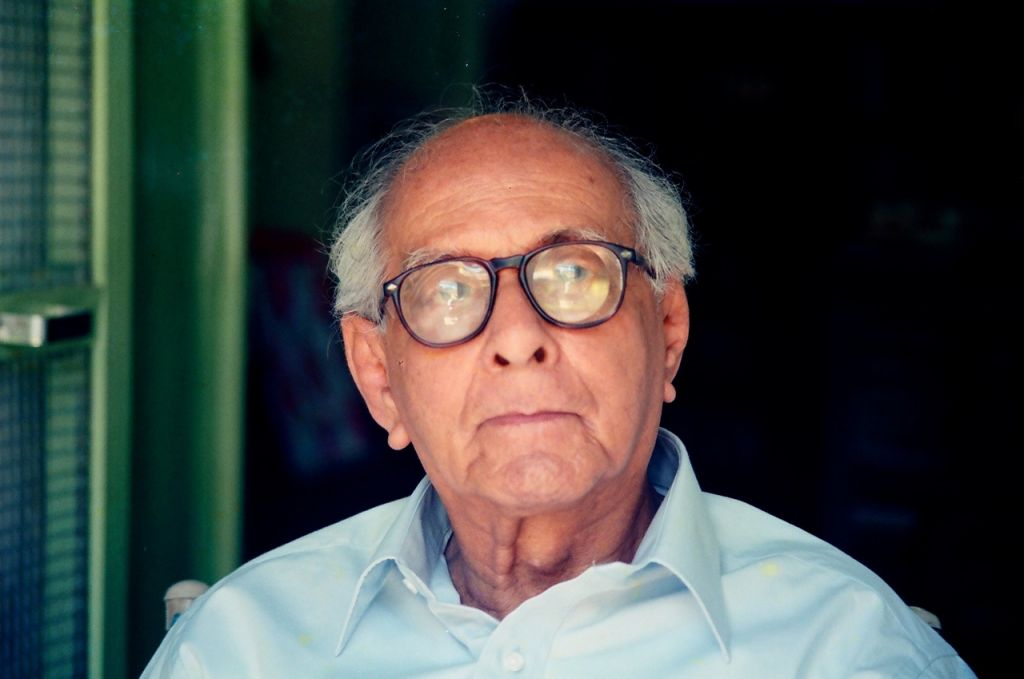
About the Author: K. D. Sethna (25.11.1904 — 29.6.2011) was a Parsi sadhak who joined Sri Aurobindo Ashram at the age of twenty-three in December 1927. He was a noted poet, author, scholar and cultural critic whose published works include more than fifty titles. In 1930 he received the name of Amal Kiran from Sri Aurobindo. He was the editor of the monthly magazine Mother India from the time of its inception in 1949. Some of his notable books are The Secret Splendour, The Poetic Genius of Sri Aurobindo, The Adventure of the Apocalypse, The Passing of Sri Aurobindo: Its Inner Significance and Consequence, The Indian Spirit and the World’s Future, Sri Aurobindo on Shakespeare, The Vision and Work of Sri Aurobindo, Sri Aurobindo—The Poet, Altar and Flame, The Mother: Past-Present-Future, The Problem of Aryan Origin: From an Indian Point of View, Ancient India in a New Light, The Spirituality of the Future: A Search Apropos of R.C. Zaehner’s Study in Sri Aurobindo and Teilhard de Chardin, Aspects of Sri Aurobindo, The Beginning of History for Israel, The Inspiration of Paradise Lost, Problems of Early Christianity, Problems of Ancient India, Our Light and Delight: Recollections of Life with the Mother, Science, Materialism, Mysticism: A Scrutiny of Scientific Thought and The Development of Sri Aurobindo’s Spiritual Thought and the Mother’s Contribution to it.
What follows is the background of Sri Aurobindo’s letter to Amal Kiran dated 1 August 1938. Under a wrong impression, Amal Kiran—while staying in Mumbai (then known as Bombay)—had taken a huge quantity of a powerful drug prescribed by a doctor friend of his. In fact, he had taken forty-eight times the normal dose and was about to die. It took him almost ten years to regain his vigour.
In a letter to Sri Aurobindo written after his recovery from the heart strain, Amal Kiran informs his Guru:
‘I am all agog to know whether I should pack up for Pondicherry. Should I come away with my heart still far below normal by medical standards? I surely can’t expect it to catch up with normalcy so soon after that mistake of mine with the tonic stimulant powder given me by a friend. You know that owing to an error in instructions, instead of taking the normal dose, I swallowed more than 4 grains, which—if I may believe the doctors—means about 50 times the normal dose, over 4 times the dose a horse might be given and nearly 25 times the dose at which the drug begins to be sheer poison for human beings! I also remained without real medical aid for 45 minutes! In my awful condition I only kept calling to Mother and you. Of course I am again up and doing, and I can’t take this set-back very seriously, though I have semi-collapses now and then and the medicos say I need regular attention and should not exert myself. Mother and you get me out of all scrapes; the sweet grace of you both has been unfailing. And I don’t think I am much frightened by theoretical possibilities of death. Will my undertaking to come away do me any harm? This is a year in which, I believe, the Truth-Consciousness may make up its mind, or rather its Supermind, to descend. I was expecting a wire from Mother in May; it’s almost the end of July now—but the year is not out yet, and August 15 is pretty close. Won’t I be losing something great if I don’t throw all caution to the winds?’
Sri Aurobindo’s reply dated 1 August 1938 was in response to the aforementioned letter.
In his book, ‘Our Light and Delight’, Amal Kiran recounts this incident and adds: ‘Nirod, after meeting me on 21 March 1940 in Pondicherry, informed Sri Aurobindo of my conviction that I had been saved by a special divine intervention. Sri Aurobindo emphatically said: “Yes.”’
Sri Aurobindo to Amal Kiran (1 August 1938): ‘You should remember the Mother’s warning to you when she said that you would have your realisation in this life provided you did not do something silly so as to shorten your life.’—
Before he left for Bombay in February 1938, Amal Kiran had an interview with the Mother in which she had warned him against any accident happening to him and doing serious damage to his body.
Amal Kiran writes: ‘…the last step of precipitating the new body into the old was not taken. The Mother appears to have found out that the Supreme’s decision for the body was to end its struggle and suffering. She ceased in her efforts to keep the body going.’
This reminds us of two statements issued by André Morisset, the Mother’s son, about the Mother’s departure. Here are the concluding portions of the letters André Morisset, the Mother’s son, had written to a couple of non-Ashramite friends several years after the events to which they refer. We are reproducing them from photocopies in which André Morisset’s signature appears. The photocopies were kindly sent from Switzerland to Amal Kiran alias K.D. Sethna by the latter’s friend Herr Carlo Schüller. They throw authoritative light on two events that have been topics of discussion for a long time, particularly the topic of the Mother’s departure from among us on 17 November 1973.
J’ajouterai simplement que j’ai vu Mère tous les jours depuis mai 1973, quand elle a cessé de voir les autres et que j’ai assisté à son retrait qu’elle avait décidé depuis le mois de septembre.
(I shall simply add that I’ve seen the Mother daily since May 1973 when she stopped seeing others and that I have been present at her withdrawal which she had decided upon since the month of September.)
Ce que Mère a dit à Satprem en 1967 et 1973 m’a été aussi dit en des termes presque identiques et j’ai la conviction d’avoir bien suivi ses instructions au moment où elle a quitté son corps. Par conséquent pour moi la question est close et tout réveil de cette question est simplement la manifestation d’un esprit insuffisamment informé.
(What Mother said to Satprem in 1967 and 1973 has also been said to me in almost identical terms and I am convinced that at the moment when she left her body I have followed her instructions well. Consequently the question is settled for me and all revival of this question is simply the manifestation of an insufficiently informed mind.)
Herr Carlo Schüller had also sent the following note to Amal Kiran:
‘Around October 1973 a French disciple quoted André as having told him: “Mère déjà n’est plus parmi nous.” [‘The Mother is no longer amongst us.’] A Swiss disciple remembers André having earlier expressed his respect for Nolini [Kanta Gupta] as the most advanced yogi of the Ashram and strongly suspects that André shared his knowledge about the Mother’s decision with Nolini. For obvious reasons the two men kept their knowledge to themselves. Had they breathed even a single word, it would have raised a tremendous commotion before the Mother’s passing as well as after. In fact it was only a full five years later that André made his only known statement about what the Mother had confided to him.’
Source: https://overmanfoundation.org/two-important-statements-by-monsieur-andre-morisset-the-mothers-son-about-the-mothers-departure/
Amal Kiran observes: ‘Against the common-sense advice of her attendants she had been insisting for reasons of her own on walking, even though there had once been a frightening break-down. Now came a pause. The whole day of November 14 she was quiet but at night again she wanted to walk. The attendants said: “Mother, you should not walk.” She, as her main attendant Pranab tells us, “obeyed” them. Pranab continues: “That was on the 15th. From that day she became absolutely obedient. Whatever we told her she did.” This calm passivity of the Mother was obviously the pointer to the knowledge that had come to her that her embodied being was to be abandoned at last. The obedience which had been noted was not to her attendants but to her own transcendent Self.’
Let’s read what Pranab Kumar Bhattacharya has recalled about 14th and 15th November 1973:
‘That day, the 14th, she was more or less normal. She took some food and the day passed quite well. Then at night she started telling me again to raise her shoulders, her legs and later her whole body. We did that several times. Then she said, “Make me walk.” We were hesitant, but as she insisted, we lifted her up from the bed. She could not walk, staggered a little, almost collapsed. Seeing this, we put her back in bed. We saw that her face had become absolutely white and the lips blue. Then we decided that whatever she might say, we must not take her out from the bed again to walk. She took about twenty minutes to recover; she started saying, “Lift me up again, I shall walk.” We refused. She asked us why we were refusing. We said, “Mother, you are in such a weak condition that it will do you harm.” Then she said, “No, lift me up.” We did not. She began to plead, sometimes shout. All this continued until fifteen minutes past one. At that time we thought we would give her some sedative, so that she might rest quietly. Then we gave her Siquil as the doctor had prescribed. It took her about 45 minutes to become quiet and she slept from 2 to 4 o’clock, but after getting up she started saying, “Pranab, lift me up and make me walk. My legs are getting paralysed; if you help me to walk again, they will become all right.” But we did not listen. After the first frightening experience, we had to remain quiet. She went on entreating till about 6 o’clock when she fell asleep.
‘The 15th passed off quite well. She took more food than usual. At night again she began asking me to lift her up. We lifted her up, then she wanted us to help her to walk, we refused to do that. We said, “Mother, you should not walk.” She immediately obeyed us. We had to lift her up several times and the night passed off smoothly.’
[Source: Pranab Kumar Bhattacharya, ‘I Remember’, Part II]
Satprem, another confidante of the Mother, writes in the last volume of his trilogy on the Mother entitled ‘Mother or The Mutation of Death’:
‘She lived the process until the end. It was the process that continued. And She said that same day, on the same subject: *It has become very intense. But at the same time, there’s the knowledge: “Now is the time to win the Victory.” Which comes from above. “Hold on hold on, now is the time to win the Victory.” Quite interesting really. All three things together. If we gather all three things together, what do they mean?… Probably what She lived more and more acutely until that November 17. She was told nothing, so She kept going, it was that simple. The process kept going. “She went out like a candle,” related one of those who used to watch over her⎯no heart attack, nothing. Not even a trance or a coma. She continued as long as it was possible. She had to stay there completely and until the end. Why?… The process probably had to continue in death. She was not allowed, her entourage did not allow the cataleptic trance, they would never have had the necessary patience. But they allowed death, it was “recognized,” accepted as a medical fact. And since She could not perform the operation in her bed, She went into a tomb to do it. There, nobody would disturb her, it was the best possible cocoon, they would even burn incense sticks. “You have to go through death in order to conquer death”, She had said. There are no tricks in a tomb. Trance is still a yogic trick. There is no door left. So, it remains the supreme Door.
‘On November 14, around midnight, She asked to walk. “I want to walk, otherwise I’ll become paralyzed.” She leant on the arm of one of her attendants and She walked … until She turned blue.
‘And the days became more and more painful. She refused to eat, then accepted, and refused again. They scolded and cajoled her like a sick person. She was always half-seated: her back was full of burning bed sores. Every twenty minutes She would ask to be lifted from her chaise longue. Lift me up…. During the night of November 16, She asked again to walk. I want to walk—oh! She would have liked to enter death on her two legs. They refused. She struggled until the end, as long as there was a breath left in her body. In the afternoon of November 17, the signs of suffocation accelerated. At 7:10 P.M., her doctor gave her a heart massage. At 7:25 P.M., her breath stopped.’
Satprem observes in ‘Mother or The Mutation of Death’:
‘In the thick of that incredible masquerade, on November 18, as I was among that crowd, staring and staring without understanding at that small white form under the humming fans, I had the most powerful experience of my life. I was unable to have any experience, I was there like a dumbfounded stone, with a splitting headache. I simply stared, without even a prayer in my heart, nothing. If She had get up to take her leave of that whole incredible jumble, it would have seemed to me the only sensible thing. She did not get up, but all of a sudden, something took hold of me, literally pulled me above that headache and that dreamlike crowd, then … it was a tidal wave. I knew what Power was, it was not in vain that Mother had taken my hand and drawn me into the experience. But there, it was not someone that had “an experience,” it took place as if outside of me, I was nobody, I was only witnessing a fact. I was immersed in a formidable wave of a Power that was made of elation, as it were⎯perhaps love, but it was an elation that was love⎯elation like a cataract, uninterrupted, without a gap, and it pealed out: a formidable peal all over the universe. All the flood-gates of the world were open. And it said, it rang in my ears as all over the world, a formidable, though soundless voice : NO OBSTACLE … NOTHING IMPEDES … NO OBSTACLE, NOTHING IMPEDES…. And it kept pealing over and over again, each word as if all the bells in the world were pulled together in a single, formidable peal of bronze: NO OBSTACLE … NOTHING IMPEDES … NO OBSTACLE …. And a joy in it, a triumph, oh! something that laughed so splendidly, but so formidably, and swept everything away on its way, toppling the walls, breaking the gates open⎯nothing impedes … no obstacle. As imperative as a Last Judgment. A cataclysm of joy.
‘I held out for a quarter of an hour, then I went out into the street, or else I would have burst. And it still kept pealing. I walked to the seaside, my body was shaking with it. Then it calmed down. And there was no “Mother” or “I” or even an experience in that⎯or rather it was the world that had the experience. Yes, in fact it was like the first manifestation of “something” over the world. We can stick labels on it, but it laughs at all labels. It was a formidable Fact. On that November 18, something happened.
‘Perhaps the first terrestrial wave of the joy of the new world.’